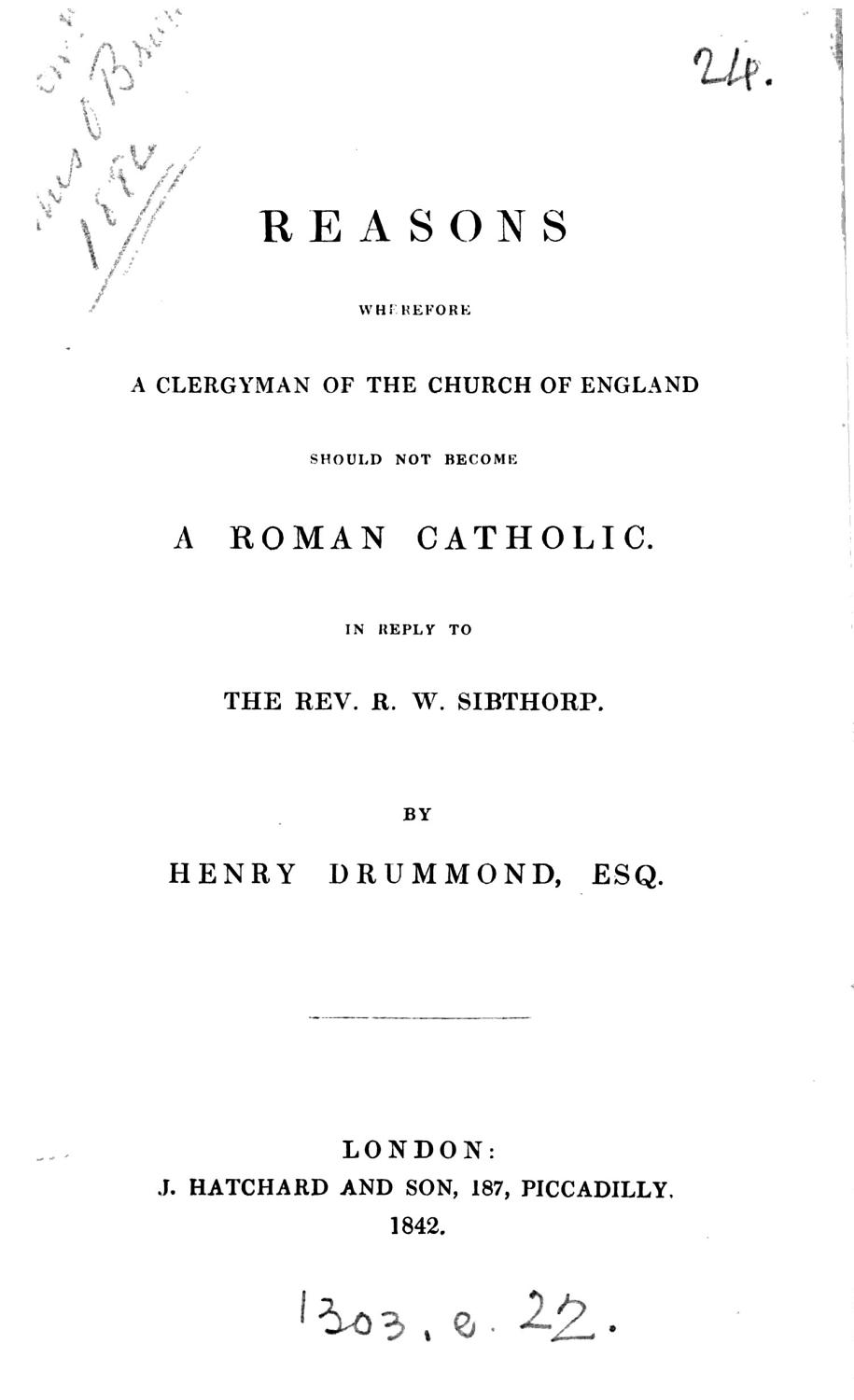
Reasons Wherefore a Clergyman of the Church of England Should Not Become a Roman Catholic
Reasons Wherefore a Clergyman of the Church of England Should Not Become a Roman Catholic is a controversial pamphlet by Henry Drummond, published in the middle of the nineteenth century. It is by the earlier Henry Drummond, the Member of Parliament and religious controversialist who lived from 1786 to 1860, rather than by the later Scottish evangelical biologist of the same name. The pamphlet was written in the context of the great religious upheavals around the Oxford Movement and the conversions to Rome of figures like John Henry Newman and Henry Edward Manning.
The pamphlet sets out, in numbered and argued form, the reasons that Drummond believed should prevent a thoughtful clergyman of the Church of England from following Newman and Manning into the Roman Catholic Church. The arguments are partly historical, taking up questions about the authority of the early councils and the development of Roman doctrine, and partly theological, addressing specific points of difference such as the doctrine of purgatory, the cult of the saints, and the authority of the Bishop of Rome. Drummond was himself a complicated religious figure. He was a major patron and lay leader of the Catholic Apostolic Church, which had emerged from the prophetic ministry of Edward Irving, and his theological positions were not those of conventional Anglicanism. But on the question of the Roman Catholic claims he was firmly opposed.
The pamphlet is direct and polemical in the manner of mid Victorian religious controversy, with the strong personal voice of a writer who clearly believed the questions at stake were the most important questions of the age. Some of the historical arguments have not stood up well to a hundred and seventy years of further scholarship, but the pamphlet remains a useful primary document for understanding how a particular type of nineteenth century Protestant intellectual responded to the Oxford Movement.
The pamphlet is short, perhaps eighty pages, and is mostly of interest now to readers of Victorian religious history. It pairs naturally with the writings of John Henry Newman from the same period, particularly the Apologia pro Vita Sua, where Newman explains his own movement in the opposite direction, and with the broader controversial literature that the Oxford Movement produced on both sides.
About the Author
Henry Drummond was a 19th-century Scottish evangelist, writer, and lecturer. He is best remembered for his essay The Greatest Thing in the World, a meditation on love.
See all books by Henry Drummond →