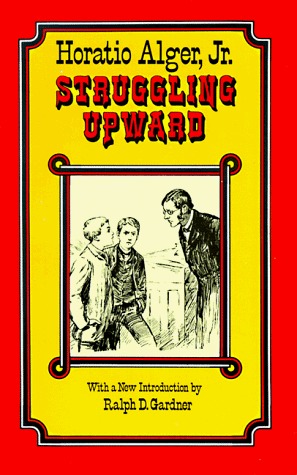
Struggling Upward, Or, Luke Larkin’s Luck
Struggling Upward, or Luke Larkin’s Luck is one of Horatio Alger Jr.’s better known novels, published in 1886 and following the standard Alger pattern with particular precision. Luke Larkin is a fifteen year old boy in a small upstate New York town whose family has fallen on hard times after the death of his father. Luke supports his mother through odd jobs and small money making schemes, all while enduring the casual cruelty of the wealthy banker’s son who has been making his life difficult.
The novel kicks off when Luke does a small kindness for a stranger passing through town, who turns out to be a wealthy man whose recognition of Luke’s character will eventually open up the opportunities the young man has been waiting for. Through a chain of carefully arranged coincidences, the kind that nineteenth century melodrama traded in heavily, Luke finds himself entrusted with a sealed package containing valuable bonds, hunted across the western territories by villains who want to steal what he is carrying, and tested at every step by the kind of moral choices that Alger’s protagonists always had to face. Luke acquits himself with the honesty, courage, and good judgment that the genre demanded, and the novel works toward the moral resolution Alger’s readers expected.
What distinguishes Struggling Upward from some of the other Alger novels is the relative strength of the plotting. The chase sequence across the western territories has more momentum than the more contained urban plots of his New York books, and the villain in particular is rendered with more specific menace than the generic bullies who often serve in his novels. The struggling upward of the title points to the moral and economic upward movement that the entire genre is built around, with Luke’s slow rise from genteel poverty to established middle class respectability serving as the kind of model that Alger believed his young readers should be inspired by.
For scholars of nineteenth century American children’s literature, of the cultural construction of the self made man, or of the wider print culture that shaped American boyhood in the post Civil War decades, Alger’s catalogue remains essential. Struggling Upward is one of the better known entries and a fair sample of his style at its most polished. Many of his books are now in the public domain.
About the Author
Horatio Alger Jr. was a 19th-century American author famous for his rags-to-riches juvenile novels, in which poor boys rise through hard work, honesty, and a little luck. His name became shorthand for the American self-made success story.
See all books by Horatio Alger →