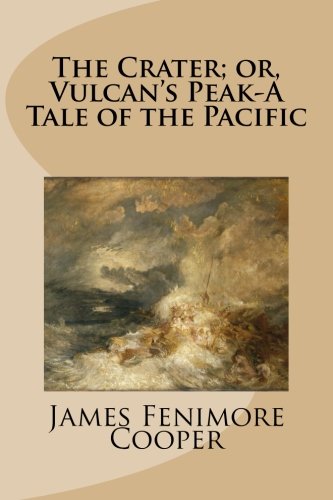
The Crater; or, Vulcan’s Peak-A Tale of the Pacific
The Crater, or Vulcan’s Peak is one of James Fenimore Cooper’s late novels, published in 1847 just a few years before his death. The book is one of the more unusual entries in his catalogue, combining the sea adventure mode he had used in earlier novels with a strange utopian premise that puts a small group of American sailors on a remote Pacific island and follows the slow growth of the settlement they build there.
The protagonist is Mark Woolston, a young Pennsylvania sailor whose ship is wrecked in the Pacific. Mark finds himself stranded on a remote uninhabited island, where he is eventually joined by other survivors and slowly builds a settlement that begins to look like a small successful colony. The Vulcan’s Peak of the title refers to the volcanic activity that has shaped the islands and that continues to play a role in the novel’s geography. Cooper uses the isolated setting to dig into questions about the foundations of American society, the proper relationship between religion and government, and the dangers of democratic excess that he had been worrying about in his late nonfiction writing.
The novel is sometimes read as Cooper’s response to Alexis de Tocqueville’s Democracy in America and as his last word on the trajectory of the American experiment. Mark’s island colony begins as a model of the kind of well ordered society Cooper believed America had been at its founding. As more settlers arrive, including some who bring with them the political and religious factionalism Cooper saw spreading through the contemporary United States, the colony begins to fall apart in ways that the book treats as warnings.
Cooper’s prose is in the formal style of his time, which can take some getting used to. The political and religious commentary is more pronounced in this novel than in his earlier adventure fiction, and modern readers may find the conservative framing more direct than they expected. For Cooper completists, for students of nineteenth century American utopian fiction, or for readers interested in how Cooper’s late thinking about the American republic shaped his fiction, The Crater is worth knowing.
About the Author
James Fenimore Cooper was an early American novelist best known for The Last of the Mohicans and the Leatherstocking Tales, frontier adventures that helped shape the myth of the American wilderness.
See all books by James Fenimore Cooper →