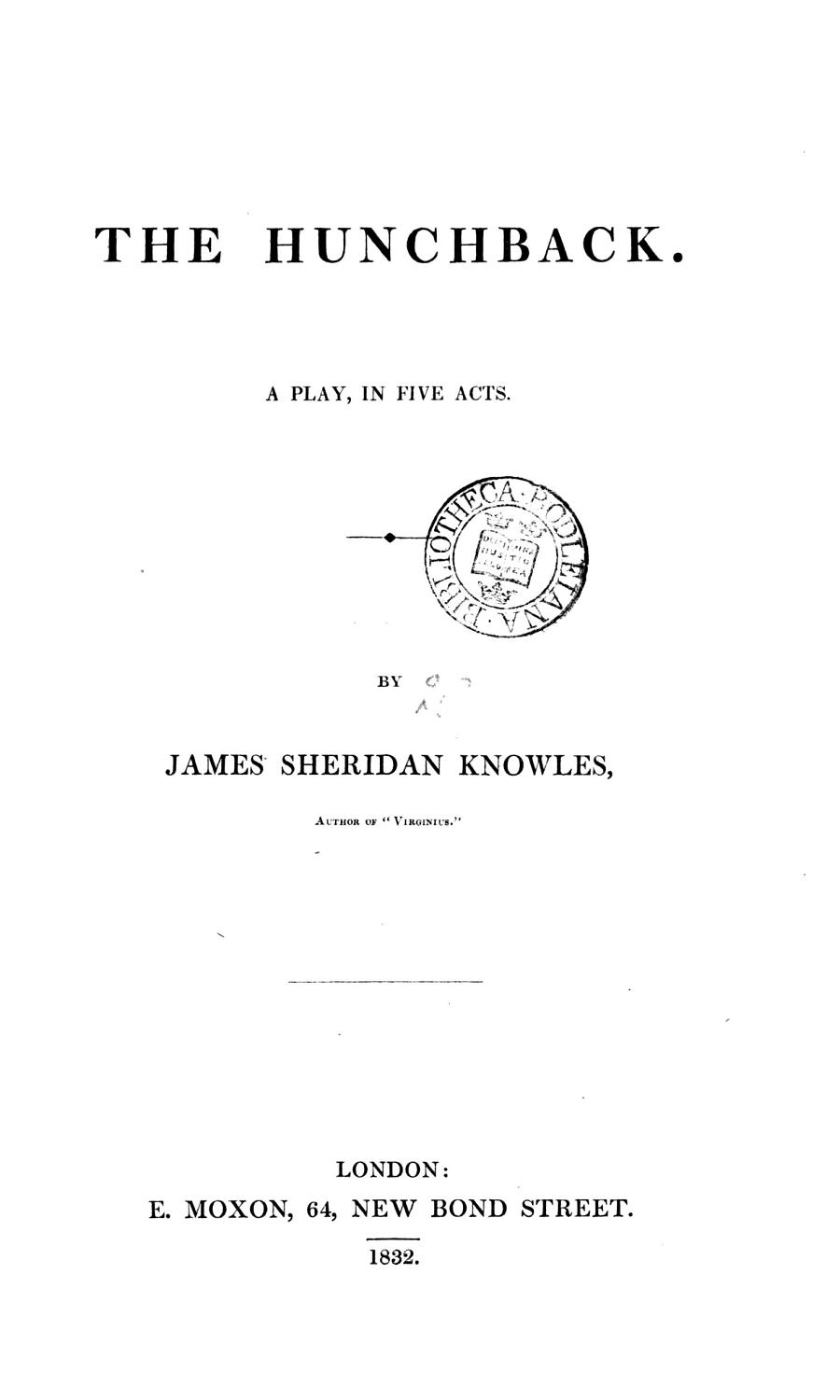
The Hunchback
The Hunchback is a verse drama by James Sheridan Knowles, the Irish playwright who lived from 1784 to 1862. The play was first performed at Covent Garden in London in 1832 and was Knowles’s greatest commercial success, remaining one of the most popular plays in the English language theatrical repertoire for several decades after its first production.
The play is set in the late medieval or early renaissance period and centers on the figure of Walter, who has been raised as the supposed son of a hunchbacked clothier named Master Walter but who turns out to be the heir to a substantial inheritance through circumstances that are gradually revealed across the action of the play. The romantic plot involves Walter’s love for the young Julia, the various complications that arise from the gradual revelation of his true identity, and the eventual resolution that brings the lovers together while resolving the various other family and inheritance questions that the play has set in motion.
The figure of Master Walter the hunchback is the most interesting character in the play and the role on which the play’s theatrical reputation has largely depended. Master Walter has been the actual father of the young Walter, having concealed his identity and his marriage in order to protect his son from various political enemies. The slow revelation of who Master Walter actually is, and of what he has done to protect his son, gives the play its most powerful dramatic material. Many of the most successful nineteenth century English language actors played the role of Master Walter, and several of the most celebrated performances of the play in the second half of the nineteenth century were remembered primarily for the central performance of the title character.
Knowles wrote the play in the verse tragedy tradition that dominated serious English theater in the first half of the nineteenth century. The verse is elevated, the plot turns on dramatic revelations, and the moral framework is broadly the romantic medievalism that Walter Scott had popularised in his historical novels of the previous generation. The play was theatrically effective in a way that most early nineteenth century verse tragedies were not, partly because Knowles had substantial practical experience of the theater and understood what audiences would actually respond to.
The play runs about a hundred pages in the standard published form. For readers interested in early nineteenth century English verse drama, this is one of the more successful examples of the genre.
About the Author
Read and download 2 free books by James Sheridan Knowles on BDeBooks. Browse the complete collection of James Sheridan Knowles’s works available as free PDF and EPUB downloads. Discover novels, fiction, and other writings by James Sheridan Knowles in our online eBook library.
See all books by James Sheridan Knowles →
Listen to The Hunchback Audiobook Free
Listen to The Hunchback by James Sheridan Knowles free online. The full audiobook (2 hr 29 min, 5 chapters, read by volunteer narrators) streams free on this page.
The Hunchback (1832) is a public domain work.
| # | Chapter | Length | |
|---|---|---|---|
| 1 | ACT I | 34:05 | |
| 2 | ACT II | 22:45 | |
| 3 | ACT III | 23:41 | |
| 4 | ACT IV | 33:49 | |
| 5 | ACT V | 34:19 |
Prefer reading? Read The Hunchback online free or download the PDF and EPUB above.