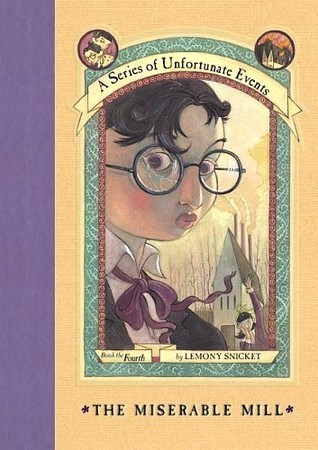
The Miserable Mill
The Miserable Mill is the fourth book in Lemony Snicket’s A Series of Unfortunate Events, the thirteen volume children’s series written by Daniel Handler under the Lemony Snicket name. The Baudelaire orphans, Violet, Klaus, and Sunny, have been moved from one terrible guardian to another across the previous three books, with the villainous Count Olaf consistently appearing in disguise to threaten them and the well meaning but ineffective adults around them consistently failing to recognize the danger.
In this volume the children are sent to live and work at the Lucky Smells Lumbermill, owned by a man named Sir who refuses to give his real name and who pays his workers in coupons rather than actual money. The conditions at the mill are grim by even the standards of A Series of Unfortunate Events, with the children expected to do dangerous adult labor and to subsist on chewing gum for lunch. Klaus, in particular, falls into special trouble when he is caught up in a hypnotism scheme that involves the mill’s chief eye doctor and the inevitable return of Count Olaf in yet another disguise.
Lemony Snicket’s narrative voice continues its characteristic running commentary throughout, addressing the reader directly, defining unusual vocabulary, warning about the bleakness of what is coming, and offering the kind of melancholy wisdom that has made the series memorable. The Miserable Mill is one of the more directly social commentary heavy entries in the early series, with the depiction of child labor and worker exploitation handled with the kind of precise comic horror that the series specializes in. The Brett Helquist illustrations add to the atmosphere with their high contrast Edwardian style.
The early Series of Unfortunate Events books are tighter and more contained than the later volumes, which expand into larger mythology around the secret VFD organization. The Miserable Mill is one of the most self contained, with a single setting, a clear villain, and the kind of episodic structure that the early books used effectively before the series began its long arc toward the ambiguous conclusions of the later volumes.
For families with young readers who can handle the genuinely dark tone, the early series is a great place to start.
About the Author
Download free books by Lemony Snicket on BDeBooks. Read Lemony Snicket’s works online or download as PDF/EPUB · part of our growing free eBook collection.
See all books by Lemony Snicket →