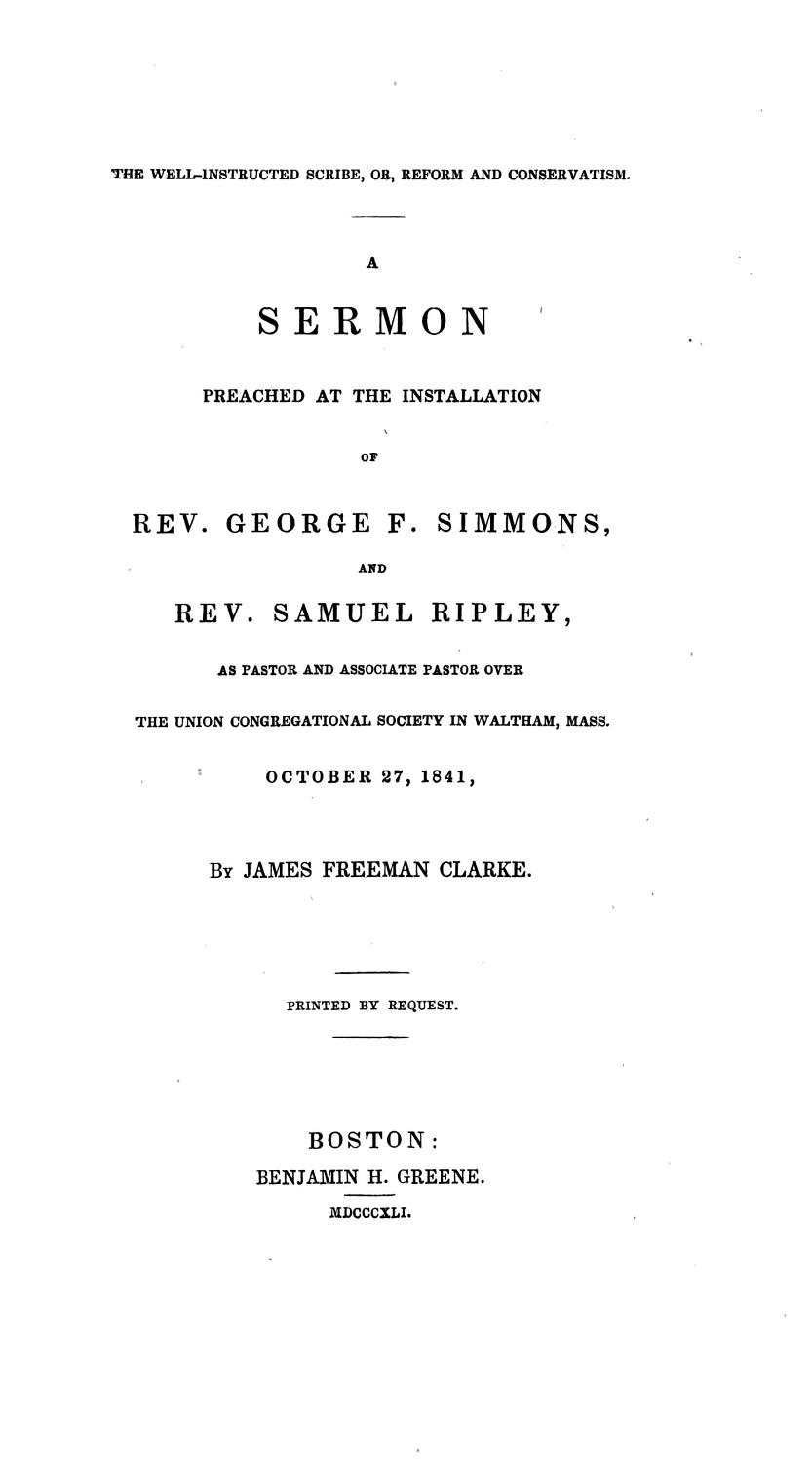
The Well-Instructed Scribe; Or, Reform and Conservatism
The Well-Instructed Scribe, or Reform and Conservatism is a discourse by James Freeman Clarke. The title comes from Matthew 13:52, where Jesus says that every scribe instructed in the kingdom of heaven brings out of his treasure things new and old. Clarke uses the verse as the spine of a meditation on how religious life should balance the inherited tradition against the demands of new thought.
The argument matters because mid-nineteenth-century American Unitarianism was split. The Theodore Parker wing wanted to push further away from traditional Christianity, treating miracles and biblical authority as outdated. The Andover-influenced wing wanted to hold the older positions. Clarke worked in the middle, arguing that the choice itself was false. Real religious thinking holds old and new at the same time, drawing on tradition while staying open to where honest modern inquiry leads.
Clarke develops the position with the directness he brought to all his preaching. He had been pastor of the Church of the Disciples in Boston since 1841 and had thought through these questions in pastoral practice rather than in academic abstraction. The discourse uses concrete examples from biblical study, from worship practice, and from the church’s relation to social reform to show what the balanced approach looks like in actual application.
Clarke’s middle-ground Unitarianism eventually prevailed in the American Unitarian Association and shaped the trajectory of the denomination across the late nineteenth century. Parker remained admired but seen as too radical to be the model. The more conservative wing slowly lost ground. Clarke’s position became the working consensus.
The discourse runs about thirty pages and works as a single sitting read. It pairs with Clarke’s other published sermons and with the wider mid-century Boston liberal Protestant literature.
About the Author
Download free books by James Freeman Clarke on BDeBooks. Read James Freeman Clarke’s works online or download as PDF/EPUB · part of our growing free eBook collection.
See all books by James Freeman Clarke →