
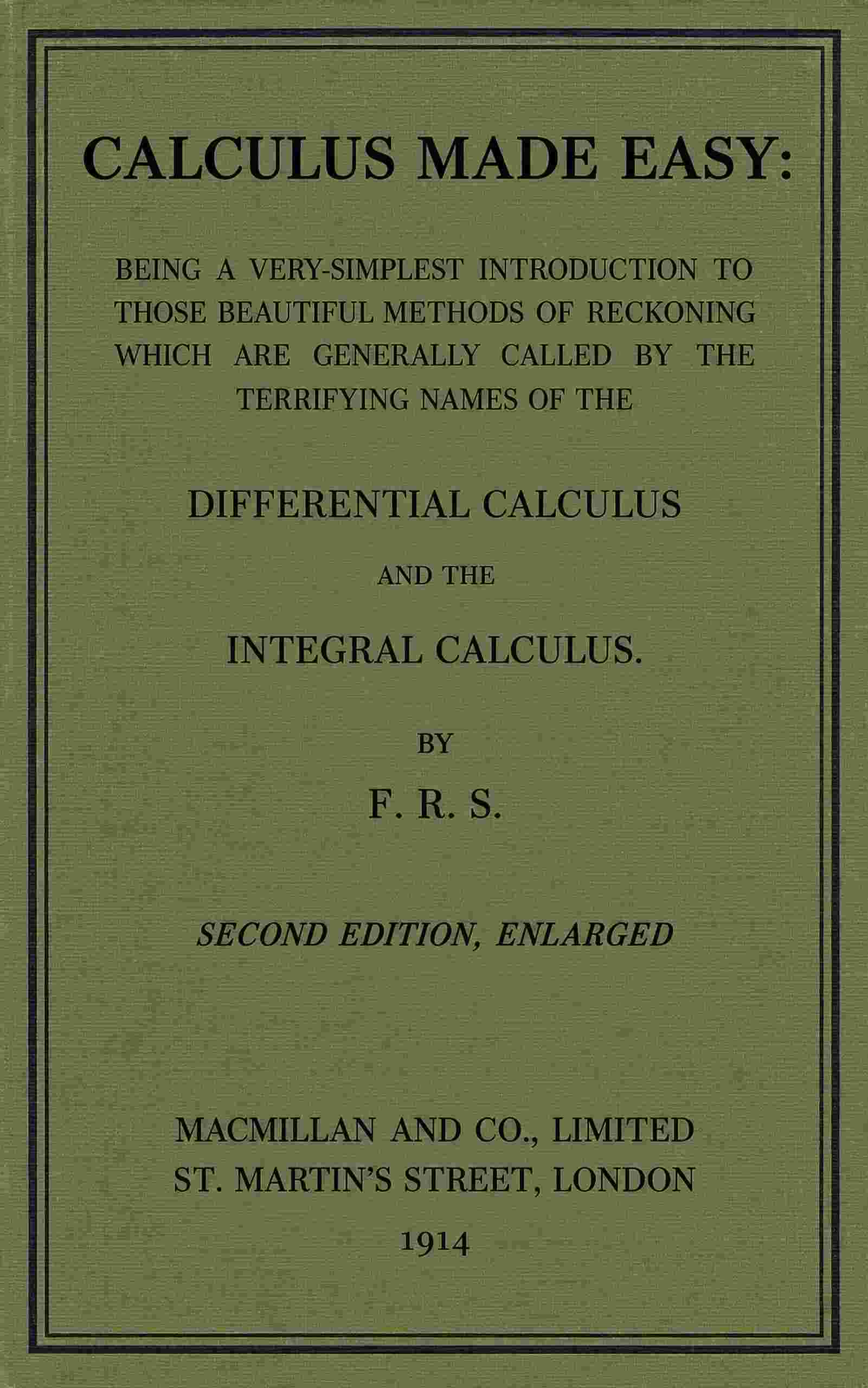
Calculus Made Easy
- Downloads
- Under 100
- Pages
- 230
Listen to Calculus Made Easy Audiobook Free
-
Preface to the Second Edition, Prologue
2:05 -
Chapter I: To Deliver You from the Preliminary Terrors
2:36 -
Chapter II: On Different Degrees of Smallness
11:07 -
Chapter III: On Relative Growings
17:26 -
Chapter IV: Simplest Cases
17:41 -
Exercises I, Answers to Exercises I
4:01 -
Chapter V: Next Stage. What to Do With Constants
17:55 -
Exercises II, Answers to Exercises II
11:30 -
Chapter VI: Sums, Differences, Products, and Quotients
32:31 -
Exercises III, Answers to Exercises III
10:14 -
Chapter VII: Successive Differentiation
5:29 -
Exercises IV, Answers to Exercises IV
6:37 -
Chapter VIII: When Time Varies - Part 1
16:13 -
Chapter VIII: When Time Varies - Part 2
15:14 -
Exercises V, Answers to Exercises V
6:25 -
Chapter IX: Introducing a Useful Dodge
25:32 -
Exercises VI and VII, Answers to Exercises VI and VII
11:12 -
Chapter X: Geometrical Meaning of Differentiaton
16:27 -
Exercises VIII, Answers to Exercises VIII
5:45 -
Chapter XI: Maxima and Minima - Part 1
14:10 -
Chapter XI: Maxima and Minima - Part 2
17:14 -
Exercises IX, Answers to Exercises IX
5:43 -
Chapter XII: Curvature of Curves
13:50 -
Exercises X, Answers to Exercises X
7:15 -
Chapter XIII: Other Useful Dodges - Part 1: Partial Fractions
23:51 -
Exercises XI, Answers to Exercises XI
8:21 -
Chapter XIII: Other Useful Dodges - Part 2: Differential of an Inverse Function
5:23 -
Chapter XIV: On True Compound Interest and the Law of Organic Growth - Part 1 (A)
19:03 -
Chapter XIV: On True Compound Interest and the Law of Organic Growth - Part 1 (B)
27:45 -
Exercises XII, Answers to Exercises XII
6:56 -
Chapter XIV: On True Compound Interest and the Law of Organic Growth - Part 2: The Logarithmic Curve
2:48 -
Chapter XIV: On True Compound Interest and the Law of Organic Growth - Part 3: The Die-away Curve
21:56 -
Exercises XIII, Answers to Exercises XIII
8:15 -
Chapter XV: How to Deal With Sines and Cosines - Part 1
8:57 -
Chapter XV: How to Deal With Sines and Cosines - Part 2: Second Differential Coefficient of Sine or Cosine
6:37 -
Exercises XIV, Answers to Exercises XIV
9:01 -
Chapter XVI: Partial Differentiation - Part 1
7:36 -
Chapter XVI: Partial Differentiation - Part 2: Maxima and Minima of Functions of two Independent Variables
4:33 -
Exercises XV, Answers to Exercises XV
6:45 -
Chapter XVII: Integration - Part 1
5:09 -
Chapter XVII: Integration - Part 2: Slopes of Curves, and the Curves themselves
6:43 -
Exercises XVI, Answers to Exercises XVI
2:10 -
Chapter XVIII: Integrating as the Reverse of Differentiating - Part 1
9:03 -
Chapter XVIII: Integrating as the Reverse of Differentiating - Part 2: Integration of the Sum or Difference of two Functions
1:53 -
Chapter XVIII: Integrating as the Reverse of Differentiating - Part 3: How to Deal With Constant Terms
9:10 -
Chapter XVIII: Integrating as the Reverse of Differentiating - Part 4: Some Other Integrals
5:59 -
Chapter XVIII: Integrating as the Reverse of Differentiating - Part 5: On Double and Triple Integrals
4:21 -
Exercises XVII, Answers to Exercises XVII
6:36 -
Chapter XIX: On Finding Areas by Integrating - Part 1
23:42 -
Chapter XIX: On Finding Areas by Integrating - Part 2: Areas in Polar Coordinates
3:44 -
Chapter XIX: On Finding Areas by Integrating - Part 3: Volumes by Integration
3:44 -
Chapter XIX: On Finding Areas by Integrating - Part 4: On Quadratic Means
4:04 -
Exercises XVIII, Answers to Exercises XVIII
7:43 -
Chapter XX: Dodges, Pitfalls, and Triumphs
14:52 -
Exercises XIX, Answers to Exercises XIX
5:05 -
Chapter XXI: Finding Some Solutions - Part 1
15:00 -
Chapter XXI: Finding Some Solutions - Part 2
13:05 -
Epilogue and Apologue
3:25
Calculus Made Easy (1914) is a public domain work.
The audio edition streams in the page. There is no audio file to download.
About this book
Silvanus P. Thompson wrote this short course for readers who have been put off by the symbols of calculus. His prologue admits that some calculus tricks are easy and some enormously difficult, and promises to show only the parts that are not hard. The second edition, dated 1914, adds worked examples and exercises, with answers at the back.
The opening chapter explains the two key signs in everyday terms: one stands for "a little bit of" a quantity, the other for "the sum of" such bits. From there the book moves through degrees of smallness, relative growth, constants, sums, products and quotients, successive differentiation, maxima and minima, curvature, compound interest and the law of organic growth, partial fractions, and finally integration and finding areas.
It suits students, self-taught learners and anyone who wants the ideas of differentiation and integration explained in plain language before meeting the formal versions.
Contents
About the author

More from this genre
See all- Y Your Mind and How to Use It AudioYour Mind and How to Use It
- S Stories of Symphonic Music AudioStories of Symphonic Music
- M The Myths of the North American Indians AudioThe Myths of the North American Indians
- M Myths of Northern Lands AudioMyths of Northern Lands
- S The Story of GreeceThe Story of Greece
- D Dr. Montessori's Own Handbook AudioDr. Montessori's Own Handbook
Discussion
No comments yet. Share a thought, a question or a favourite passage.
Copyright concern? Read our DMCA policy
Read or download
Public domain book This work is in the public domain and free of copyright. Anyone may read, download and share it.
- PDF 3.56 MB
- EPUB 5.33 MB
Downloads start right away. How to open EPUB on your phone
Book facts
- Author
- Silvanus P. Thompson
- Reading time
- About 3 hours
- Genre
- Educational
- Formats
- PDF, EPUB, Read online, Audiobook
- Audio read by
- Bruce Kachuk, clarinetcarrot, Le and others