
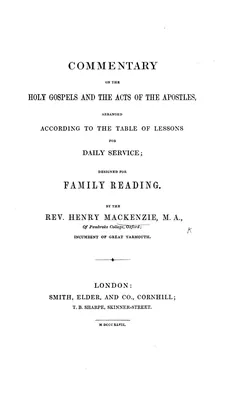
Commentary On the Holy Gospels and the Acts of the Apostles
Pages
This chapter is long, so it is split into 9 parts.
THE CHURCH CALENDAR:
80 FAR AS IT'SELATBS TO THB .SAIlLT BEAOINO OF
TH£ HOLT SOSFELS AND THE ACTS.
THE CHURCH' CALENDAR:
80 FAS AS IT RBLi.TBS TO TBB TtAllH HEASIVO OF
THE HOLT GOSPELS AM THE ACTS.
i
JULY TO DECEMBER.
THE CHURCH CALENDAR:
so FAR AS IT BELATB8 TO THB :I>AIJ.T RBAOINO OF
THE HOLT €08P£L6 AND THE ACTS.
THE CHURCH' CALENDAR:
so FAR AS IT RBLATBS TO THE DAILY HEADING OV
TEE HOLT GOSP£LS iM TBE ACTS.
COMMENTARY,
^^^^^krf^^^^^^^M^
Januart 2— May 3— August 31.
ST. MATTHEW, Chap. 1.
The Gospel, the good tidings of the grace of God, brought to man by Jesus Christ, is calculated to excite in us the liveliest emotions of wonder and of love: of wonder, at the clear development of the mysterious atonement for sin; of love, at the price the Son of God
was willing to pay for the redemption of a fallen race. Unlike all human schemes, the wisdom of GrOD deals rather with the heart than with the mind of man: His revelation, while it never contradicts, often surpasses our reason, and thus humbles while it exalts us, and excites our admiration while it wins our affection.
In reading the Gospel of St. Matthew, we must bear in mind that it was written especially for the Jewish people; and hence, that much stress is laid on the Israelitish descent of Our Lord according to the flesh. On the genealogy which we have just read, it may be remarked, that in two instances a sinful descent is exhibited; and in a third the descent of an alien is named, herself the remote offspring of sin.
These instances are Pharez and Solomon in the first case, and Ruth the Moabitess in the second. The lesson to be learned from this is of a twofold character. First, it shows the faithfulness of God in the fiilfilment of His promises; and that the sins of men, however dangerous to themselves and their posterity (1) B
Jan.'2—Mai/il] FAMILY READINGS. [Augutt SI
inilicidually, are not permitted to interrupt the course of (Jod's covenanted blessings to His people generally. Secondly, that God exhibits tenderness and mercy towards the descendants of those who have erred from his laws—though the sins of the father axe visited to the third and fourth generation, yet the wrath of a long-suffering God is rapidly exhausted: and we find that the children of Tamar and of Bathsheba united with the offspring of Lot in transmitting to future ages the blessing of the seed promised to faithful Abraham.
The mystery of the incarnation as recorded by St. Matthew should bring to us the deepest thoughts of gratitude. Had it not been for this act of mercy, man could not have wrought out the resurrection from the dead, to replace the race in the condition that it occupied before sin entered into the world, and death by sin. The work of the sanctifying Spirit, the Lord and Giver of life, was necessary to create the pure and unsullied offspring of the Virgin's womb, ere a clean thing could be brought out of an unclean; and thus, the course of Nature was altered, that the course of Grace might be fulfilled!
The character of Joseph, " a just man," seems exhibited as a pattern for us to follow: while under the painful impression of being betrothed to an unworthy person, he was willing to bear his humiliation and his grief in private, rather than make her a public example, and bring her to a shameful end—for death, by stoning, would have been her punishment according to the law. Unlike this, too many of us are given to blazon abroad the infirmities and errors of our brethren, rather than to screen them with that charity which covereth a multitude of sins.
Nor was the charity and forgiving disposition of Joseph the only point in which he is set before us as deserving of (2) Jan.S^May4^ rAMlJ.Y READINGS. [Sqttember I
imitation. His ready reception of, and obedience to, the revelation of God, stand in striking contrast with the conduct of the world at large, who will not rouse themselves from the sleep of sin to listen to the tones of that revelation calling them to repentance.
January 3— May 4— September 1.
ST. MATTHEW, Chap. 2.
The different ways in which the purposes of God are accomplished, and his foreknowledge shown in the fulfilment of prophecy, are strikingly exhibited in this chapter.
Whence the wise inen came is still a doubtful question; but the instruction to be derived from their coming is not, on that account, the less manifest. These, our Gentile fathers, the sheaf of the first-fruits of the heathen presented to our great High Priest, exhibited an instance of perseverance, of boldness in the cause of truth, of a manly sense of duty, of obedience to the revelation of God, and of a firmness of faith, which christians in modem times would do well to imi-tate. And when we remember that their faith depended on the solitary prophecy of Balaam, added to such imperfect knowledge as had been attained from the traditions of the Jews who had been scattered hither and thither during their captivity in the East; while
we have the whole prophecies of the ancient Scriptures spread out before us; we may well feel humbled at the littleness of the fruits we exhibit, contrasted with the large harvest gathered in to God's glory by them.
The massacre at Bethlehem teaches us how the feeblest instruments may be made to promote the glory of God. (3) B 2
Jan. 4-Maif 5] FAMILY READINGS. [S^ttmber 2
The unconscious testimony borne by these innocents was^ as a martyrdom in deed though not in will, of less moral dignity than that testimony which is borne by will as well as deed. But it answered nevertheless its purpose of marking the sin of the opponents of Christ, and writing in characters of blood the record of the incarnation; holding, out at the same time a fearful warning as to the lengths of sin to which the indulgence of evil passions often hurry our fallen race. The kings of the world stood up, and the princes took counsel together, against the Lord and against His Anointed; but their counsels were defeated, and the hostility they menaced was turned against their own bosoms, when the cry of Rachel weeping for her children entered into the ears of the Lord of Sabaoth, to caU for vengeance on their murderers.
January 4— May 6 — September 2.
ST. MATTHEW, Chap. 8.
A GENERAL expectation pervaded the East, that some great person was to be revealed as a Deliverer to the Jewish nation, when an extraordinary personage made his appearance in the wilderness of Judea. Dressed in the prophetic garb, as of old Elijah was wont to appear before Ahab— exhibiting in his diet the most rigid self-denial
—and manifestly endued with that prophetic power which had slumbered for four centuries before—crowds of penitent sinners in turn trembled and melted under the resistless power of his eloquence, as he called upon them to " Repent, for the kingdom of heaven was at hand!" This personage was John the Baptist.
(4)
Jun. l^May 5] FAMILY READINGS. [September 2
The faithM preacher of repentance earnestly protested against that too common error of the Jews, who rested upon their privileges as descendants of Abraham, without walking in the steps of that faith which characterised their spiritual ancestor; and from this we should learn that we too have responsibilities attached to the blessed privileges we enjoy, as brethren by adoption of the promised Seed.
The Baptist had no more reason to remind the Sadducees and Pharisees of the future sifting of the family of Israel, than the heralds of Christ in the present day have to remind us of the future purification of His Church. And it seems as if God intended that His written word should keep us in mind of these things, even apart from His ministry, when we find such passages as that in thp chapter before us written for our learning.
Nor should we fail to observe, that powerful as the Baptism with water unto repentance was under the teaching of Christ's herald, yet he indicates a still more efficacious Baptism, that of the Holy Ghost.
We ought then, in reflection on this passage, to observe, that we must be subjects of one of two things prophesied:—either of the Holy Ghost, which sanctifies and preserves ; or of the unquenchable fire, which bums up and destroys.
The Baptism of Christ by His forerunner, would seem to partake somewhat of mystery, inasmuch as the sinless one does not appear to be a fit subject of the Baptism unto repentance : but the expression of our Lord with reference to it, ** thus it becometh us to fulfil all righteousness," seems to have reference to the perfect righteousness which is by the law, which Christ desired to fulfil. The High Priest, under the old dispensation, had been washed with water previous to his initiation into office; and thus the High Priest, under the new, deemed it fitting to undergo the same rite. Nor was this (5) duty left without acknowledgment; for immediately on its performance, we find a testimony from heaven borne to the mission of the Son of God. The Spirit of love, and peace, and holiness, rested
on that divine brow; and the voice of Him, that of old shook the earth with thunders and lightnings, now testified in the tones of paternal afifection, that the seed promised to the patriarchs was come, to hallow the earth and bless the nations with his presence.
January 6— May 6— September 3.
ST. MATTHEW, Chap. 4.
No sooner had the Son of God received the token of His Father's acknowledgment, than His and our great enemy, Satan, sought to beguile Him from the ftilfilment of filial obedience. Not only in the agony of Gethsemane was the contest of salvation carried on : not only in the physical pain of the cross was the battle of man's atonement fought: in the forty days of long enduring abstinence—in the painftil vigils —the weary nights—the aflSrighting loneliness of the rugged deserts of Judea—yea, and still harder to be borne, in the seductive temptations of the arch-deceiver, to supply the wants, and
" fulfil the desires of the fiesh and of the mind," " in weariness and painfulness, in watchings and fastings,'* was the awfid conflict maintained between the prince of the powers of the air and the well-beloved Son of God.
In the Three Temptations brought by Satan before our Lord, we may be reminded of those baptismal vows which we ourselves are pledged to ftilfil. The First, having been (6)
Jon. 5~Afay 6] FAMILY READINGS. [September S
directed against the senses^ may remind us of our promise to renounce the lusts of the flesh. The Second, having been addressed to a feeling of presumption, the root of which is to be found in a want of abiding belief in God's promises, may remind us of our pledge, to believe all the articles of the christian faith. The Third, having been addressed to ambition, may teach us the necessity of obedience in reality, as well as its mere profession in name; and thus impress upon us the third and most practical pledge of our baptismal covenant— that, not seeking the indulgence of our own, we are to
keep God's holy will and commandments, and walk in the same during our whole life.
It is worthy of remark, that our Lord commenced His preaching with a call to repentance: and herein we may trace the harmonious agreement that exists between the herald of Christ, of Christ himself, and of the Church of Christ. John the Baptist announced the mission of the coming Messiah in the striking words, " Repent ye, for the kingdom of heaven is at hand:"—Christ drew the attention of the listening multitudes to the same idea, expressed in the same language; while the Church of Christ has, for long ages, opened her daily services with sentences expressive of repentance, has exhorted her children to confess their sins with a penitent heart, has placed a repentant confession in their mouths, and has reminded them, in the conditional absolution pronounced by her minister, that God "hath given them power and commandment to declare to His people, being penitent, the absolution and remission of their sins." And, ss if the necessity of repentance as insisted on throughout ler Sunday and daily services were insufficient, she states etpressly, in her "
instruction to be learnt of every christian before they can be confirmed," that " Repentance, whereby (7) Jan.7^Map7] FAUILT READINGS. [Septen^er 4
they forsake sin," no less than Faith, is required by persons even to be received into covenant: thus exemplifying in the most forcible manner that vital truth of Christianity, that Penitence is the humble arch, beneath which we must bend our stubborn wills, before we can pass even the threshold of the house of God ; that it is the key, without which even the door of Faith cannot be unlocked; that its dim, and yet imperfect light, is the very first effect of the dawning illumination of God the Spirit,—of the everlasting day-spring from on higli! If then, this be the case, we should examine carefiiUy into our own hearts, to see whether we have felt the influence of that Repentance, the necessity of which has been thus strongly insisted on.
^^^^^^^^^^^^0^0^0t0^0^0*^0^^*0i^t^l0*0*0t^»^0
January 7— Mat 7— September 4.
ST. MATTHEW, Chap. 5.
Surely, there never existed so absolute and entire a reformation of recognized principles of action as is to be found in the first twelve verses of this, our Lord's Sermon on the Mount. Human dignity, worldly joy, pride, desire of large possessions, love of rule, all that the world holds most dear, are^^at once set aside; and humility, meekness, truthfulness, mercy, purity, peace, gentleness, endurance, enthroned ii their place. It is difficult for the heart of the natural man t> recognize the beauty of the system thus enjoined. But wheie the spirit of grace has touched the soul, and ''old thin|s are passed away and all things become new " to the believer, there is the superiority of Christ's teaching to the worldy code at once made manifest. The mind whose affections ire set upon things above, can afford to think lightly of the thiigs (8)
Jan.1^Mayl] FAMILY READINGS. [September A
highly esteemed on earth. The soul, whose rest is found amid the enduring realities of immortality, is elevated beyond the lower influences of a quickly passing existence, except in so far as they are subservient to the attainment of the life which is to come. A sense of the dignity and permanence of its position, as an agent for God, makes it feel the awful nature of the duties it has to perform, and the expansive power with which under grace it has been gifted. Thus, its whole life and system of action is altered from what it had been, while in a state of darkness as to God's will. Its light ceases to be either of a restrained or of a selfish character; and, with enlarged perceptions, it is readily devoted to an enlarged course of usefulness.
While our Lord was encouraging such an elevation of mind as this.
He seemed desirous to impress upon the attention of His hearers the fact, that this teaching was not alien from the spirit of the law ; but rather the realization and fulfilment of it, however apparently opposed to the letter: and hence He took occasion to preach one of the most practical homilies ever uttered, from the text of the lawgiver Moses. Righteousness, forbearance, forgiveness, purity, conjugal
fidelity, simplicity of thought and word, submission to evil, and love ybr off, are here holily and beautifrdly enjoined upon us. How must we mourn, that with such teaching before us, so many fail to be influenced by it: how should we personally implore our Father in Heaven, that when we read such " words " as these of Christ, they may be made " spirit and life " to ourselves. The standard set before us is indeed a lofty one; but we may feel assured that Christ has enjoined upon us no more than He will enable us to fulfil, if we seek that mind which dwelt in Him.
Jtm ^>^Ma^^} FAMILY READINGS. [September 5
January 8— May 8— September 5.
ST. MATTHEW, Chap. 6.
The portion of the Sermon on the Mount contained in this chapter is, equally with the last, a protest against a worldly, and the erection of a divine, standard of thought and action. The spiritual character of almsgiving is set forth under our Saviour's teaching: the idea of reward is not withheld from the charitable mind, but the kind of reward which we should desire is shown to be of a heavenly and not of an earthly character. Prayer, too, like almsgiving, is similarly treated, and a similar reward foretold.
Perhaps this teaching was intended to guide the mind to the true doctrine of human merit. Were we to speak (zbaolutdy of meritorious service before God, we should be contradicting the language as well as the general tenor of Holy Scripture : but the passages in the chapter we have read show us that we may speak of human merit rdatively. Reward would not be given by a perfect judge, without desert of some kind ; and though man cannot deserve reward for the performance of that which is only duty, yet he may, in a relative sense, deserve it, as having done that duty better than those vriith whom he was brought into comparison.
The divine model of prayer, here set before us, is so perfect and so beautiful as to be beyond all human praise. May we have grace to use it as it was intended by Him who uttered it! recognizing God as our
Father—showing in holiness our desire to hallow His name—striving, in so far as our instrumentality is blessed, to bring about the coming of His
Kingdom—exhibiting an obedience constant and ready as (10) that of the angels—receiving as a gifb^ with grateful hearts, our daily bread—exercising in our minds a perpetual act of forgiveness toward those who injure us—vesting on the strength that is made perfect in weakness, to resist temptation, and keep free from evil—and in all things ascribing power, and kingdom, and glory to Him to Whom alone those attributes belong.
To almsgiving and prayer our Lord annexes "the spiritual duty of fasting and self-denial, contrasting, it at the same time with that adherence to ritual discipline as a mere external form, which seems to have been L characteristic of carnal IsraeL The true treasure of the soul, the true light of the eye, and true singleness of service, are here also pointed out; and the chapter ends with a warning against over-carefulness, and an affectionate adjuration to increased faith. Were our faith indeed sound, we could never fall, so long as we had these words impressed on our hearts! But careless ears and carnal hearts mark the Christian as well as the Jewish disciple. A thoughtless inattention or an indolent forgetfulness are common snares of Satan, fraught with consequent evil. Let us watch and pray against such temptations!
^k^k^kA^^^^^^^^^^^^^^^^^^^^V^>^^M^^S^i^^«^^^^MM
January 9— Mat 9— Septbhbbr 6.
ST. MATTHEW, Chap. 7.
A POWEKPUL reason for moderation in judgment is set before us by our Lord in the conunencement of dtis chapter. Were our thoughts, and words, and actions, fully revealed and weighed in the balance of strict justice, and we bound to stand or fall by the award pronounced upon them, which of (11)
US would be enabled to fieu^e fearlessly the terrors of judgment? Let us remember then, when we pass opinions or censures on the conduct of others, that, ''with the same measure we mete, it shall be measured to us again." If we bear this rule in mind, we shall find it a perpetual incentive to charity.
The instruction to treat with cautious reverence that which is holy, seems to have been addressed to the disciples in their peculiar character of teachers of others; as though it were meant to be their special ofiice to bring out that which was true and real from kindred minds, and not to waste their instruction upon unsympathizing feelings. But although this was probably the case, a similar lesson may hence be learnt by all—^that is, to cultivate a holy communion among saints, rather than waste their gifts by seeking the society of wilful despisers of the will of God. True, such instruction might be misinterpreted by a carnal mind: one who had fallen into the snare of spiritual pride, might, under its influence, be led to foster an unkind and exclusive spirit; but the real disciple of Christ would readily detect slich a snare of Satan, by applying the test of the preceding words— ^^ Judge not, that ye be not judged."
It seems almost as if this train of thought were passing through the Saviour's mind, when, immediately after the instruction adverted to.
He directed His disciples' attention to the duty of contiQued prayer.
In this we find the destruction of all selfishness—^in this is required an absolute prostration of the supplicator before the throne of grace.
The man of prayer goes out of himself, that he may be filled with God, even as Christ emptied Himself of divinity, that He might assume the human nature: and hence our Lord follows up His injunction to the duty of prayer, by an exhortation (as (12)
though it would follow as a necessary consequence) " to do to others, as we would have them do to us."
The argument whereby our Saviour convinces the dis-ciples of God's readiness to hear their prayers is perfectly conclusive. Earthly
parents love their offspring, and even the less indulgent among them give what is needful for their food and sustenance. How much rather then shall the great and beneficent universal Father provide for the needs of those who are called into the adoption of His sons! Nor should we fail to remark, that this argument was applied to the disciples immediately after they had been assured of their own sonship by Christ himself, who taught them to address God as their "
Father."
Nor, if we admit this argument to have been conclusive to them, can we fail to admit it as equally conclusive to ua, who, by the terms of our baptismal covenant, are made members of the body of the same Christ, and children of the same eternal Father!
nji_rrf^fw"^"w~ " ~ ii ~ — — — — —— — ——»■— — — — — -»— — i
~ M ~ - — — — — ^-
January 10— May 10— September 7.
ST. MATTHEW, Chap. 8.
One of the most interesting and instructive parts of this chapter is the account given of the healing of the "servant" or the child of the centurion—^for the word used in the original bears either of these significations. The faith of the Gentile officer was of extraordinary power, and realized that internal vision which stamps the highest order of belief. His modest reply to our Lord's proposal that He should come and heal his child, conveys, imder a beautiful analogy, a picture of the perfect (13) JmnlO^May \&] FAMILY READINGS. [SeptewAer 7
power of Jesus over the spiritual world. How feeble is our faith compared with this! How imperfect are our conceptions of the unseen influences ever going on around us! We do indeed in theory recognize Gob's power; and in the language of the Psalms, which we firei^uently repeat, we admit that " the hosts of God encamp around the dwellings of the just:" but few, very few, realize to themselves, as did this pious Gentile, the fact that the unseen ministers and messengers of God are ever on the wing ready to obey His behests, and to bring or to withhold the balm of healing according to His omnipotent will. Surely we ought not even to allude to this fact, without striving to retain in our minds more vividly those words of our Church's office for the visitation of the sick— " that Almighty God is the Lord of life and death, and of all things to them pertaining, as youth, strength, health, age, weakness, and sickness." Nor should we rest here: as with our bodies so with our souls: as with our temporary tabernacles so with the spirit that animates them: " Christ is head over aU things to His body, the Church;" and if indeed we be members of that mystical Body, we must not only recognize, but /eel the vitality that He imparts to us. Whether indeed we feel it or not, we are under its influence: but how sad a thought is it, that we should allow such blessed influence to be going on around us, and yet not be partakers of its blessedness.—May the lesson of the Centurion's faith be made the means of strengthening ours!
But the lesson thus learnt is not the only one: we are taught by this record the fact> afterwards insisted on by St. Peter, " that in every nation, he that feareth God and worketh righteousness is accepted with Himi" And hence, we learn not to pride ourselves on the privileges to which we
are called, as though their possession alone would secure to (14) Jan, 10—May 10] FAMILY READINGS. [September 7
US a pre-eminence in God's favour throughout eternity. How solemnly should those words come home to every disobedient child of God's covenant, whether Mosaic or Christian: " many shall come from the east and west, and shall sit down with Abraham, and Isaac, and Jacob in the kingdom of heaven, but the children of the kingdom
shall be cctst out into outer darkness^ Of many other records in this chapter fraught with instruction, that of the difficulties in the way of following Christ is perhaps the most deserving our observation. This is a practical question, as important to us as to those of whom we have just read. The earnest desire of the Scribe was met by our Lord with a declaration that He renounced the world. More homeless than the beasts of the field, or the birds of the air. He indicates herein that His followers must be equally ready to deny themselves all worldly indulgence. How this lesson was learnt by them, we know from St.
Paul's expression, "God forbid that I should glory, save in the cross of our Lord Jesus Christ, by whom the world is crucified unto me, and I unto the world." And the fact that we must be either thus crucified to the world, or if not so, dedd to Christ, is shown by our Lord's answer to the other of His disciples, who waited for his father's death before he should avow himself the Lord's follower—** Let the dead bury their dead." They that are alive to the world are dead to Christ: they that live to Christ are crucified to the world; To one of these classes each of us belongs; and how solemn should be the enquiry whether, when the final retribution comes, we shall be found among those
"dead in Christ who rise first," or awake to shame and confusion efface, when we find ourselves among those " children of the Iringdom'^ who are "cast out 1"
Do we but feel the witness of the Spirit within us that we (15) ,,,...
shall be among the former^ our rest, amid the turmoil of the worldj will be as sweet and gentle as was that sleep of Jesus, which refreshed His holy frame when the waves of the stormy sea struck terror to the heart of His less feithfril disciples!
Jakuart 11— Mat 11— September 8.
ST. MATTHEW, Chap. 9.
The many miracles, of which we read in this chapter, are calculated to give us the most exalted idea of the power, as well as of the compassion of our Lord Jesus Christ. The connexion of the forgiveness of sins with the healing of sickness, in the first of these, should teach us to recognize calamity as the offspring of sin: and
although it might lead to presumption, were we to attempt to connect every special visitation with a special sin, we may still wholesomely reflect upon the certainty of sin requiring punishment from a God of justice; and hence scrutinize with cautious fear our own actions, lest partaking of wilfiil sin, they bring upon us punishment as certain as deserved. Some of us perhaps, in the comforting truth that the blood of Jesus Christ cleanseth from all sin, may be apt to lose sight of the moral system of God's government, and forget that personal error requires personal chastisement. It is not however consistent with our belief in GoD*s justice, to suppose that He will allow wilful sin to go unpunished, even in the believer; and few of us who look within ourselves, will fail to trace this course of Providence as manifested even in our own career on earth.
The simplicity with which St. Matthew relates his own call to the apostleship of Christ is admirably illustrative of (16) Jan. 11—JIfay 11] FAMILY READINGS. [Septembers the character of the true believer, and affords a pleasing contrast to the way in which worldly men are apt to recite events in which they have been prominent actors. How earnestly should we strive after that self-denying obedience that enabled the publican at once to give up the lucrative duties of his office to obey the call of Christ! And how thankfully should we, who know the fallen nature that we have inherited, and the imperfection that characterizes all our services even as redeemed christians, receive the gracious intimation we have just read, that the Saviour came *' not to call the righteous, but sinners^ to repentance;" while "mercy" rather than " sacrifice "
delights the Father of Whom, through Him, we are made the adopted sons.
In addition to the lesson we have learnt regarding the connexion of punishment with sin, this chapter also teaches us in a special manner the connexion of faith with healing.
Two blind men, who had given an earnest of their belief in Jesus as the Messias, by addressing Him as the Son of David, (the first time, it may be remarked in passing, that this title was given Him, except by
the angel Gabriel before His birth) were brought into the house before Him; and on being questioned as to their faith in His power, were healed with the remarkable words *'according to your faith be it unto you." May we not hence believe, that were our faith equally strong, we might be made partakers of similar proofs of its efficacy?
The way in which the Pharisees argued against the miraculous power of our Lord, proves how ready are servants of Satan to do their master's work in seeking to neutralize the will of Jehovah: but the record of the Evangelist teaches us how such opposition is to be met, viz, by continuing in the path of duty and goodness. Immediately after the statement (17) c Jan. 12—Afay 12] VAMILT RBADIN08. [September 9
of their opposition^ we read the account of our Lord's continuing mercies to the afflicted. Let this guide us in our personal course of conduct: if we meet with opposition in our christian career, let not a carnal temper induce in us a feeling of hostility towards those who oppose us, but rather let it act as an inducement to increased perseverance, that with Mrell-doing we may put to silence the ignorance of foolish men.
^>*^*^*0^0^^*^^^^>^^*^>^^*^^*^^^l^>0*0^0^0^0^0^0^0
^0*0^090
January 12— Mat 12— September 9.
ST. MATTHEW, Chap. 10.
The call of the twelve disciples, whom our Lord also named
"Apostles," as being sent forth with authority and commission from Him, seems to indicate system and regularity in the way in which He intended His Gospel to be propagated on the earth. Whether the twelve were chosen in reference to the number of the tribes of Israel,
or themselves and the other seventy also with an intention to represent the Priests and Levites of the old dispensation, under Himself the Great High Priest of the new, is not perhaps of moment to our personal salvation: but considering that all things under the Law had " a shadow of good things to come," such an idea is, to say the least, not improbable, and would seem to make the intention of God more clear to the believer in subsequent ages.
Of the twelve thus chosen, it may be remarked, that Lebbeus, whose surname was Thaddeus, was the same person called Judas the brother of James, in the Gospel according to St. Luke, and was author of the Epistle that bears the name of (18) Jan. 12--ilffly 12] FAMILY READINGS. [September 9
Jade. The injunction given to these earliest missionaries shows how marked was the intention of Christ to give eveiy opportunity of salvation to the stiff-necked and rebellious descendants of Abraham.
Even the Samaritans, partaking as they did of a partial descent from the same stock, were excluded by definite order from the preaching of the kingdom of heaven at this period. Affectionate interest in '' the lost sheep of the house of Israel" filled the Saviour's mind, and to them alone was the offer of salvation to be made.
The powers with which the Apostles were invested seem to have anticipated the declaration of the Apostle Paul, that true godliness has promise of the life that now is as well as of that which is to come.
They were enjoined to bring present health and manifest blessing, as well as by the teaching of the Gospel of the Kingdom to elevate the.
mind to communion with its Author.
The unselfishness of their mission seems also to stand in marked contrast with the love of personal advantage which characterizes the world. " Impart" was to be henceforth their motto; the free grace of God which had come to them through Jesus Christ was to flow through no limited channel, but they were enjoined to dispense to others the graces with which they were entrusted, with the same
liberality that had marked its bestowal on themselves. How admirable a lesson may we all learn from these instructions! the gifts we possess are not our own, but entrusted to us as stewards of the manifold grace of God : and, lest an over-carefdl prudence should make us too chary in imparting them to others, we are taught that neither gold, nor silver, nor raiment, shall ever be lacking, so long as we bear in mind the commandments and the service of Goo.
(19) c 2
Beyond this lesson however, of universal applicatioii, we are bound to recognize, in the chapter before us, the special authority bestowed on the appointed teachers of God's ^word: they are invested with an awful dignity, but a portion of the responsibility of their mission falls upon those to whom it is delivered by them. No one can listen to the word preached by them without having to answer before God for the way in which he has received it.
The mode of expression used by our Lord at the close of the chapter, as though He were the author of division, must not lead us into the error of supposing that He desires its existence. The fact is that evil, having found its place in the world, will always rise in antagonism against the preaching of the truth. Where Christ teaches unity, there Satan will insinuate the seeds of division: and this knowledge should make us examine very cautiously into the fiiture tendencies as well as the present manifest results of our actions. We are too commonly apt to look only to the present, and thus, by our short-sightedness, to bring about evils that a prudent forethought would have enabled us to avoid.
January 13— May 13— September 10
ST. MATTHEW, Chap. 11.
The reply of our Lord to the inquiring disciples of John adduces the double testimony of internal and external evidence to His truth. In appealing to His works as proo& of the truth of His word. He exhibits that moral harmony which is itself an internal evidence of truth: but in the words
of His appeal. He quotes a prophecy of more than seven cen-(20) turies old, which was an external testimony that He was the Messias whom they expected.
The high testimony that our Lord bears to the charactei of the Baptist cannot cause us the surprise that we must feel at the remark which concludes it, "he that is least in the kingdom of heaven is greater than he." This must indeed startle us as to the magnitude of our privileges as heirs of that kingdom. How few of us realize the dignity to which we are thus called! To regard the world around us, we might suppose that no higher dignity were offered for our acceptance than that which this world affords: wealth, rank, office, have their worshippers among those who are already called to far higher privileges than either wealth, or rank, or office can bestow. And we, who in our baptismal covenant^ acknowledge ourselves " made members of Christ, children of God, and inheritors of the kingdom of heaven,'* are too often found infatuated foDowers of some earthly bauble, despised by Christ, forbidden of God, and utterly alien from a heavenly nature.
It may be instructive briefly to recapitulate the principal facts in which the greatness of the Baptist consisted:—1. He was foretold some hundreds of years before, by Isaiah and Malachi, as a "
prophet" and a " messenger of the Lord:" he was therefore their equal in office, and their superior in being the object as well as the organ of the prophetic influence of the Spirit of God. 2. His birth was preceded by a twofold miracle, and he was filled with the Spirit of God from his mother's womb. 8. He was blessed with extraordinary success as a preacher of the word of God, and, as turning very many to righteousness, became heir of the promised blessing, *^ that he should shine as a star in the firmament for
(21)
ever and ever/' 4. He had the high honour to baptize the Redeemer^
and to witness a miraculous attestation to the favour with which that baptism was received. 5. He had an excellency in his office^ that was peculiar to himself of all the prophets, in fitting and preparing the
minds of the people of God for the immediate reception of the Lord of life and glory. 6. He was one of the first, who, by being enabled to bear witness to Jesus Christ as the Son of God, became partaker of his Saviour's blessing, " Blessed are your eyes, for they see^ and your ears, for they hear: for verily I say unto you, that many prophets and righteous men have desired to see those things which ye see and have not seen them, and to hear those things which ye hear and have not heard them." These distinctions lead us readily to the conclusion declared in the chapter before us, " that none then bom of women were greater than John the Baptist." Let us now consider what are the privileges pledged to us, that place us as members of the christian covenant in a higher position than that occupied by this favoured man. " Beloved, it doth not yet appear what we shall be, but we know that when Jesus.shall appear we shall be like Him :" these are words of the inspired Apostle blessed to a peculiar extent by the love of Jesus, and addressed to all members of the kingdom of heaven in the affectionate but awful exhortation, commencing " Beloved, now are we the sons of God." Even now then in this world we " have received the spirit of adoption, whereby we cry Abba, Father:" even now we are " the called of Christ Jesus:" even now we are " called to be saints:" even now, ** being justified by faith, we have peace with God through our Lord Jesus Christ, by whom also we have access by faith into this grace wherein we stand and rejoice in hope of the glory of God :" even now '^ there is no condemnation to them which are in Christ Jesus,
(22)
Jan. 14—-ilfay 14] FAMILT READINGS. [September \\ who walk not after the flesh but after the spirit—^for the law of the spirit of life in Christ Jesus hath made them free from the law of sin and death:" even now " the Spirit beareth 'witness with our spirit that we are the children of God, and if children then heirs, heirs of God and joint-heirs with Christ."
May God keep us humble and holy under these exalted privileges, and so guide us to the realization of their high standard, that we may
not be partakers of the condemnation of those rebellious cities which refused to recognize the mighty works done in them by Christ.
January 14— May H — September 11.
ST. MATTHEW, Chap. 12.
The nature of the Sabbath as a day of rest and spiritual communion with God, appears to have been very little understood by the carnally-minded Jews. Jealous for the literal folfilment of their law, they were anxious that every tittle of it should be fulfilled, while they seem not to have apprehended how holy and just and good was the spirit in which it was framed. This passage is instructive, inasmuch as it not only shows that Christ was Lord over the Sabbath, and declares His superiority to the material temple built to His Father's honour, but because it discloses the spirit and intention of the law of the Sabbath, and proves it to have been a benevolent ordinance for the good of man, and not merely a harsh injunction for his restraint.
This principle was farther illustrated in the miracle of healing recorded immediately afterwards: and it must be with (28)
a painful revulsion of feeling that we turn from this instance of beneficence in Christ to the account of His formal persecutors taking counsel for His destruction. Few more powerful contrasts could be exhibited between the expansive and spiritual benevolence of the divine, and the narrow and exclusive intolerance of the carnal mind.
The work of the Divine Spirit was so manifest in the acts of Jesus, that the people at large could not resist the conclusion that He was indeed the promised son of David: but the snares of Satan were too wily and too powerfiil to allow free course to their testimony. Their rulers ascribed to the influence of Beelzebub the working of miraculous power; and though our Lord's argument was such as to overthrow their assertion, yet we imagine that their habitual respect for their governors was such as to prevent its having its frdl weight upon their minds. Indeed, we are not left to imagine this: for the
testimony of modern travellers proves the truth of the idea, inasmuch as the Jews of Jerusalem at the present day never think of denying the reality of the christian miracles, but content themselves with denying their having been the effect of Divine power.
The awful warning against blaspheming the Holy Spirit, should teach us the extremest reverence for the written word of God, and for the living Church, as well as for the person of Christ. These are each as much the work of the Spirit as was the quickening of the Saviour's holy body: the words recorded of Christ are spirit and life as well as those spoken by Him, and the mighty fabric of faithfrd souls in all ages, built up a spiritual house in Him, has been cemented together only by the same omnipotent agent. Parts of this mysterious and gigantic building we have personally to show forth our union therewith; if our hearts be still indulging their cor-
(24)
ruption^ or our language still impure^ we are weaving the web of Satan into the frame-work of the body of Christ, and thus rendering ourselves liable to that awful condemnation, ** If any man defile the temple of God, him shall God destroy." In the subsequent part of the chapter, our Lord sets forth that doctrine so frequently urged in Holy Scripture, that increased privilege brings with it increased responsibility, while the allusion to the forgiveness of Nineveh is calculated to speak peace to the troubled mind that believes an irreversible sentence of condemnation has gone forth against it.
Against the Ninevites the word of condemnation had gone forth: but receiving the sentence in humility and contrition, the condemnation was recalled and pardon sealed in Heaven. The greater than Jonas hath procured a Uke recall for us, born under the wrath of GoD, and too often alienated still farther from Him by personal sin: " we had sentence of death in ourselves, that we should not trust in ourselves, but in God that raiseth the dead, who delivereth from so great a death, and doth deliver; in whom we trust that He will yet deliver us."
■«^l^«^^iM#«^^N^«^^«M^AAA^^l^h^^k^^W«M^^^^^«^i^«
^l^i^
January 16— Mat 15— September 12.
ST. MATTHEW, Chap. IS.
The mode of instruction by parable seems peculiarly suitable to the genius of the eastern nations. Not only is their taste encouraged by presenting a visible symbol before them, but their active imagination delights to seize and apply the truth hidden under the covering that contains it. Our Lord (25)
appears to have adapted with peculiar nicety the subject matter of His instruction to the minds He had to instruct, and to the scenes amid which He was moving. It might appear somewhat harsh that this uncertain kind of teaching should be given to those who needed the simple elements of the knowledge of salvation: but the true clue.to this apparent harshness ifi given in the chapter before us, where our Lord says, " whosoever hath, to him shall be given, and he shall have more abundance; but whosoever hath not, from him shall be taken away even that he hath." This principle is carried out in the whole of God's dealings with man; and to us, who live in the midst of privileges, abounding in greater number than any other period or country ever exhibited, it should convey an awfiil warning; lest we,having much without,prove to have nothing within, and that which has been given be henceforward taken away from us.
* The piarable of the sower warns: us against the temptations^ which beset those who have once listened to the word of God. That of the tares and wheat tells us of the power and subtlety of our enemy, of the necessity of sifting ourselves to see to which of the classes we belong, and of judging ourselves that we be not judged of the Lord.
The certainty and the nature of the coming judgment is likewise herein prefigured in striking terms: the main'difference to be noted being that living, sentient, and responsible creatures are represented under the image of mateiial substab^es. An argument is also in^plied in .this parable that should reconcile us to the imperfect constitution under which we now exist; the admixture of evil with
good, that we see everywhere around, is the effect of the working of Satan, and the manifestation of his servant. Sin—the existence however of this evil should strengthen
(26J
rather than weaken our faith; all things work together for good to them that We God, for He that is with us is mightier than he that is against us; and if at times iniquity seems to predominate over justice^ it must be the part of the christian to look forward in undoubting confidence to that final retribution^ " when all things that offend and do iniquity shall be gathered out of the kingdom of the Lord."
The figures of the grain of mustard-seed, the leaven, the hidden treasure, and the pearl of great price, seem to reiterate the same lesson—that is to say, that religion is the one thing needful, and that compared with it all others are insignificant. The parable of the net is an instance of that peculiar appropriateness which distinguishes so much of our Lord's teaching. He was still by the sea-shore, and addressing Himself to men who were for &e most part fishermen by profession: and while the intention of the parable indicates the lesson of final retribution which had been just previously taught^ by that of the tares and wheat, it aieems also to direct them to an universal system of teaching, which should embrace the despised and outcast of society as well as the learned and wise and noble of the world. All who would receive thetr teaching were to be made subjects of the Kingdom and Church of Christ; it was to be left to the infallible wisdom of God to decide who should remain members throughout its eternal glories.
We should not:read of the contempt with which our £de« deemer was received by the neighbours of His own houBdlu^, without observing how frequently a similar feeling is displayed amongst ourselves. We are.dften unwilling to receive truth for truth's sake; and we >reject it if it does not come in a form which pleases our tastes, or coincides with our preconceived ideas. Let not the punishment of the Galileans be lost upon