
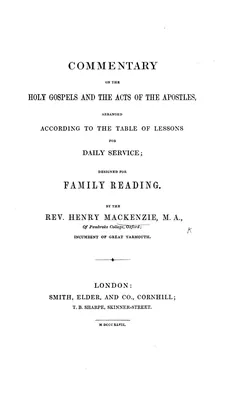
Commentary On the Holy Gospels and the Acts of the Apostles
Pages
This chapter is long, so it is split into 9 parts.
(27)
US: Jesus did not there many mighty works because of their unbelief; and if we are partakers of their want of faith^ we too must expect a withdrawal of the g^ace and favour of the Son of God.
■*^«%'W»l^^^»»^%^^^
January 16— Mat 16— Sbptbmbbr 13.
ST. MATTHEW, Chap. 14.
A STRIKING instance of the power of conscience is given U9 in the case of Herod (Antipas): and yet, though his conscience was so much aroused as to make him believe that the living Christ was the dead Baptist; though we find it shook his faith as a Sadducee, and made him doubt and even repudiate his previous denial of the resurrection of the dead; yet this farther lesson is to be drawn from his conduct, that conscience alone does not produce reformation; that an acknowledgment of wrong may be made without leading to the performance of right. Thus, while conscience, which is part of our aelfy may produce remorse, we must go out of our self, if we wish to attain a change of heart: the working of the Spirit of God is needed before the natural will can be converted to Him.
Our Lord's conduct in withdrawing Himself from the power of the murderer of His herald seems to teach us that caution is not inconsistent with faith: the enthusiasm of an over-excited mind might lead man to tempt God by courting unnecessary danger: the mind of Christ, as revealed in the chapter before us, explains that prudence is not less necessary in the world because faith has attained perfection.
In the miracle of the five thousand fed by five loaves and two fishes, we have many lessons taught us: the most im* (28) portant of these seems to be the divine manifestatioii that was thus made in the person of Jesus. One of the miracles
wrought under the Mosaic leading was that of feeding the multitude with bread from heaven: the Jews therefore might naturally suppose (as indeed we learn from St. John that they did) on the sight of a similar miracle^ that the performer of it could only be that ''prophet" whom Moses had declaied
** should be raised up by God like unto him." Thus their faith would be confirmed in the fact of Jesus being the Messias^ at the same time that they would see a power manifestly divine exhibited in the promised son of David.
They would also be led, by viewing His Sovereign power over the laws of nature, to see that His Kingdom was not merely one of this world, but that His sway was exerted over the invisible things of the creation: and thus they might be led, or at least prepared, to appreciate the spiritual nature of the dominion He was to establish. Their bodies being sustained, would teach them dependence upon Him for the supply of all earthly needs; while the mode of sustenance would teach them also His power to bestow upon them heavenly gifls.
The miracle of Christ walking on the water, and His mercy in saving His disciple whose £edth failed him, should lead us to contemplate with reverence and affection the divine
power and unfailing love of our Lord. We, like the doubting Apostle, axe too frequently alarmed out of our faith by the storms of difficulty and blasts of temptation that beset us amid the waves of life; and yet the everlasting arms are around us, as surely as the arm of Christ was stretched to save the sinking Peter, if we will but open our inward vision under His teaching, and walk by &ith as seeing things invisible.
No wonder, when this manifestation was made to the Apostles, that they came and worshipped Him as the Son of God : but (29) it 18 not enough for us to recognize their conduct, we must also co-operate with it: we too must see and feel the glory of God in the hce of Christ Jesus: we too must cling close to Him, worship Him, fear Him, lore Him, follow Him: and as, under the power of His Spirit, we grow more and more conformed to His image and likeness here, so shall we be gradually fitted for enjoying the fulness of His presence and participating in His glories hereafter.
January 17— Mat 17— Sbptbmbbr 14.
ST. MATTHEW, Chap. 15.
The early part of this chapter sets forth, under a striking lesson, the duty of conscientious honesty. The Scribes and Pharisees were contented with a formal obedience to the ceremonial law^ but did not perceive that which was holy, and juBt» and good, concealed beneath its surfieu^e. Our Lord exposes their error, and teaches that they who do not serve God with an honest heart serve Him in vain.
We cannot be surprised that the Pharisees were offended at such teachmg as this being delivered to the multitude. Few of us like to be told of our faults; none to have them exposed before the sight of
others. But this sin of the Pharisees was so gross and glaring, so mischievous as well as offensive, that nothing short of a public exposure seemed likely to effect, its cure. We should ask of ourselves.
Are not we guilty:of self-deception even as they? Our natural corruption,, our heaxt-impuxity, needs a heart«clean8ing as much as theirs; and inasamich as we have no power of ourselves to think anything as of ourselves, we must seek the cleansing (80) power of God's Holy Spirit, and ever bear humbly in mind that our sufficiency is alone of Him.
From the compassion of our Lord displayed towards the suppliant mother of Canaan, we learn that the urgent faith of the alien is acceptable with God. It was not because His disciples besought Him to send her away (that is, to heal her daughter and dismiss her,) but because of her own great humility and undoubting faith that He granted her petition. This should be an incentive to us to exhibit those graces which Christ thus acknowledged to be acceptable in His sight; and though the relationship wherein by God's covenant we fitand to Him, as baptbed into His body, gives us a claim to approach Him which she did not possess, yet that very relationship is itself a gift of grace, and an additional reason for us to bear in our body the marks of the Lord Jesus.
When we read in the latter part of the chapter of the love of Christ displayed toward the multitudes, of their wonder at His power, and of the grateftd praise wherewith they glorified the God of Israel, we too shall have our hearts lifted up in thankftdness, remembering that these records have been wrifr ten for our learning, to lead us as disciples to the feet of Christ, through whom all temporal blessings are acquired to us, as well as those spiritual gifts which our hearts acknowledge. Even as He fed the fainting multitudes in the wilderness. He continues to sustain now those who come to Him lor their daily bread. Let us, then, Uke the wandering multitude, lift up our hearts and voices in thankftilness to Hun from whom we derive our sustenance; and endeavour, under the support of His Spirit, to show forth our gratitude " not only with our lips but in our lives."
(31)
Jam. le—lf^ 18] VAMILT RBADIN08. [Sqi^ember l& January I&^Mat 18— September 15.
ST. MATTHEW, Chap. 16.
When man witb a carnal and unbelieving heart demands as a right a sign of favonr from God, he will meet with rejection, as did the Scribes and Pharisees. And yet it is observable, that even in Christ's rejection of them a word was dropped by the way, that if any one spiritual person were among them he might profit by it. The sign of the Prophet Jonas was mentioned by our Lord, to shadow forth to any who would receive it the mystery of His coming death and subsequent resurrection.
The dulness of the disciples in apprehending the teach-ing of their master, with reference to the leaven of the Pharisees, shows us strikinffly how very hard the heart of man Is, and 1i.at this Section of nTture doth remain even in them that are regenerate. To those who suffer trial as to the means of subsistence, the reference of Christ to His power in multiplying the means of life, sh6uld convey a sense of hopeful confidence. Our heavenly Father knoweth that we have need of these things; and they who are taught by His Spirit to feel their filial relationship may rely undoubtingly upon Him for all needful supply.
But the allusion to the leaven of the Scribes and Pharisees should not be allowed to pass, without leaving useful matter for reflection behind it. The great father of lies, the author of their, and of all, hypocrisy is ever seeking to introduce His leaven, not only into the world at large but into our own hearts personally. Satan is just as anxious to withstand Christ now as he was then, and inasmuch as he is
(32)
powerless against Him personally, he seeks to wound Him through the sides of His brethren; and if we would desire to withstand him
snccessfiilly we should take unto us the weapons of Christ—
^humility, obedience, and love.
It was no light testimony that was borne by the people to the power that Christ exhibited, when some took Him for the Baptist, some for Elijah, and some for other of the Prophets. They were feeling after the truth, and, like all who do so in sincerity, made some approaches to it. But man cannot by searching find out God ; and it was to the enlightenment vouchsafed by His Spirit alone, that the rock-like confession of Peter was to be ascribed, '* Thou art the anointed one, the Son of the living God."
It is much to be feared that we do not suiEciently acknowledge this truth. The personal work of the Spirit in grafting us into the Church is far too little thought of; and thus the baptism into His name, in union with that of the Father and the Son, is often degraded into a mere ritual ceremonial. The personal sustaining of the soul by the same blessed Being is also too frequently lost sight of amid the bustle and excitement of the world. May we have grace to think more of the Spirit (as we declare Him in the Creed to be) as the Lord and Giver of life to us.
As the faith of Peter in his confession is an example, so is his worldliness in his subsequent rebuke of Christ a warning to us; he seems to have expected to gain the crown without first submitting to the cross, and that this error is prevalent even yet, our own hearts too painfully prove. Let us then seek to bear more constantly in mind (and let the value of the human soul, as laid down by Christ Himself, enhance the recollection) that Christ also suffered for us, leaving us an example that we should follow His steps. (83)
^^»^^^^*»^»^#^^<H»^»
^^»^>»^^^^»^»%i^^^>^(i^^^>'N^N*^^^»>^»^*^<^*y^^^
ST. MATTHEW, Chap. 17. A woxDHOvs mystery is revealed to us in the commencement of this chapter— God has proved Himself to the Apostles to be the God of the living • He of whose sepulchre no man knoweth unto this day, and he vho was visibly taken up from the wondering gaze oj the fiuthful Elisha, are sent in spiritual but visible life to converse with the transfigured Jesus in the sight of His fevoured Apostles. The giver of the law, and one of the most eminent among the prophets, converse with the Messiah in this opening scene of His glory, concerning His decease which He shall accomplish at Jerusalem. What a wondrous and glorious consent is here set before the eyes of the faithful! The Law, th$ Prophets, and the Christ agree upon that death which is to be the wages of sin. The power of the Holy Ghost invests them with a visible glory; and the voice of the Father testifies that He is well pleased with the way in which His beloved Son will fulfil His mission.
The return of the three Apostles with their Lord from Mount Tabor was marked by a fresh evidence of His divine power; and the faithlessness of His disciples, as proved by their impotence over unclean spirits, met with a deserved rebuke from Him who had called them to the exercise of faith. The rebuke is as useful to us as to them; it is our unbelief that makes us weak; we, as they, can do all things through Christ which Btrengtheneth us; but if we wilfully give up His promised aid and trust to ourselves, then will our impotence proved as manifestly even as was theirs. In resisting
'^mptation to sin, in aiming at a higher standard of holiness, in
.:_vercoming indolence, and a natural disinclination to heavenly
|iings, we must ever faithfully seek the assistance of a Spirit
: (3*)
w.
^
higher than our own. In the strength of tjiat Spirit we may triumph over the world, the flesh, and the devil, to resist whom we are pledged by the vows of our baptismal covenant: but if we rest content with such strength as is natural to us, and seek not in all things the aid of the Spirit of Christ; the world, the flesh, and the devil will assuredly triumph over us.
In the conclusion of the chapter the divine doctrine of obedience to government is very distinctly laid down: and if we be faithful followers of the Lord that bought us, we like our Master shall be subject to principalities and powers, obey magistrates, be ready to every good work, speak evil of no man, be no brawlers, but gentle, showing all meekness unto all men.
January 20— May 20— September 17.
^.
ST. MATTHEW, Chap. 18.
The natural man seeks aftei;. greatness and distinction upon earth. Even the disciples of Christ are not free from this failing. His personal followers exhibited it when on earth, and vast numbers of the members of His Church are equally subject to it at the present day. If we are of the number of these weak brethren, let us learn from the coinmencement of this chapter that humiUty and docility are signs of true greatness. The infant in age is an object of care to the angels
pf God ; and the infant in spirit, he who is humble, and meek, and lowly in heart, is an object upon which rest the affections of God himself.
Selfish ambition, like other sins, if it be not cast out by the spirit of grace, grows with our growth and strengthens with our strength. Our errors become as it were a part of our-self; as much identified with our moral nature as our members (85) D 2
Jan. 20—3fay 20] FAMILY READINGS. [Siptember \7
with the body whereof they form a part. But we must learn, from what we have just now read, that if we value our eternal salvation, we must cast them from us be they dear as a right eye or a right hand. If we tamper with our sins, we are tampering with that which has power to drag both body and soul down to hell.
And when the weight of sin really presses heavily upon us, and we feel our own weakness and inability to shake it off, then should we most cheeringly remember our Saviour's most gracious words, that He came to seek and to save that which was lost. To the mind trembling under the sense of its own lost estate, the Saviour's love brings holy and healing balm. The good Shepherd, who gave his life for the sheep, is ever on the watch to call the wanderer home, and to supply him with that divine grace which is, through the will of the Father, perfected in human weakness.
The grace of charity, the power of prayer, the judicial authority committed to the Church, the pledge of Christ's presence to those who unite to supplicate the Father in His name, are all set forth in this chapter; while in the parable recorded at the end, the doctrine of forgiveness is clearly laid down. Like that of our heavenly Father, our forgiveness toward those who trespass against us should be unrestrained: unrestrained, that is, not to the encouragement of error, but when the error is confessed; for confession, in cases of
human error as weU as those directly committed against God, is a necessary preliminary to forgiveness. May we have grace fully to feel our own need of forgiveness before God, and in true humiliation to offer that prayer *' God be merciful to me a sinner," which of old was not, nor ever will be, offered to the throne of grace in vain.
(86)
0^^^0it^^0^m^0mn^0^0^0m^0t0^^^^^^i^^^^^^^^»'f^f^
January 21— May 21— September 18.
ST. MATTHEW, Chap. 19.
The love of Christ in healing the multitudes that followed Him, and the malignity of the Pharisees in seeking to involve Him in a contradiction of the law of Moses, are set forth in striking contrast in the commencement of this chapter. Even our human apprehensions readily perceive how lovely is virtue in the abstract, and how offensive is its opposite vice. But though our moral nature freely recognises this as an external law, it requires something more than this to lead us personally to the practice of holiness. One of the most vicious monarclis that ever existed, is recorded to have said that he respected virtue in others though not virtuous himself; and thus our moral sense is ready enough to confess the superiority of holiness, while in our own persons we serve the law of sin.
In the exposition that our blessed Lord gave of the Mosaic law with reference to marriage. He showed that there was an accommodation therein to the low tendencies of our carnal nature. This imperfection exhibits plainly the temporary character of the legal dispensation, while the high ground of moral purity laid down in the Gospel sets forth as manifestly its enduring and permanent character. Here, as in the preceding chapter, we have testimony of God*s love for little children: and it ought to impress the youngest child of our families with a holy gratitude, to know that such as he are objects of angelic watchfulness, and called by a voice of love to receive blessing from their Redeemer.
The interesting history of the rich young man teaches to all who will receive it the snare of wealth, the duty of holiness, and the necessity of self-denial: but beyond this, it teaches (37) Jon. 22—Jfoy 22] FAMILT RBADIMGS. [SepUmber \9
also the all-sufficiency of the grace of God for rich or poor who trust in Him.
How wonderful a prophecy was that of the Lord Jesus^ when twelve thrones of judgment were promised to the twelve Apostles^ and yet one of the twelve then present became a son of perdition, and by transgression fell from the exalted honour intended for him! Should not this teach to us the lesson of humility, and make us fear lest we to whom the promises are sealed through Christ Jesus should also be cut off? If indeed we lay firm hold upon Christ as the rock of our salvation, no power can separate us from His love: the reward of the faithful shall then be ours. But if we be tossed to and fro with every wind of doctrine, wavering and of doubtful mind, then indeed we have cause to fear that we shall not receive any favour or blessing of the Lord.
^^•^^^^F^^^^^^^*^^^»^^^^^^^^t^^^^^^^n^»^^f^*^^0^^
^9^^^*^*^tm
January 22— May 22— September 19.
ST. MATTHEW, Chap. 20.
The expression of our Lord that many that were last should be first and many that were first should be last, seems to have been considered by Himself to require explanation: for immediately after its utterance He proceeds to show how this should be, by the parable of the labourers hired into the vineyard. The sovereignty of God, as universal proprietor, is here displayed, as well as the justice of His covenant vindicated : in the language of the translators of the Bible, the parable " showeth that God is debtor unto no man." It is
supposed to refer specially to the Jews as the earlier, and the Gentiles as the later, called into God's family, and thus to (38)
shadow forth the mystery, from the beginning hid in God, of the in-gathering of the Gentile to an equal privilege with the Jew. But apart from this, while it vindicates God's justice in "keeping covenant," it also strikingly exhibits His goodness in '* showing mercy:" and if there are among ourselves those who have experienced a late conversion of heart to Him, while that life which was His by right had been previously squandered in indolence or self-indulgence, we surely should from this parable be made to feel the greatness of His love, and be led thereby to devote ourselves more unremittingly to His service during our remaining time in His vineyard on earth.
Twdce before this had Christ foretold His coming death to His disciples ; but now for the first time did He state the mode of that death: a mode that must have struck them as almost incredible, when they knew that He was not likely to conunit any offence against the Gentile (that is, the Koman) government, and that they were not likely to persecute Him for religious opinions to which they were utterly indifferent. The perfect knowledge, however, of future events thus displayed by their master, must have strongly confirmed their faith in and dependence upon Him when, shortly after, they found them verified to the minutest particular.
What a lesson to ambition is that read by our Lord to Salome and her sons, and their fellow-disciples! Service, not Rule, is the order thus given to all members of Christ. May we have grace to bear this ever in mind, and seek to follow the holy example of Him who came not to be ministered unto but to minister!
The closing miracle recorded teaches a lesson by which all of us may profit. Let us not heed the rebukes of the
worldly multitude who would keep us back from Christ, but (39) Jon. 25—Afa^ 23] FAMILT READINGS. [SepUnJfer 20
call on the Lord Jesus in faith, as the Son of David, the promised King of Israel, and we too may hope to hare our vision enlightened, the darkness of nature taken away, the veil removed from our hearts, and ourselves enabled to gaze undazzled on the full Beveladon of the Sun of Righteousness!
January 23— May 23— September 20.
ST. MATTHEW, Chap. 21.
If the disciples' minds were not so habituated to miracle as to be unmoved by its recurrence, they must have been deeply impressed by the circumstances of the Lord sending for the colt He needed, as well as by the fulfilment of the ancient prophecies, which He exhibited on using it for His entry into the City of Jerusalem, or as it is poetically termed " the Daughter of Zion." No less than three of these were thus realized:—Malachi had declared that " the Lord was to come suddenly to His Temple," and He did so; Haggai had declared that '
the glory of the latter house (that is, of the second Temple, rebuilt after the return from the seventy years captivity in Babylon) should be greater than that of the former," and by the visible indwelling of the Lord of Life, it became so; and Zechariah had uttered the prophecy quoted in the chapter just read, which, inconsistent as it seemed, was equally fulfilled by the entry of Jesus which has been recorded.
The purification of the Temple requires perhaps a little explanation.
It seems strange to us that oxen, doves, and money-brokers' desks, should find place at all within those holy precincts. The reason was, that it was found more conve-
(40)
Jan. 23_Afay 23] FAMILY READINGS. [September^
nient for worshippers from a distance to purchase on the spot the sin and peace-offerings required by the Mosaic Law than to bring them from the country: but this convenience grew in time into an offensive traffic^ which encouraged cupidity and the lowest feelings in the
dealers^ and dishonoured the sanctity of that building which was consecrated to the service of Jehovah. Hence it was, that the Son, jealous for His Father's honour, purged the Temple of this abuse.
Perhaps also the act was farther intended to show the useless-ness of such sacrifices under^the coming dispensation of grace.
The cursing of the unfruitful fig-tree—so unlike most of the miracles of the loving Saviour—while it shows forth at once His divinity and humanity in the power and in the ignorance displayed upon the occasion, seems to have been recorded for some special purpose.
This may have been to indicate the end of the Apostate Judas, whose special unfruit-fulness was so soon to be exhibited. We should take warning by the solemn lesson so painfully and practically illustrated.
And as this gives us warning, may we not also take example from the parable of the penitent son ? Which of us can look into his heart and say he has always obeyed his Father's will ? Shall we not then repent and do the first works appointed to us, ere it be too late ? The voice of the Lord, by parable, by warning, by example, sounds throughout His written word, calling us to be built up upon Him the tried comer-stone! If we are truly rooted and built up in Him no power shall separate us from His love: but if, while we profess to go and work in His vineyard, we are found still lingering in the world at large, this same corner-stone, that might have been our salvation, will fall upon us to our everlasting destruction !
^^M^^MAArfN^i^^^A^^k^^«A^^^^k^S^M^^#M«^WWM^^
(41)
Jon. 24—Jlfa^ 24] FAMILY READINGS. [September 21
January 24— May 24— September 21.
ST. MATTHEW, Chap. 22.
If they who rejected the invitation to the marriage of the king's son were cut off from his favour, can we wonder that the Jews who rejected and crucified the Lord of glory should be visited with the armies of God and have their city burned up ? And all this did
happen to them within forty years of the time of the parable we have read being uttered. But let us carry on the idea a little farther. The Jews, the descendants of fsdthful Abraham, were for their wickedness cut off from the Ghreat King, and He sent out His servants to call us, members of the Gentile family, to fill up the gap made by their falling off. Have we then come to His summons clad with the requisite wedding-garment ? It would be an awftd thing to deceive ourselves on this point. The message of God to us was intended to bring us into the closest relationship with Himself, even that of sons. It was no less than to make us His heirs. His joint-heirs with Christ. The righteousness of Christ constitutes the wedding-garment which we are to wear. We cannot assume this garment of ourselves, but it is provided for us and offered to us to wear. Are we wearing it now ? Are we partakers of that true fellowship with the Father and the Son through the Spirit which enables us to recognize Jehovah-Jesus as our righteousness ? How solemn is the consideration that, although all of us as a christian family are among the many called, there may be some of us who are not among the few chosen!
The picture given us of the subtle attempt of the disciples of the Pharisees with the Herodians to lead the obedient Son of God into rebellion against the civil authority, is well (42)
Jan, 2i—May 24] FAMILY READINGS. [September 21
worth the attention of the christian student in all ages. The powers that be are ordained of God : and surely God will never so contradict Himself as to make it a duty in any one of His children at any time to lift the standard of rebellion against constituted authority.
When our Lord explained the doctrine of the resurrection of the dead, and the spiritual character of His Father's revelation to Moses, the multitude were astonished: a clear proof this, that God's word had not free course so as to be glorified amongst them : and though perhaps the explanation was given for the special refutation of the Sadducee, and the general instruction of the unbeliever of that day,
yet may we not ask. Is not this a warning to the days of high christian civilization as well as to those of Jewish darkness ? Our christian life is assuredly not sufficiently recognized amongst ourselves: and if all of us, masters and servants, parents and children, equally felt that our life was hid with Christ in God, as the Bible teaches us, we should realize more the mutual relationship that exists between us, and understand better the mighty Unity in which we are bound up together!
The closing verses of the chapter show how love and wisdom triumph over all opposition. Did we but seek those high qualifications in humble prayer from Him who alone can give them, we too might hope to rise superior to all the difficulties with which we are surrounded in a world that lieth in wickedness, and especially from those which emanate directly from Satanic subtlety. Let us seek more earnestly henceforward to obtain grace to walk worthy of the vocation wherewith we have been graciously called of God !
(43)
Jnn,^^May25] FAMILY READINGS. [September 22
January 26— Mat 25— Septrmber 22.
ST. MATTHEW, Chap. 23.
The opening of this chapter very impressiyely sets forth the dignity and responsibility of all placed in authority: and the principle laid down in our Saviour's words applies as closely to heads of families and masters of households as to those holding the station of public rulers. In goveming and in teachiligy those who sit in the seat of authority are to meet with respect and obedience, even if they themselves fail to act up to the spirit of the rules given them by the source of all authority: but as they have a Master, in heaven. Who is of purer eyes than to behold iniquity, they must beware, lest, by erroneous teaching or rash exercise of the power committed to them in trust, they render themselves liable to divine judgment.
How fearful that judgment is we may gather from the woes denounced by the Redeemer against the exclusive, hypocritical, formal, blind, and wicked Pharisees. His omni* science took away the cloke that concealed the deformity of their sin, while His justice denounced the woe that was its due.
These stern rebukes have led some to believe that persons convicted of error should meet with similar rebukes from ourselves in the present day; and hence, an indiscreet zeal, or even a censorious or uncharitable spirit, seeks to shield itself under cover of the Saviour's example. But it is observable that our Lord's rebukes were directed against a class, not against individuals of that class. Nicodemus, a disciple, was one of these; and assuredly from what we read of him, we cannot suppose that such censures would apply to him personally. This then may teach us that our
(44)
Jan, 27-^Mi^ 06] FAMILY READINGS. [September 2S
oppositioii^ when called for, must be directed rather against error itself, than against the sinner who has fallen into its commission. We may compassionate the fallen person, while we hate the sin that has seduced him. But even this compassion may be carried too far; as in the case of repeated, unrepented, wilful sin being indulged. In such case, the apostoKc injunction must be fulfilled by those in authority
— " them that sin rebuke before all, that others also may fear!" we must strive so to exercise government as not to interfere with the law of charity; and so to exercise charity as not to offend against the law of justice.
The pathetic lament of the Lord Christ over fallen and impenitent Jerusalem shows how sore is the strife when charity and justice contend in a loving heart. None feel this more strongly than the parent in his rebuke of the child of his affection. And if Parents know this by sad experience to be true, how should it act with a reflex effect upon themselves as children of God ! The Universal Parent beholds us. His children by adoption into Christ Jesus, with watchful love; let us strive, in the grace of His Spirit, so to fulfil the desires of His love,
that, unlike His daughter of Zion, we may never provoke His anger or His jealousy!
January 27— May 26— September 23.
ST. MATTHEW, Chap. 24.
What do we learn from the prophecy of Jesus in answer to His disciples' admiration of the buildings of the Temple ? Was it not an indication of the fall of the system which the temple represented ?
The law which had a shadow of good things to come was now waxing old, decaying, and
(45)
JaM.^^~Mmy^] FAMILY BEAOING8. lSeptmAer2S
ready to yanish away. It had fulfilled its temporary purpose; having only been added to the original purpose of God because of transgressions; and only being intended to last until the Seed should come to whom the promise was made. It had acted as a schoolmaster in bringing the world to Christ; and now that Christ was come, its end was answered and its duty was accomplished.
But the prophecy of the destruction of the Temple led the disciples to inquire, and our Lord to reveal, still more con* ceming the then unfulfilled purpose of God. It would perhaps savour of presumption, did we attempt to say exactly where a line was to be drawn, separating the prophecy of the destruction of Jerusalem from that of the final judgment. But the striking fulfilment of most of the events predicted up to the end of the thirty-fifUi verse^ within forty years of the utterance of these awful words; the special reference made to the symbol of Roman power, the eagles that were to gather together over the carcases of the slain; the distinct declaration that that generation was not to pass until the prophecies announced should be fulfilled; all these considerations would make us believe that, in a primary sense at least, the destruction of Jerusalem by Titus in the year of our Lord seventy-two, was the realization of that which was revealed.
The concluding portion of the chapter has probably a more direct reference to the final coming of the Son of Man, and was intended for the guidance of all time generally, as well as specially for the believers of the apostolic age. And it is not improbable that the earlier as well as the later portion of the chapter has a spiritual reference to that awful day, of which the coming of Christ in judgment on Jerusalem was but a type.
How solemnly then should the words of the prophetic Redeemer "watch therefore," ring in our ears! The dwellers (46) Jan,^^May2T\ FAMILY READINGS. [September24
of the doomed city, like those of the cities of the plain, and like the victims of the flood, refused to watch: and fearful judgment fell upon them unawares! May it not be so with the Gentile Church ? May not strife and division, faithlessness and sensuality, coveteousness and want of charity, be our characteristics at His coming, even as they were theirs ?—Let us then watch and be sober, living as *' faithful and wise," not as " evil" servants of the Lord Jesus, holding ourselves ever ready for His summons, not merely " looking for," but " hasting unto the coming of the day of God !"
January 28— May 27— :S£PTEMBER 24.
ST. MATTHEW, Chap. 25.
One lesson of watchfulness was not thought sufficient by our kind Lord. He repeats it again and again; as it was the point of instruction in the last chapter, so also is it in this. Be ye ready, be ye ready, is the note of warning which the voice of Christ ever echoes in our ears.
And how do we receive the instruction? Are we the more ready because we axe told to be so ? Or are we still disobedient children,
*'stiffiiecked, and uncircumcised in heart and ears ?"—Let the wailing cry of the virgins shut out &om the presence of the bridegroom teach us the fear^ consequence of neglecting to seek the unction from the Holy One!
The parable of the talents teaches us to add to watchfulness diligence. God has given to each of us a work to do. To every one according to his several ability some gift is entrusted, which he may use to God's glory or abuse to his own condemnation. Not only is man placed in a relationship to
God by the revelation of His will; but on the mode in which (47) Jan. 28-^lfay 27] FAMILY READINGS. [Stpieaber ^
he fulfils that relationship depend the interests of others also: and just as the temporal interests of others would have been affected by the increased wealth of the unprofitable servant in the parable, so will the spiritual interests of those with whom tee are connected be advanced or retarded by the use we make of the gifts of grace wherewith we have been entrusted. If we shroud from view our knowledge of the Son of God — if we are ashamed of Christ and His words—if we deny the relationship to the Father which He by His Spirit has wrought in us—we may not only ourselves be cast out at the last, but find that our negligence and sin have been instrumental also in keeping back others from the joys of the kingdom of heaven!
The closing section of the chapter is in the highest degree interesting.
It not only gives us by implication an account of the christian duties in a social point of view—not only bids us prepare for a personal examination before the throne of Christ—^not only holds out the glorious assurance that we relieve and comfort Him in the person of His feeble and suffering members—not only reads to us the solemn lesson of *' everlasting punishment" to the sinner, and " life eternal *'
to the saint—^but beyond all this, it gives to us most valuable and practical instruction, by teaching us the very imperfect con-ceptions men have of their ovm doings. The righteous know not how much good they do; the wicked know not how much they leave undone! the righteous act from a sense of duty and reap reward: the wicked act from a love of self and reap rebuke. Surely, if this were taught us merely as a guide to worldly actions, it would influence our conduct and teach us to add humility and obedience to the diligence and watchfrdness already enjoined! How much rather then should it influence us, when the prize for which we are striving is a crown of immortality.
(48)
JoH. 2d^Map 2S] FAMILY READINGS. [September 2& January 29— May 28— September 26,
ST. MATTHEW, Chap. 26,
If this chapter had been read as a tale of fiction it would have melted half the world to tears. As a series of most awful facts, it is too often passed by with the most reckless neglect. Prophecy of His coming, betrayal, and crucifixion, by The Victim, first attracts our attention: then comes the record of the consultation of His enemies: then the incident of the anointing at the festival, which brought forward our Lord's sanction of sumptuous outlay for great purposes, and His prophecy that the deed should be had in continual remembrance, while it also led Him to prepare His disciples still more plainly for His withdrawal from them: then the record of the fall of one of the chosen twelve in his traitorous covenant with the Lord's enemies: then the awful conviction of the traitor in the presence of his brethren: then the earliest account of that memorial of dying love wherein the faithful of eighteen centuries have shown forth the Lord's death, and wherein the faithful living and yet to live will show it forth till Hb come: then the great sanction for christian Psalmody, a prophecy corroborated by a prophecy, a weak though fervid protestation grounded on human affection and invalidated by human weakness, a truth revealed through the foreknowledge of God : then the description of that crowning scene of affliction, when Gethsemane witnessed the final strife between the enemy of souls and the obedient Son of man; of the rest of the nine, of the drowsiness of the three, of the suffering, the rebuke, the prayer, the agony of the One: then the account of the betrayal by one, of the defence attempted by one, of the submission of the One, of the (49) ^ E
Ja»« 29—J#ay 2H] FAMILT READINGS. [Sqttember 25
desertion bj all!—then the false, yet true, witness against Christ, the adjuration of Caiaphas, the acknowledgment of Sonship and Messiahship by the Lord Jesus, His condemnation by the assembly, and the contumely of the multitude!— then, finally, the denial, the self-accusing recollection, and the penitence of the most zealous disciple of the Saviour!
Thoughts too deep for words must crowd on the be-lieyer's soul, when he reads or hears such a record as this. It is of THE Redeemer of the world that it is related. It is of his living Redeemer. It is of Him, but for Whom, and for Whose sufferings there described, he would not have been enabled to address the great God by the endearing title of Abba, Father!
The relationship we bear to GoD is boimd up with all of these events.
Apart from their occurrence we have no knowledge of a Saviour.
Apart from the sins of our race that Saviour need not have so suffered. Are we then of those who, with the faint-hearted disciples, would desert the Lord that bought us and redeemed us by His blood
? of those who, with the more culpable Peter, would deny Him? of those who, with the most guilty Judas, would betray Him ?
We have need to be penitent and contrite like the awakened Peter—
and faithful, constant, and loving, like the favoured John—if we desire to show ourselves believers in the record we have read to-day!
(50)
January 30— May 29— September 26»
ST. MATTHEW, Chap. 27.
We are drawing near to the closing scene of all. The malice of the Jews, who lacked power to put Jesus to death,, was so far successful as to bring Him in bonds to the Koman governor. Perhaps we may understand this record better, and trace more strikingly the foreknowledge and providence of God, if we bear in mind the fact that the Jews, by their subjugation to Rome, had lost the judicial power of life and death, and thus had of themselves no power to pass
sentence on Jesus whom they persecuted. Thus it was that the Lord's prediction of His " being lifted up"" was fulfilled, in the fece of all human probability: thus it was that the prophecy of His being "
delivered to the Gentiles ^ was realized^ while the Jews only bore Him enmity: thus it was that the death by stoning, for the blasphemy of which He was accused, was changed to death by crucifixion, for treason of which He was not even supposed to be guilty.
And how wonderfully in all this was the foreknowledge of God exhibited \ The potter's field recalled the words of Zechariah ', the buffeting and scourging those of Isaiah; the mocking and jeering those of David.
And as if the reference to the past were insufficient tO"
prove the wondrous dignity of Him who suffered, earth, air, and mountains joined in the marvellous tribute r the rent veil of the temple told its work was done: the graves gave forth their sheeted tenants to the air, and saints, as a sheaf of the first-fruits of the harvest of the dead, spread the glad tidings through the holy city that the power of death was annihilated I (51) e2
Jm. 8D_lfdy S9] rilCILT EBADIN6S. [Sepiember 96
But let US observe the marked contrast exhibited between the hardened sinner and the &ithfdl child of Gon. The latter^ in awe-stricken faith, was enabled to trace all these testimonies to the Messiahship of Jesus: even the terror-stricken Gentile was compelled, by the force of the visible testimonies borne to Him, to acknowledge Him to be the Son of God. Not so the wilful sinner, hardened in unbelief: He could see nothing but the crucified malefactor stiffening on the accursed tree!—^And is not this an exact picture of the faithful and unbelieving in the present day ? the latter can see no farther than the ma-terial testimony of his senses carry
him. The former traces in grateful joy the guiding hand of an unseen Providence, and recognizes life and government where others see nought but death and fate.
Again, towards the conclusion of the chapter, we are struck with the surprising fulfilment of ancient prophecy, when the deposition from the cross, under the direction of the wealthy Arimathean, took the holy body of the Lord from " His grave with the wicked," and placed Him " with the rich in His death."
The watchful fidelity of the sorrowing Marys gives us a beautiful picture of feminine tenderness and devotion. Eve-like, they mourned over the murder of their righteous Abel! and while they thus displayed their loving reverence, the enemies of the Lord gave an equally powerftil illustration of the hideousness and impotence of human enmity. They sought to chain the Lord to the tomb to which they had driven Him: and while the faithful disciples were '* resting the sabbath day according to the commandment," the chief Priests and Pharisees combined to break it, in the vain hope of keeping Him a prisoner who was about to rise triumphant over death and the grave.
(52)
^^i^^^WWiW^W^^i^^^^^M^^^^^^^^^f^i^^^p^^^,
January 31— May 30— September 27.
ST. MATTHEW, Chap. 28.
ThA revelation of God to the wicked is harrowing and terrible: to them who seek Jesus which was crucified, it comes with cheering tones to banish fear. The word of the angel to the Mthful watchers did that which the written word does to us. It heralded the risen Christ. It pointed to His humanity in showing the place where the Lord lay, and thus convinced them of His perfect sympathy with themselves. It announced His divinity in the tidings of His Lordship over death, and thus convinced them of His power to free themselves from him that had the power of death, that is, the devil. It declared
His ftiture manifestation to them, and encouraged them in the hope of re-union with Him, and thus assured
«
them of His will to exercise the power He possessed on their behalf.
All this the written word does for us. The Gospel according to St.
Matthew, which we have now concluded, brings us to the knowledge of the Son of God, pre-existent, incarnate, instructing, suffering, triumphant, mediatorial, supreme.
Let us ask of ourselves then, have we received Him as He is thus revealed to us ? Have we, like the holy Joseph, and the faithfrd eastern Magi, recognized the divine and kingly power manifested in the infant offspring of the Virgin's womb ? Have we, like the listening multitudes, and attached disciples, received with joyful hearts the instruction Christ's teaching has bestowed ? Have we, like the Cyrenian Simon, learned to bear the cross of Christ's suffering ? Have 'we, like the joyful Marys, learnt to believe the revelation of Christ triumphant? Have we, like the contrite Peter, ac-(53) Jim. 31—lf«y 30] FAMILT READINGS. [S^Hember ^
quired a knowledge of the lore of Christ mediatorial ? Have we^ like the worshipping disciples^ bent low at the feet of Christ supreme ?
If we have thus learned from the record of St Matthew to know the only true God^ and Jesus Christ whom He has sent, then have the words of the Gospel been made spirit and life—even life eternal—to
us! then may we rejoice abundantly in these good tidings of peace and love—then may we ponder on the words of inspiration with joy unspeakable and full of glory, in that He who came to be a propitiation for the sins of the whole world, and to restore to forgiven man all that he had lost in Adam, has been revealed to us therein as our Mediator, our Intercessor, yea our Saviour !
END OF THE GOHMENTART
ON THB
GOSPEL ACCORDING TO ST. MATTHEW.
W^^^k^^^^^^A^^MV^AA^^^^^^V^'^iV^^'^^^V^'V^'W^
(M)
COMMENTARY
ON TBB
GOSPEL ACCORDING TO ST. MARK.
February 1— May 31— September 28.
ST. MARK, Chap. 1.
The marked diflFerence between the commencement of this and the preceding Gospel is, that St. Matthew thought it necessary to trace the legal descent and announce the miraculous birth of the Lord Jesus: these are assumed by St. Mark, who proceeds at once to announce the office of the Baptist and relate his baptism of Christ.
The fact of our Lord's temptation immediately after His public recognition of God from heaven, would seem to indicate to us the necessity of watchfulness after Grace received: it is at such times that Satan is most active in his temptation to lead the soul away from God, and neutralize the benefit his gifts have bestowed.