
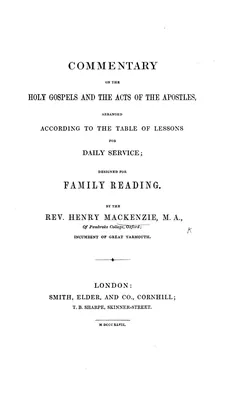
Commentary On the Holy Gospels and the Acts of the Apostles
Pages
This chapter is long, so it is split into 9 parts.
When we read of the call of Simon and of Andrew, and of the sons of Zebedee, we shall be wholesomely reminded of the way in which most of us have been engrossed by worldly callings before we have recognised the voice of the Son of God calling tis to leave our worldly business and to follow Him, to set our affection on things above rather than those on earth.
(55)
F«6. 2-^vjm1] family KBADIK08. [SepUmber 29
There is a striking lesson also conreyed in the record of the Evangelist, that immediately after witnessing the effect of His miracles on the people^Our Blessed Sayiour sought privacy and prayer: how should this teach us humility under success^ and the duty of seeking communion with God after every exercise of exciting duty!
When Our Lord was reminded of what would in worldly language be called the success of His preaching, we find that He iipmediately left the scene of His popularity to carry elsewhere the blessings of His instruction. This betokens the unselfishness of His ministration, and should serve as a practical protest against such as seek the praise of man rather than the performance of duty before God.
His teaching also in the synagogues, and His direction to the cleansed leper to show himself to the priests, and thus fulfil the Law of Moses, should teach us the debt of gratitude which toe owe to the family of Israel, through whom we have received the oracles of God.
If Christ thought them worthy of His love and His instruction, it cannot be the part of the Christian to despise or contemn them; and though the sins of Israel were consummated in the Crucifixion of Him who came to redeem them, yet we must remember that blindness has but in part happened to Israel, and that their restoration is an event still to be hoped and prayed for; while the lesson of their fall is calculated to bring to us, who, as Gentiles, are concluded under sin with them, a striking warning, and teach us not to be high-minded, but fear lest we also should be cut off.
(56)
^AAA^««AMAA^^^^«^^^MS'«tf^'^^V^A^^AAA^A^
1%6.2--Ji0ie 1] FAMILY READINGS. [September^
Febrtjart 2— June 1— September 29.
ST. MARK, Chap. 2.
The miracle of which we have read in the commencement of this chapter is valuable not merely as a testimony to the power of the Son of Man to forgive sins on earth, but also as proving the efficacy of Faith in those who seek His blessing. Were our feelings more consonant than they generally are with those of the four who bore the sick of the palsy—were the thought uppermost in our minds when we see our friends and neighbours palsied with sin, *' let us seek to bring them to Christ,"—^we might indeed look for an increase of His gifts in the world, and humbly hope to be made instrumental in promoting His glory among men.
The conduct of the Scribes and Pharisees in despising Our Lord for His communication with publicans is unhappily too often realized in the present day by many, who undervalue the efforts of His self-denying followers to make known the truths of the Gospel to those of their fellow-sinners who yet lie in darkness and in the shadow of death: let us not in this respect be partakers of other men's sins, but rather bear constantly in mind^ that if that mind dwell in us which was also in Christ Jesus, our part will ever be to promote, by all means in our power, the calling of sinners to repentance.
We are taught in this chapter also the existence of a duty too much slighted in the present day-^he discipline of fasting and sdf-denial. The Bridegroom has been withdrawn from his spouse, the Church; and we, the Children of the Bridechamber, mourn for Him who is taken away from us:
happy for us if we mourn in a rightful spirit, for then we shall be comforted, and He who now Touchsafes us but (57)
'
Feb. S^~Jtme 2] FAMILY READINGS. [SepUmber 90
spiritual glimpses of His mysterious power^ will^ in the day when He maketh up His jewels, reveal Himself to us face to fiice as a man speaketh with his friend.
The right use of the Sabbath is also here taught us: that Holy Day was not given to be profaned by the reckless, or abused to the purposes of sensual indulgence, but was bestowed as a direct gift from God, wherein one-seventh portion of the primal curse of toil was remitted to man, and a holy and blessed Channel opened, whereby he was not only authorised, but enjoined to approach the presence of that God from whom by sin he had been alienated. May our Sabbaths here on earth be so consecrated to the service of Our Lord in Heaven, that they may fit and prepare us under grace for that enduring Sabbath—
that rest that remaineth for the people of God, where there is fulness of joy and life for evermore !
m0m0*^t^^^t^t^^^^t^^0^0^0t0^0t0t0^^^^^t^k^^^>^^t^*^»
^*^^^*^*^*^>
February 3— ^June 2— September 30.
ST. MARK, Chap. 3.
Our Blessed Lord had scarcely laid down the principles on which the Sabbath was founded, ere He had occasion to illustrate them. It appears, that His previous remarks had already kindled the suspicion of those rigid formalists the Scribes and Pharisees, for they were watching at this time to see whether He would do anything which was, in their estimation, an infringement of the Sabbath. It is no marvel to us that the Lord's anger was kindled against such hardness of heart as they exhibited; but when we read the record, we should
look into our own hearts, to see whether there be not there also a dependence on formal observances, rather than on (58)
Feb. 3-~Jun€ 2] FAMILY READINGS. [S^temher 90
that spiritual obedience which seeks to do the will of our Father: we may not indeed^ with the Pharisees and Herodians, take counsel against the Lord, yet we are but too apt to participate in the blindness of the former, in looking to the externals of conduct rather than receiving into our hearts the life and spirit of the words of Christ.
The language used by St. Mark, in recording the selection of the twelve Apostles, teaches us the purpose that Christ has of a separate order of men being set apart for the ministry of His word. He did not send all his followers to preach, but only consecrated of them to that sacred oflSice whom He would; and hence, from this alone, were it not also abundantly evident from the writings of St. Paul and others, we should infer, that although all Christians are bound to shine as lights in the world, holding forth the Word of Life, yet that the ministry in the Church of Christ need a separate call and distinct ordination to their appointed service.
On this part of the chapter, there seem two points especially worthy of note:—First, that even the separation of the ministry under Christ's personal call did not save Judas from final apostasy—Next, that no sooner had Christ organized his system of teaching, than his friends looked upon him as out of his right mind. And each of these points brings with it its lesson—the former is, to pray for our ministers lest they, like Judas, fall from grace—^the latter, that as devotion to God assumes the aspect of madness in the eyes of an unbelieving world, we must be prepared to bear the cross of derision and contempt (yea, even from those near and dear to us) when we devote ourselves in earnest to the pursuit of the truth as it is in Jesus.
To this pursuit, the concluding verses of the chapter
afford a most winning encouragement: the brotherhood of (59) Christ is stamped upon those who do the will of God ; aaid if we, under the guidance of His Holy Spirit, bear the Insu-ks of His brotherhood in suiFering obedience here. He will not deny the relationship when He comes to reign lit glory hereafter.
m^0^0^0^^^m0*0*^*0*0*^t0*^^0*0^0*0^^*0*0^0*0^^^i*»0*
0^0*^*^m0^
Fkbruary 4—^JuNE 3— October 1.
ST. MARK, Chap. 4.
It must have been a very striking scene to have witnessed the little vessel near the shore of the sea of Galilee, with the Saviour of the world teaching from its deck the thronging crowds that came to listen to His doctrine. Happy is it for us, that that doctrine is preserved entire for our learning, even as it was delivered to the multitudes of Syria of old. The instruction of the parable of the sower must come home to our hearts, just as it did to theirs: the thoughtless and the reckless wayside hearers—^the glad but fickle receivers of the word—the sensual, who cannot resist the temptatidtis of riches or the flesh—^yea, and thank God, the meek and devoted followers, who bring forth fruit to their Master's glory-
^all exist now as then: but surely, when we make this acknowledgment, we ought to look very seriously into our own hearts, and strive to ascertain to which of these classes We ourselves belong. The words of Christ have not been brought to us to be but as a "sounding brass or a tinkling cymbal;" and if they have been really fraught with light to our souls, that light must be exhibited in fit proportion to those around us. Some such reflection as this seems to have been passing in th^ Saviour's mind, when he carried on the similitude of the
kingdom of God, and showed its gradual developement in (60) Fe6. 5_Jtin£4J FAMILY READINGS. [October 2
holy practice. The harvest that courted the isickle was intended to be laid up in the gamer of the eternal Husbandman; the plant that grew to unexpected magnitude was intended to give shelter to God's creatures; and thus the two leading objects, designed by God to be manifested in us who receive His word, are made known—Christian beneficence, which shall promote His glory on earth—Christian fruitfulness, which shall redound to His glory throughout eternity.
The closing miracle, which showed the power of the Son of God over the restless elements, succeeded^ as we may weU have imagined, in bringing out the adoring wonder of His disciples; and shall we, as moral and responsible agents, be less obedient than the boisterous wind or raging ocean ? Shall we, whose hearts and minds were intended to be sanctified instruments to God's glory, be so excited by the vain coimnotions of the natural passions of carnality, as not to recognise that voice of love which alone has power to bring them peace and stillness? If our ears are opened and our hearts softened, those tones will be as powerful to us as to the elements of old; and, safe imder their directions, we too shall find ourselves brought safely to the haven where we would be.
«^^l^l^^lMtfW«M*W«MaW«MtfWWW«tfN»«M*V«MMMM[
February 5— June 4— October 2.
ST. MARK, Chap. 5.
When we read the records of demoniacal possession, we n^ust feel thankfiil that that curse has been mitigated in subsequent ages. True, the legions of Satan axe abroad, and unclean spirits are perpiitted to hold a limited power over us,
(61)
but the great comfort that the Gospel brings to us is the assurance that He that is for us is mightier than they that be against us: angels (evil as well as good) and principalities and powers being all subject unto Christ our Head.
The conduct of the Gadarenes in requesting our Lord's departure after He had conferred on their locality a manifest advantage^ would have seemed strange as well as imaccount-able, were it not that we are familiarized with similar conduct in such as reject the mission of the Gospel among ourselves. Certainly no greater folly could be chargeable upon them for requesting the Saviour to depart out of their coasts, than may be charged upon those who, with the word of Christ in their hands and His promises repeated in their ears, still wilfiilly reject the proffered blessing, and cling to that sin the wages of which is death.
But though the Gadarenes at large rejected the Saviour, one grateful heart at least responded to His love. The healed Demoniac sought to follow his Benefactor, and wished to spend his life in duteous attendance upon His person. The answer of our Lord to his request is fraught with instruction to all of us— " Go home to thy friends, and tell them how great things the Lord has done for thee and has had compassion on thee." Let us take the lesson home to ourselves; and if indeed we feel that the grace of God has called us from a state of sin to a yearning after the presence of Christ, let us not expect that that yearning, which may perchance be characterized by something of our natural wilfulness, is to be fiJfilled as we desire, but rather let us seek to fulfil the Lord's expressed will, and make known to others the effects of His power on our souls. If indeed Christ dwell in our hearts by faith, we shall not be able to retain Him as a selfish possession: His love will oharacterize our life; His grace irradiate our (62) Feb. e^^une S] FAMILY READINGS. [October 3
conduct: His difiusive charity exhibit itself in our thoughts^ words^
and actions.
We should not leave this chapter without feeling our faith as well as our gratitude strengthened. The instance of the father who not only sought relief in His child's sickness^ but believed in the power of Christ over death, as well as that of the strong but timid faith of the afflicted woman, who felt that even the garment of Christ would bring purity with its touch, should both powerfully impress us as
examples to be followed. Were our faith like theirs, we should be lifted far above the stream of worldliness that too often sweeps us along in its course. Our hearts and hopes would alike be elevated, and the world around would see more clear tokens of spiritual life than the present cold obedience even of believers commonly displays.
A^^VVAi/V^^*^^ %/\,'>/>/%^*%^W%*^#^ > February 6— ^June 5— October 3.
ST. MARK, Chap. 6.
While the wisdom of Christ accounted for His unfavourable reception at home, on the principle that a prophet is not esteemed in his own country, His revelation has left us the fact for our guidance, that want of faith on the part of those to whom the word is preached neutralizes the purpose of God for their salvation. How solemn is the instruction this conveys to us. How closely should we examine into our own hearts, to see whether we are thus among those who resist, until at last by resistance we quench the Spirit.
The commission given by our Lord to His Apostles, whom He sent two and two before Him, shoidd make us very careftil how we slight the tidings which His messengers bring (68)
J?«6.6.-^/lia€ 5] FAMILY READIN08. [Odober 3
US in the present day. The doctrine of repentance and remission of sins is preached by them as well as by their predecessors in the Church; and this doctrine can no more be rejected by us than by the then inhabitants of Syria^ without risk of involving its rejectors in that judgment which will be less tolerable to be borne than that of the cities of the Plain.
The record of the sin of Herod Antipas^ and the power of conscience as exhibited in him^ is more fully related in this chapter than in the record of St Matthew. An over-admiration for worldly accomplishments was the instrumental cause of his crime; and hence we may leam^ that though those things which embellish life are
nowhere forbidden in Holy Scripture^ while used for innocent purposes, yet that they may very easily be perverted to evil, and become destructive of the soul's well-being.
We have in this chapter another instance of oux Lord's seeHng priyacy and prayer aAer a miraculous exertion of His power; recorded again thus early, apparently with the intention of establishing in us the practice of frequent private communion with God. It is thus only that we can expect to be sustained against the frequent assaults of our great enemy. The world may believe that it is impossible for a man to live without society | the christian knows that it is impossible for him to live spiritually without solitude. True, his duties require him to be much in public, but in order to perform those duties fitly, he muat he much with God in private. It is the communing with one's own heart in the stillness of one's own chamber that enables man to realise to himself the continued presence and superintending providence of God : and without a sense of that presence, however active or energetic or benevolent man may be, he never can fulfil God's purposes as a faithful son, because he will be always led astray by the (64) i^«6. 7~Jim« 6] FAMILT READINGS. [October 4
objects of sight: the christian's walk must be that of one as seeing things that are " invisible/' and, until he attains this inward vision, his mind will still be " of the earth, earthy," and incapable of appreciating the high destinies of members of Christ's body, and sons of God by adoption.
We have a sad testimony to the truth of such reflections as these, when we read of even the favoured Apostles, that " they considered not the miracle of the loaves, for their heart was hardened." May such hardness of heart be taken away from us; that we, following Christ in single-minded earnestness, and realizing His promised presence in the midst of His Church, may be enabled to walk by faith and not by sight, until the glorious time shall come, when we shall see Him face to face, and faith be lost in fruition.
■ —»~ "■ ■*MM ~<*vi 'V-w'%'*w~ ii "irv~ i ^' ii ~^'~M~M~ior^rv~
i riri_rij'v.>M'
February 7— June 6— October 4.
ST. MARK, Chap. 7.
Of all the vices that disfigure man, none has been so severely censured by our Lord as that of hypocrisy. The Pharisee of that day seems to have been a living lie—a man whose whole aim was to attain credit in the eyes of others for that which he was not. How such a system could ever have gained credit even among people possessed of common sense, much less of a revelation from God, seems strange to us; but the fact is manifest from our Saviour's words that this degraded class enjoyed considerable reputation among the Jewish people at large. The mere adherence to external ceremonial would have been comparatively of slight importance; but when it was made a substitute for the real and living truth that it represented, it could not but be an abomination in the sight of God !
(65) F
The iUu8tration which our Saviour gives in the case of what is called
" Corban/' may require some brief explanation. The nominal dedication of a son's property to the service of God was supposed to free him from any obligation to support his parents in indigence; and thus^ by a false pretence of religion, these hypocrites screened themselves from the performance of a direct religious duty. May we not hence take a lesson home to ourselves of the scandal necessarily brought upon our holy faith by those who assume a sanctity which has no real existence ? Surely religion has never had enemies so dire as those who cmiy pretend to be its friends. If the truth of God finds a home in our bosoms^ it will indeed show itself to those among whom we move; but if we make a mere external profession of a faith that.is unreal, we can only be laying up in store for ourselves that hopeless condemnation which awaits the hypocrite at the final judgment.
The parable which immediately follows our Lord's condemnation of hypocrisy continues the lesson previously enforced. It shows us that a radical and entire change must be effected in the heart of man before he can ''believe unto righteousness," or " do works meet for repentance." No longer looking upon the actions as constituting the man, the world was thenceforward taught to look to the man as originating the actions. The perishable body with its accidents varies from day to day, but the man within is intended to endure for ever to God's glory: we, therefore, must look within ourselves and scrutinize our own hearts, to see whether they be right with God. If the divine Spirit has been recognised by us as the author of a new creation within, we may then hope and believe that the work of sanctification will go on unto perfection: but if we are still (66)
insensible to any agency save that of mental power or of moral guidance, we must seek to realize the deficiency that exists, and strive in prayer for that Holy Grace which can alone " create a clean heart and renew a right spirit within us."
The mercy of Christ as exhibited to the gentile woman we have had occasion to notice in reading the Gospel of St. Matthew, but the remaining miracle recorded in this chapter does not appear to be mentioned by the other Evangelists. This act of mercy deserves notice for its being accompanied by an external sign. It was clearly in Christ's power to produce the effect merely by a command, yet we find that the external agency was not dispensed with: may not this teach us to receive with grateful hearts those " outward and visible signs of inward and spiritual grace given to us," which He has vouchsafed to His Church in the two Sacraments ? May we have grace not only to trace His mercy in giving us these pledges of His love, but also to show forth our gratitude by an humble and faithful use of them!
February 8— June 7— October 6.
ST. MARK, Chap. 8.
The compassion of our Lord in feeding the multitude on a few loaves and fishes is calculated to teach us more lessons than those already deduced in our previous consideration of it. We are so apt to regard the operations of nature as things of course, that we forget to trace the working of divine power therein as a perpetually recurring miracle; and yet to us, were it seen for the first time, it would be as strange that (67) r 2
the seed which we cast into the ground at one season should multiply itself in rich abundance and luxuriant beauty at another, as that the loaf, which from that seed is made, should have been multiplied as it passed through the hands of the Apostles; like the gourd of Jonah, which sprang up in a moment of time, but which, under the ordinary economy of providence, would have taken a lengthened period to reach maturity! But surely, as a principle, it requires no undue amount of faith to believe that the power which made laws can also dispense with them; or, that He that gave nature a being, could change its course at His will ?
We cannot read without surprise in this chapter that the disciples again should be so blind and hard in heart as to have misapprehended our Lord's warning against the leaven of the Pharisees and of Herod: but we ought not to read it without calling to mind how repeatedly we ourselves are guilty of similar blindness, when we allow the threatnings and the warnings, yea and the affectionate invitations of Christ, to come to us so often unheeded.
The bread of life, " the true manna that came down from heaven," is offered for our acceptance; the exhortation to follow Him as the only Way is again and again repeated; and yet, in reckless inattention, too many of us reftise His gracious offers, in order to follow the natural inclination of a worldly mind and an unbelieving heart.
The gradttal healing of the blind man instructs us not
to expect the work of spiritual conversion to be in all cases all at once completed. Many there be whose eyes are not thus suddenly opened to the truths of the Gospel of Christ; and if such be our case, and we feel that we are but yet in a transition state, this miracle may afford us encouragement and lead us to wait for the second application of the Saviour's (68)
^Feb.O—JttneS] FAMILY READINGS. [October 6
touch, whereby we may be enabled to recognize Him as the true Tree of life, ever standing in the midst of the garden of the Church.
The faithful confession, yet subsequent want of faith, of the Apostle Peter, should teach us humility in our confession of Christ: lest that, like him, being puffed up with the Saviour's commendation, we presume to think ourselves wiser than that Saviour Himself! How seriously should we ponder on His summons to self-denial in the cause of His Gospel— How solemnly should we listen to His warning on the value of the immortal soul—and how careful should we be, lest a false earthly pride should make us in any case *' ashamed " of Him, who would thus be led to be ashamed of us, when He comes in glory to claim the kingdoms for His own!
February 9— June 8— October 6.
ST. MARK, Chap. 9.
The opening verse of this chapter is connected with the conclusion of the last; and seems to have reference to the winding-up of the Mosaic and the commencement of the Christian dispensation.
We have had occasion to notice the mystery of the transfiguration in reading St. Matthew's Gospel, but there is one point in this record that calls for especial remark. We are informed, that, after our Lord had foretold His death and resurrection, the disciples questioned
among themselves what the rising from the dead should mean. This indicates that they were still ignorant of the spiritual nature of their master's kingdom: and the fact of this ignorance should teach (69) Feb. d'-June»] FAMILY READINGS. [October 6
US a lesson of gratitude for the fulness of the revelation with which we ourselves have been blessed. It may, and indeed musty seem strange to us that we should be in possession of a greater amount of knowledge than the Apostles in immediate attendance upon Christ; and yet it is perfectly clear, that if they in the period under review had seen the Creed which bears their name, it woidd have been fuller of mystery to them than it is now to us.
The miracle of healing, which immediately followed the transfiguration, is recorded at greater length here than in the previous Gospel. The encouraging remark of our Lord, that all things were possible to him that believeth, is here added; and the earnest supplication of the afflicted parent is described with graphic simplicity. The tearful request of the latter for grace to supply his involuntary mistrust should come home to all of us in the hour of earnest prayer: there are many who are willing with him to make the confession, " Lord, I believe;" but how few of us feel his sense of imperfection in the faith we profess, and add the humble petition "help thou mine unbelief!"
It is worthy of remark also, that in this chapter the Apostles were twice informed of the coming death of the Lord. According to St.
Matthew's Gospel sorrow was their prevailing feeling at this second announcement, but we find from this that ignorance as well as a mysterious fear mingled with their sorrow. This seems to throw more light upon the state of their minds; it shows that the majesty of Christ had impressed them with a solemn reverence for His person —
a striking testimony this to the dignity of the Man of Sorrows.
There is a great lesson taught us in the rebuke of our Lord to the gentle John, who forbad the performance of
(70J
-F«6. 10—June 9] FAMILY READINGS. [October 7
miracles by one who followed not with their company: the lesson seems to be that of toleration. Our Lord gives no commendation to irregularity, nor does He say how far such an one might expect encouragement or blessing from Him: He simply points that if there be good done, that good must redound to His glory. May we not take this home to ourselves? Does it not teach us, that the extension of the kingdom of Christ is to be carried on by tolerant charity, not by coercive exclusion ? We, like the disciples of Christ of old, have our own work appointed us to do, and for that we shall hereafter have to give account. If others see, or think they see differently, our part is not to "forbid" them, knowing that in some way or other their testimony will have its effect. We are neither to sanction nor encourage such testimony, but we are to leave it to take its own course, knowing that it will be overruled for good by our Divine Master; while the" zeal which they who separate from us display, may teach us to be more earnest in our privileged duty of following close to Christ.
February 10— ^June 9— October 7.
ST. MARK, Chap. 10.
The law of matrimony is here laid down as in the parallel passage in St.Matthew's Gospel; but from this record we find that it was our Lord who originated the reference to the law of Moses.
We have also herein Christ's testimony recorded to the dignity of young children, and the favour they enjoy in the sight of God. How thankful should this make the heart of every parent, who learns hence to recognize the guardianship of the Almighty over His own beloved little ones! (71) Fti.l0—Jk»t9i TiUlLY RBADIKOB. [Otiiiber 7
The record of the rich younf; man who came running in haete to pay his devotion to Cbriet, and asked of Him the way to an eternal inheritance, is here repeated with the in-tercBting addition, " that Jeans beholding him loved him." We are tempted to inquire, can the love of Jesus have been bestowed on any one in vain ? but the future history of the '
youth is left in obscurity. The lesson, however, on the ^
temptation of riches, drawn from his unwillingness to give up the treasures of earth for those of heaven, should not be lost by any who read it. It would seem enoogh to make us all in love with poverty, when we find the enarea to which wealth exposes its possessor; yea, and beyond this, when we read '
the promise of blessing to the poor, inasmuch as "theirs is the kingdom of heaven." Did but the rich man bear always in mind that he was God's almoner, and the poor that he was God's pensioner, the temptation of either class would indeed be infinitely lessened. It is this absence of recognizing God's intontion, this walking by sight and not by faith, which makes every situation in life so fraught with snares to man. May we have grace to look less to ourselves and more to Him, and then we know that His guidance will not be denied to us.
The journey to Jerusalem recorded in this chapter must have been so sad and sorrowful, that we need not wonder at the disciples being both amazed and afraid: for here we find that, for the third time, our Lord foretold His approaching betrayal and death. To us indeed it may seem the leas mournful, because we know that the resurrection was foretold -' '\e same time; but we must bear in mind that they were j
rant of the power of that resurrection, which has been revealed to us; and hence, that they could not have the |
alation under the trial of which in the present day we
)osseBsed. (72)
F'eb. n^-June ]0] ^ FAMILY READINGS. [October S
In the account given of the sons of Zebedee soliciting posts of eminence in their master's kingdom, there is this difference between the present record and that of St. Matthew, viz; that here it is stated to be their own request, there that of their mother. A fair inference from this would appear to be, that the ambition of the mother induced and carried into effect the petition ; but that they notwithstanding participated in the desire, and hence became subject to the rebukes of our Lord.
May the words of those who brought the summons of Christ to the blind suppliant be applied by the Holy Spirit to each of our own hearts—"be of good comfort, rise. He calleth THEE!"
*^t^^^^t^t^t^^^t^t^t^*^»^n^t^l^»^*^t^l^^^t^t0^0*^>0^^0k
^0^0*^
Februart 11— June 10— October 8.
ST. MARK, Chap. 11.
How marvellous a fulfilment was that of the prophecy of Zechariah, when the inhabitants of Jerusalem saw " their King coming unto them, just and having salvation, lowly and riding upon an ass, even upon a colt the foal of an ass." Five centuries had passed away since he who had uttered the words was gathered to his fathers, and yet all strange and even contradictory as they seemed, they were here literally fulfilled on the entry of Christ into Jerusalem.
There seems to be a lesson of value taught us in the retirement of Christ to the privacy of Bethany, after the exciting labours of each fearful day of the week preceding His crucifixion. Mere rest and peace, one would suppose He might have secured by the simple expression of His will; but He seems anxious throughout His whole history to show
the fitness of solitude and seclusion for meditation, and the (78) PtO. li^^June \0] FAMILY REA]]kNOS. ^ [Odober %
harmony that existed between the works of nature and a spiritual communion with its author. We cannot suppose that He needed this as an aid to devotion; but we may suppose that He thus indulged His human nature as a guide to such as would seek to follow Him in the path of holy meditation.
That the Scribes and Chief Priests should be offended with teaching directly addressed against themselves^ can be no matter of surprise to us; but the malignity of these unhappy men seems to stamp them as nothing less than the agents of Satan, when their fear led them to seek how they might destroy Jesus. The " devil was a liar and a murderer from the beginning;" and these, his wretched ministers, seem to have been but too ready to have acted out His purposes, when " they conspired together to take away the life " of Jesus, because He rebuked them for loving " to talk of lies " more than of righteousness.
It is very striking to observe how, in the midst of all the terrible trial of this afflictive week, the Redeemer's mind seems to have been ever set upon promoting the happiness of others. The lesson of forgiveness and forbearance which He inculcated as a necessary accompaniment of prayer, is clearly one fraught with benefit to all who act upon it: not merely to the one forgiving ill, inasmuch as it frees him from the threatened unforgiveness of God, but to those equally to whom his forgiveness extends: for it is next to impossible that we can experience conduct so truly Christ-like without attributing it to the true motive whence it sprung, and being led to appreciate its moral beauty. Or even supposing the extreme case of our moral perceptions being thus blunted, it must, through the proof of our hardness of heart, raise a testimony in favour of charity, from those who witness our insensibility to its loveliness.
(74)
Feb, 12^June \2] ^ FAMILY KRAPINGS. [Oeteber 9
Fbbruay 12— June 12— October 9.
ST. MARK, Chap. 12.
This most comprehensive chapter recapitulates much that has been previously recorded by St. Matthew. The object of the first parable, though directed against the Jews, is calculated to convey a serious lesson to Christians of the present generation: in this, as well as in most other of our Lord's course of instruction, we find divine wisdom forcibly illustrated, in that the instruction given on a temporary subject is calculated to confer an enduring benefit. The divine mind comprehending all the wants of the human race, so lays down its revelations as to meet the requirements of a fixture, while it satisfies the needs of a present, generation. While our Lord taught to the Jew his sin in rejecting the prophets and messengers of the most High, and prefigured His own death by their wicked hands, He instructs us of the no less punishment that awaits the favoured Gentile in the Christian Church, if he crucify the Son of Gon afresh, and by exhibiting a body of death instead of a form of life, put him to shame.
By the ungodly life of every merely nominal Christian, the ignominy of the Cross is set forth, and a dead Christ exposed to the sneers of an unbelieving world; while the living witness of holiness in the Christian, sets fi)rth, as a light of the world, the glory of the resurrection of the Lord.
We should indeed take solemn warning home to ourselves from the announcement made to the Jews, " The Lord of the vineyard will come and destroy the husbandmen, and will give the vineyard to others." When we remember the numberless blessings with which our christian country has been blessed, may we not truly say, " What nation is there so great, who hath God so nigh unto them, as the Lord our God is in all things that we call upon him for V* and yet, where are the rich (75) Feb, I2~^une \2] FAMILY READINGS. [October 9
fruits that might reasonably have been expected from our National Christianity ? Where are the evidences of Christian Life^ Christian Union^ Christian Charity, and Christian Holiness, which auyht to be universally exhibited ? ^Let us, then, *' not be high-minded but fear," lest He who spared not His rebellious people of old, cut off us also who so frequently rebel against Him now!
Apart from the individual moral resurrection necessary in the regenerate child of God, our Lord in this chapter sets forth the mystery of the second resurrection. The argument whereby He shows it to have been known to the patriarchs is not perhaps quite clear to the cursory reader: it may be briefly explained thus:— God revealed Himself to Moses some centuries after the death of Abraham and Isaac and Jacob, yet He did not reveal Himself as the God of the living Moses, but still as the God of those his ancestors who were long since taken from the eaxth; it was manifest therefore to Moses that these his departed ancestors had a real existence at the time that God addressed him; for if they had not, GoD would have been the God of the dead, and not of living beings—an idea which never entered into the mind of any pious Jew. How then, the question would naturally be asked, did these departed souls exist; did they continue all the social relationships of earth; did they carry with them their earthly natures and desires ? No: personal identity and mutual recognition and reunion were indeed accorded to them; but the social and civil relationships of a fleeting dispensation, and the lower desires of an earthly nature alike perished with the using: that which was spiritual and eternal remained to ascribe glory to God in His eternal kingdom, and to fulfil with angelic power and bliss His purpose and His will, hitherto unrevealed.
(76)
■^^WS#^i*^rWM^'M%M^lA^^h^l^«^iM^l^a^^M^t^h^kM^I^^
A#
February 13— June 13— October 10.
ST. MARK, Chap. 18.
Although in the course of this chapter there are many passages which bear a palpable reference to the final coining of the Son of Man to judgment, yet it would seem clearly the intention of the Evangelist at the time that he wrote to direct attention to the destruction of the Jewish polity, not of the world at large; for although the expression of sending out His angels to gather the elect from the foxir winds might appear applicable to the coming of Christ in the larger sense, yet even this is limited by verses 28—30, wherein it is shown that the present generation was to see the consummation of the events prophesied. The remarkable prophecy of the fourteenth verse, with its accompanying exhortation, was literally fiilfilled about forty years after its utterance, when, without any apparent cause, Gallus, the Sroman commander, raised the siege of Jerusalem, and the christians took advantage of the circumstance to escape over Jordan to Pella, so that on the arrival of Titus a few months after, not a single christian was found in the city.
The horrors of the siege and the eventual destruction of the city were such as might well typify the final destruction of the earth; more than a million of the Hebrew race fell victims to that terrible visitation, while the fiilfilment of the ancient prophecy, that the tender and delicate woman should have an evil eye towards her own children, and eat them secretly from want in the siege and straitness, gave a character of horror to the judgment unparalleled in the annals of the human race.
(77)
The lesson deduced by our Lord from the prophetic announcement of these events is one that must no more be lost upon us than upon them: watchfulness indeed became him who knew not how soon the temporal judgment of God might fall upon his race; but how much more does it become us, who live in daily uncertainty of the hour when we ourselves shall have our accounts closed, and be summoned to that judgment whence there is no appeal, ^nd which shall decide our lot for ever and ever. May we have grace so to number our days
that we may apply our hearts unto wisdom; and when the temptation of the world, the lusts of the flesh, or the pride of life, hold out inducements to sin, may the thought of the Saviour's warning be re-echoed by the voice of conscience, and say to us as He did to the disciples of old— '* watch and pray lest ye enter into temptation."
^^^^^^t^*0^0^f^^^^^^^^^^^^t^^^^^*^^^^>^^s^^^^^^^^
^^^*0^^^
Februart 14—^.TuNE 14— October 11.
ST. MARK, Chap. 14.
The complaint raised by the followers of our Lord against the costly offering of the woman who anointed Him, is one frequently renewed by nominal disciples in the present day. " To what purpose is this waste ?" is demanded by all who see an expenditure that does not agree with their own preconceived notions. The Throne, and the House and the Ministry of God, have in turn been cavilled at as needless and expensive incumbrances, simply because their immediate and practical use was not appreciated by the objector: against such a temper our Lord's remark may serve as a protest; and though we have not, as they, the present Christ to whom to (78) pay honour, yet in all cases where our service be of a religious or a loyal character, and the service rendered be in faithful dependence on the will of God, we may believe and feel assured that we are working a good work for Christ.
The leading events of the betrayal of our Lord we have previously noticed in reading St. Matthew's Gospel. It may perhaps give us a clearer idea of our Lord's assemblage witli His disciples, if we bear in mind that ''the large upper room" is an almost universal appendage to every eastern residence; and it has been ably argued by the author of a standard work on '' Primitive Christianity," that this same room where the Passover was celebrated became the regular place of worship of the early disciples, and was the scene of the miraculous gift of tongues at the ensuing Feast of Pentecost.
We should not read this sorrowful record of the betrayer of Christ being one of the favoured twelve without feeling it as a warning, that the possession of the very highest privileges does not preserve the wilful sinner from ultimate perdition. How earnestly should such a thought make us investigate our own hearts, " lest a promise having been made to us of entering into GoD*s rest, any of us should seem to come short of it." Well may we tremble at the contemplated judgment of him who has abused the rich gifts wherewith he was intrusted of God ; and when we see the miserable end of the Apostate recorded for our learning, " labour, therefore, to enter into that rest, lest any man fall after the same example ofunbeUef."
And among the many privileges we enjoy, surely none can surpass that Holy Communion, the institution of which we have read in this chapter. May we not here wholesomely recall the affectionate exhortation of the Church to difai^ul participation in those holy mysteries—'* Repent you of your
(79)
sins^ or else come not to that Holy Table, lest after the taking of that holy Sacrament, the devil enter into you ajs he entered into Judas, and fill you full of all iniquities, and bring you to destruction both of body and soul."
We should not close our reflections on this chapter without thinking of the lesser fall of St. Peter as well as the greater fall of Judas. Denial may not indeed be a sign of our being so utterly lost as betrayal, but let us not forget that the former frequevMy leade to the latter; and that he who begins with the sin of Peter may end with the fall and condemnation of Judas. ** Satan desires to have ue that he may sift ue as wheat," as well as the self-confident and too presumptuous disciple of old; let us then remember not to sleep as he did while our Master prays, but to join our prayers and our watchftilness with His, lest the hour of temptation come and find us unprepared to meet it.
The record of the contumelies oflFered to the meek and suffering Jesus need no human comment; they do however need our meditative and sorrowing sympathy: they shotdd bring out our
affections and make us remember the object for which they were endured, even that " He suffered for us," " the just for the unjust, that He might bring us to God."
February 15— ^June 15— October 12.
ST. MARK, Chap. 15.
The circumstance that the Jews at this time had lost the judicial power of life and death, was the reason of the Chief Priests and Elders carrying our Lord before the Roman Governor Pontius Pilate.
Their fierce malignity could be
(80)
satisfied with nothing less than blood, and had they possessed this power judicially, it is perfectly clear that they would not have hesitated to use it. Thus was that prophecy of our Lord fulfilled, that He should be delivered up to the Gentiles and scourged and crucified; a fact that nothing but divine wisdom could have foreseen, inasmuch as the Gentiles themselves were not in the habit of persecuting for religious opinions, nor were the Jews who persecuted Christ in the habit of inflicting death by crucifixion. Thus, '*the sceptre having departed from Judah," pointed out that it was the time for the *^ Shiloh to come;" while the Ailfilment of the prophecy of His own death, in the face of seeming inconsistencies, declared the prophetic power of that Shiloh himself.
The cry of the populace to crucify the Lord, in the face of the judge's declaration of His innocence, illustrates most painftilly the wickedness of the human heart, that thus flies in the face of truth and justice to attain the fulfilment of its selfish ends and aims. Were this merely a moral question, it would be distressing to an honest mind to contemplate; but involving as it did the rejection of God's proffered mercy to the race of Israel, the denial of Christ's truth and the despite of the Spirit's grace, it forms an amount of wickedness that appals while it revolts the christian heart. We cannot conceive of any reading this record without shrinking from the sin which the Jews thus consummated. We cannot read of their cruel mockings and
scourgings, their bufiTetings and revilings, and, finally, of their murder of the Lord of glory, without recoiling from the idea of participation in such horrible guilt: and yet, do we not participate in this guilt, when by inattention to our revealed duties we count the blood of the covenant an unholy thing, and by the indulgence of self-will rather than christian obedience, we do despite (81) o unto the spirit of grace? With every sin the baptised member of Christ commits, a fresh thorn is planted in the brow of the Redeemer. With every hypocritical profession of unfelt faith, the scene is again morally enacted^ when they clad Him with a purple robe and cried unfeelingly^ " Hail, King of the Jews!'' If then we would avoid sharing the guilt of those who crucified the Son of God of old, we must be heedfrd lest, by the practical atheism of an unholy life, we crucify Him afresh.