
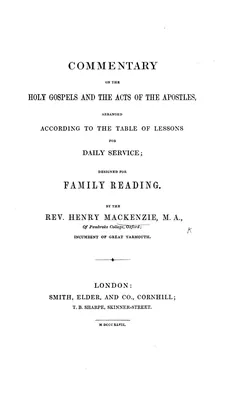
Commentary On the Holy Gospels and the Acts of the Apostles
Pages
This chapter is long, so it is split into 9 parts.
And this course of teaching, though intended specially for the Jew, was equally impressive when addressed to the Gentile. The Gospel was to be ^' preached to all the world, beginning at Jerusalem," and consequently the arguments by which the preaching of it was to be enforced, would be drawn from the ancient Scriptures in which the Jews believed. But this answered a double purpose; for while it proved the case to the family of Abraham, it proved also to the Gentile family, on the testimony of that whole race who were keepers of the oracles of God, that the coming of Jesus Christ was no new design or unexpected manifestation of a divine power; but the settled and eternal purpose, and previously revealed will, of the King of Kings and Lord of Lords, *Hhe Most Highest," JEHOVAH!
The consultation of the Sanhedrim, related in the chapter before us, exhibits a pitiful picture of the weakness of human strength, when arrayed against divine power. The very (190) April S^August 1] FAMILY READINGS. [December 4
prisoners under their judgment shewed themselves their superiors.
And when these were released, the source of their superiority was at once manifested in their conduct. It was because they were armed with the power of prayer!
How little is this vast engine applied to its right purpose by ourselves! How very few amongst us know the power we possess in our privilege of access by the Spirit to the Father, which, has been purchased for us by the passion of Christ! Let the answer of God to the prayer of the Apostles, in the renovation of the Holy Ghost which he vouchsafed to them, teach, us to whom to have recourse in the
time of tribulation, persecution, or infirmity; yea, and in the lesser trials of an every-day life, no less than in the severer afflictions of adversity. The same Lord over all is rich unto all that call upon him : and whatsoever we ask of Him in Christ's name, he will give it us.
Let the picture of faith, love, and charity, which is contained in the conclusion of the chapter, raise the standard of Christian Life amongst ourselves. The son of consolation stands forth a lasting witness against those who, professing to serve Christ, live merely to themselves. Our worldly sustenance is as much the gift of God as our means of grace. Let us strive to use them alike as instruments to the glory of the Giver!
April 8— August 7— December 4.
THE ACTS, Chap. 6.
We are so familiarised with falsehood in the world, that we are apt to look upon the awful punishment of Ananias and Sapphira as something harsh and extreme. We should rather look upon it as an unmerited mercy and (191) AprilB-^AuguMt7] FAMIIT READINGS. [December^
grace, if God keeps us in life and gives ns time and opportunity for repentance, if ever we are guilty of a lie. The Lord is a God of truth, and by Him actions are weighed. Christ revealed Himself as the way, the truth, and the life. Every thing that is false and unreal must be repugnant to the nature of God.
Moreover, we should bear in mind the circumstances of the case.
There was not merely an offender to be punished but an offence to be exposed, and its repetition to be prevented. They seem to have taken a very imperfect view of the case, who write of the punishment imposed on these wretched sinners as for a particular fraud, the repetition of which would have caused inconvenience in the Church.
It would seem to have been the introduction of falsehood at all into
the Christian system against which God, so to speak,protested: not against this particular form of fraud, which would have introduced worldly people into the visible communion of saints for gainfiil purposes. The wretched pair, who reaped the reward of their evil deeds, thought to deceive God as well as Men: and God vindicated His own omniscience by shewing to them and to the Church at large that all things were open and unconcealed with Him with whom they had to do. They had sold themselves to Satan for a portion of those goods with which God had entrusted them; and God, being not ignorant of his devices, exposed the collusion for the good of His Church, though to their discomfiture.
The rapid progress of the Gospel is again made known to us in this chapter. Multitudes of believers joined the Apostolic band, and the gifts of healing were widely diffused among the people at large. Does not this teach us not to be too exclusive in the distribution of the benefits God permits us to bestow? Though we are clearly bound to provide (192) April S^Atufust 7] FAMILY READINGS. [December 4
for our own, and to do good to them that are of the household of faith, we are still not to be unmindful of the wants of any ; and, so far as we can, we ai-e bound to relieve all who are in need. God sends His rain upon the just and upon the unjust: He giveth the heathen fruitful seasons, filling their hearts with food and gladness: He commended His love to us, in that, while we were yet sinners and enemies, Christ
died for us: and therefore, in recognition of our Father's universal love, we are bound to shew forth our adoption into His Sonship by a charity diffusive as His own.
The persecution that the Apostles suffered at the hands of the Sadducees is only what the record of their previous conduct will have prepared us to expect: and the mercy of God in miraculously delivering them from their imprisonment seems also naturally to flow from the love He bore to them as witnesses for His Son. Out of these circumstances, however, a most interesting history arose. The bold defence of Peter
—in which he recalled the principles that he had laid down in his previous address to them—and the angry and murderous counsel of the Sanhedrim thereon, led to the utterance of the manly, charitable, argumentative, and pious (though not yet Christian) speech of Gamaliel, through which, under God's providence, the Apostles were released from the danger that impended over them.
Their subsequent conduct gives us a lesson of persevering boldness in the cause of truth. Publicly and privately, they continued to raise their testimony in favour of Him, who was made unto them wisdom and righteousness and sanctification
and redemption Let us take home to ourselves the lesson thus held out for our guidance. Let us be ready and thankful, even as they, to suffer shame for Christ's sake; and never flinch from the honest declaration of our faith in Jesus as the promised Messias, our Saviour as well as the Saviour of the world!
April9-^Augu9tS] FAMILY READINGS. [Decembers April 9— August 8— December 5.
THE ACTS, Chap. 6.
As the infant church was rapidly expanding itself in form and vigour, the need of some larger machinery for its government and control became manifest. The distribution of the daily allowance to the widows and others dependent on the church; pressed heavily upon the Apostles, as well from the amount of labour it caused as from the hindrance it interposed to their preaching the Gospel. Accordingly, a new institution was introduced, grafted apparently from the Jewish on to the Christian stock. There belonged to every Synagogue three Deacons, to whom the charge and care of the poor belonged; and thus, in the earliest stage of Christianity, the order of the Diaconate was established as a part of the Christian ministry.
When, however, these had been ordained with prayer and imposition of hands from the Apostles, it would seem that they had greater gifts bestowed on them than such as would merely qualify them for overseers of the poor in their temporal concerns: for the sacred record immediately proceeds to state the rapid progress of the Word of God; and the signs and wonders wrought by the faith and power of Stephen, the most distinguished among the newly-ordained seven for the evangelical graces and precious gifts of the Spirit which he displayed.
In the persecution of this holy and devout man, which followed upon his usefulness in the service of Christ, we find a re-production not only of the spirit that dictated the crucifixion, but even of the very charges which were brought against the Lord. He had said prophetically, " If they have called the Master of the house Beelzebub, how (194) AprU 9—Avgu8t S] FAMILY READINGS. [December 5
much more shall they call them of His household;" and just as the accusation against Him was, that " He said He was able to destroy the Temple of God and build it in three days," so the accusation against His servant was, that he " ceased not to speak blasphemous words against the temple and the law, and to say that Jesus of Nazareth should destroy that place, and change the customs of Moses."
The spirit of persecution brooks neither explanation nor defence.
The fact that Christ came " not to destroy but to fulfil the law," could have been urged by Stephen with no more success than by his Master, against the stern bigots who had resolved upon his destruction. Injustice and hate marked their proceedings; and their failure in resisting the wisdom and the spirit by which he spake, only goaded them into more fierce determination to compass his death by any means, however base.
Mournfully but not despairingly must the disciples have recalled the prophetic words of their Lord, when the persecution arose about Stephen, as they watched its course and foresaw its termination: *' I will give you a mouth and wisdom which all your adversaries shall not be able to gainsay nor resist: and ye shall be betrayed— and some of you shall they cause to he put to death ! "
Would that, with the same calm and unwavering faith that Stephen and the early Martyrs evidenced, we could face the difficulties, trials,
and dangers with which our great enemy surrounds us! The obligation to exhibit christian principles is equally binding upon us as upon them, though mercifully we are not called in these days to resist unto blood. As, then, the records of their sufferings are written for our admonition, let us seek to apply to ourselves the lesson they were intended to convey !
April lO'-'AujfUMt 9] fABIILT READINGS. [December 6
April 10— August 9— December 6.
THE ACTS, Chap. 7, v. 1-29.
When we read the defence of St. Stephen, we should bear in mind the charge which was preferred against him. This was, first, that Jesus of Nazareth should destroy the Temple; and, secondly, that he should change the rites of Moses. It would certainly seem that he designed to admit this latter charge,and not improbably the former also; for he commences his defence by a recital of the leading events of Jewish history from the time of Abraham to that of Solomon. These show that several changes had taken place in the early dealings with God's chosen people. In the first place, Abraham and his descendants had been for four hundred years the elect of God, before the rites of Moses had been delivered at all, and this shews that the laws of Moses could not have been absolutely necessary to the salvation of the people of God. In the second, Moses himself had prophesied of a future lawgiver, to whom they were to hearken; implying that the rites he delivered were not to be of eternal duration. And in the third, by quoting their many rebellions, he proves the insufficiency of the law to retain them within the line of duty ; and this of itself supplies a moral argument of its insufficiency, and indicates at least the probability that the time would come, when a better and more perfect law would be promulgated.
The first suggestion that arises out of the consideration of Stephen's address, is the testimony which this inspired man bore to the verity of the Old Testament; the expression with which he commences his defence, " the God of glory," clearly disproves the accusation of
blasphemy, as it betokens his reverential respect for their common Father. His re-
(196)
April 10 — Avgu9t9'] FAMILY READINGS. [December 6
spectful recital of the Jews' early history, shows also his belief in those facts which were of common historical interest to the follower of Moses without Christ, and of Christ through Moses. His announcement of Abraham's faith sets forth an example of dependence on the promises of God, which could not have come from one who denied His providential government. His testimony to Moses as valorous, faithful, and just, could not have come from a detractor of that prophet. And thus to sum up all, while it seems probable that had he been permitted to complete his defence, he would have gone on to prove that Jesus of Nazareth would destroy that Temple in which they worshipped, and certainly would change the rites vrhich Moses delivered them, he completely vindicates hiinself from the first charge of those suborned against him, " that he spoke blasphemous words against Moses and against God ! "
Clear, uncompromising, and full of just reasoning, the defence we have been reading is the work of neither a sophist nor of an enthusiast. The wisdom and the spirit by which he spake, have been recorded for our instruction and offered for our acquirement.
Though not called as Stephen to defend ourselves before those who thirst for our blood, we have still in the midst of an unrighteous world to bear each our several testimony to the Truth of the Old Testament and the New, of Abraham and of Moses, as well as of Christ the Son of God : much may be done by each of us in our domestic circle and private walk of life, without either hypocrisy or ostentation : may we have grace to bear it as firmly and fearlessly as the illustrious proto-martyr in the cause of the gospel!
(197)
/
April 10— August 9— December 7.
THE ACTS, Chap. 7, v. 80 ad/n.
The spirit of truth is admirably contrasted with, that of bigotry in the portion of Scripture before us: the helpless defender stands in dignified simplicity before his unjust accusers, and proves the superiority of defenceless innocence over unrighteous power.
Before however entering upon the contemplation of Stephen's martyrdom, it may be proper to make a passing observation on the conclusion of his apology, for the purpose of explanation.
In recording the event of the exodus of Israel from Egjrpt, and its important consequences, St. Stephen alludes to the idolatries and misconduct of the church in the wilderness; and then speaks of the tabernacle of witness being ^^ brought in with Jesus** into Canaan, the land of the Gentiles. Now, when we find a few verses later that he speaks of seeing
" Jesus standing on the right-hand of God," we might be led to suppose that the same name signified the same person: but this would be a great error, and would lead to great confusion of ideas. The name Jesus, in the Greek, is the same with that of Joshua in the Hebrew, both signifying " a Saviour;" but the first Jesus spoken of in the scripture we are reading, was that Jesus, or Joshua, the deliverer who brought in the tabernacle from the wilderness into the
promised land; the second, was that Jesus, the Son of Man and the Son of God, the Saviour of St. Stephen, and our own!
We cannot be surprised that, under the influence of the Satanic spirit of persecution, the Jews should have been cut to the heart at the bold and uncompromising condemnation they received firom their victim; and when they heard the (198) AprUll — August 10] FAMILY READINGS. [December 8
holy aspiration of that devout man, on his witnessing the vision revealed to his faith, they would naturally, and in perfect accordance with their previous feelings, consider him guilty of the highest act of blasphemy. No wonder, then, that they should proceed to a tumultuary condemnation of the supposed sinner; and at once drag him to the place of execution, and stone him to death.
And while we learn a solemn lesson of patient endurance from the suffering, and of holy forgiveness from the prayer of the dying Stephen, we must not omit to observe also how signally that last prayer of his seems to have been blessed.
His closing petition was for his murderers, " Lord, lay not this sin to their charge! " The young man who stood by,
" consenting to his death," and " kept the raiment of them that slew him," was clearly, at least in intention, one of these : and when we find that the following year this same fiery spirit was subdued beneath the hallowing influence of the
Spirit of God marvellously shed upon him, may we not alike reasonably and faithfully trace a connexion between the prayer of the saint and the conversion of the sinner; and believe that the petition of St. Stephen was the seed that sprang up and bore j&uit in the faith of Saul ?
Should not such a reflection as this serve as a holy stimtdant to us, to increase in intercessory prayer for our enemies, as well as for our friends and for one another ?
April 11— August 10— Decembers.
THE ACTS, Chap. 8.
That is no singular instance which we read in the chapter before us, that God allows to unrighteousness a partial success, in order to bring about more securely its (199) Aprii U^Auguit 10} tAMlLT RBADIN68. [December 6
own diflcomfiture. When the persecutors of the christian faith had silenced one of its teachers by death, and dispersed the rest, they doubtless considered the great end of their persecution to be attained. But the tree of life was not so easily eradicated: wherever a slip of it was set, there it took root downward and bore fruit upward: and the effect of the persecution which dispersed the disciples was practically no less than an edict for the propagation of the gospel!
The success which blessed the teaching of Stephen in the first instance, and of his fellow-deacon Philip in the second, should teach us not to despise the most inferior ministrations in the church of God: but the fact of the Apostles at Jerusalem sending two of their own number to complete the good work which the latter had begun, seems to teach us also that that work was imperfect, without the
sanction and approval of those invested with the highest authority in the Church.
The lesson also to be learnt from the case of Simon is one of awful importance. From this, it would seem that a man may believe; that he may be struck with reverence and admiration at the works of God
; that he may be made a partaker of the covenant of Christ; that he may receive the teaching of an authorized ministry, yea and of Apostles themselves: and yet, notwithstanding all these things, he may be unto every good work reprobate, and have neither part nor lot with the true children of God.
This is a fearful fact to contemplate; and one that, if realized to the mind, should induce a stem self-examination in each one of us.
From the answer of St. Peter to Simon, the root of the evil under which he was labouring is laid bare to our apprehension: " Thou hast neither part nor lot in this matter," said the Apostle, "for thy heart is not right in the sight
(200)
AprilW — August 10] FAMILY READINGS. [December Q
of God : " and thus we are taught the solemn and instructive fact, that no external privilege, no visible blessing, is sufficient to ensure a lasting communion between the soul of man and its divine Author, unless a true conversion of the heart, a regeneration of the natural man, has taken place: for with the heart man must believe unto righteousness, before confession can be made with the mouth unto salvation!
But while the Christian mind contemplates with pain and
sorrow the lot of the reprobate Simon, and of those who are like him, it rests with refreshing satisfaction upon the case of the Ethiopian eunuch, and of those who, even as he did, earnestly and affectionately seek after a knowledge of the one true God. It would seem as though these two instances were placed in juxta-position in the holy scripture, to shew the value of a loving heart in the sight of God, as contrasted with the utter worthlessness of a carnal and self-conceited spirit. The mind and understanding of Simon had been enlightened, but this only increased his self-elevation, because his heart remained untouched. The mind and understanding of the Ethiopian treasurer were not yet enlightened; but because his heart was touched, he felt, as it were in the dark, after those great truths which his affections already to a large extent realized; and so God sent to his humble and sincere faith the revelation he so earnestly longed for, and made known to him, by the mouth of Philip, that holy Saviour of whom the Prophets did write, and sent him on his way rejoicing, to herald to his own country that great salvation, which God in mercy had made so precious to his own soul!
Here then we have a warning against a carnal belief and dead faith in the one case ; an encouragement to a warm and living feith in the other: may we have grace profitably to learn the lessons they convey ! (201)
AprU \2^AuguMi \]] FAMILY READINGS. [December 9
April 12— August 11— December 9.
THE ACTS, Chap. 9.
The character of St. Paul before his conversion appears to have been commonly estimated by a very erroneous standard. The natural distinction between the active persecutor and the sujSering saint, leads many of us to look upon the former part of his life as being just so sinful as the latter part was holy. But assuredly this is a wrong view of the case. Zeal, intended for God's service, was exhibited in the former as well as in the latter portion of his career: the real difference consisted in the one being the zeal of ignorance, the other, zeal which was according to knowledge. And this distinction teaches us a most useful practical lesson for our own guidance. When we act upon our own wisdom, and according to mere human reasoning, we are constantly liable to mistake the true relationships of life, and to fall into error; but when once the principle is established in our hearts that we do nothing except for God, and as in the sight of God,
—then the spirit that dwelleth in us keepeth us from evil, and invests us with the power of divine sympathy and the wisdom of divine knowledge.
The first great change of Saul in his conversion seems to have been the destruction of self-conceit, and the establishment of humility: like the patriarch Job, he could now say, ** I have heard of thee by the hearing of the ear, but now mine eye seeth thee: wherefore, I abhor myself and repent in dust and ashes.'*
The miraculous grace that mutually informed Saul and
Ananias of their mutual relationships in the sight of God, must have confirmed the faith of both in the guidance of that holy Spirit that quickened individual members, as well as illuminated and directed the whole body of the Church of (202) April \2 — August U] FAMILY READINGS. [December 9
Christ. And it may reasonably be doubted whether a less convincing proof of His power and of His love exists in each of our own cases, than that which was manifested in the conversion of Saul. Each who examines into his own spiritual history—which is the history of his true Life — will find that he, too, like the Apostle, has been called through grace out of the darkness and ignorance natural to man, to behold the glory of God revealed in the face of Christ Jesus !
Another important lesson that we learn from the chapter before us is, the immediate efiect produced on the-conduct by the conversion of the sinner. No sooner was Saul convinced of the truth of that faith which he once destroyed, than he became a bold and willing witness in its behalf. So should it be with us. If Christ be revealed to us as the Son of God, we must both confess Him with our lips and shew Him forth in our lives!
As the former part of this chapter is devoted to the history of the Apostle of the Gentiles, so is the latter to that of the Apostle of the Circumcision. The vigorous life that Christ had infused into His Church shewed itself forth in acts of mercy upon its covenanted partakers, as well as in attracting new members to partake of its power. The working of the Spirit was as eflfectual in bringing health to the body of Eneas, and life to the corpse of Dorcas, at the prayers of Peter, as it had been in imparting its hallowing influences to Saul beneath the hands of Ananias. In all alike, the Lord and giver of life was glorified: and when in these last days we read these records of His blessing upon the in£ant church, let us pray that we may be encouraged by more glorious manifestations of His presence amongst ourselves, that we may have the witness of that Spirit within us, that we are the children of God by faith which is in Christ Jesus!
(203)
April \3—A^r^ rs)
Aphil 13—AroDST 12— Dbcbmbek 10.
THE ACTS, Chap. 10.
This chapter opens to us a new volume in the history of the Christian Church. The prejudices which had hitherto obscured the perception of St. Peter were at once removed, and the veil which separated the Jew and the Gentile was rent in twain. The education and habits of this Apostle had made no preparation for such a revelation as that now vouchsafed, but inasmuch as they prevented his acceptance of the truth they rendered such a revelation necessary. All the details of the Law inwhich he had been educated taught him to consider his nation as a peculiar people, and to look on the Samaritans and Gentiles as unworthy to be admitted to its privileges ; and even though the compassion of His Lord had taught that the Roman centurion, when full of faith, was admissible to share Hia mercies, and that the Syro-Phoenician woman, who would not be refused, was allowed to eat of the children's crumbs: these special instances only
served to illustrate the condescension of Jesus, and he recognised therein no type of that overflowing love which sought the salvation of the whole world. Even the commission to preach the Gospel to all nations seems to have been absorbed in the direction to tarry at Jerusalem. And when the persecution after the death of Stephen sent the early Christians forth, they searched chiefly at least for the lost sheep of the house of Israel. The eunuch of Candace was probably, from his studying Isaiah, a proselyte of the gate; and certainly St.
Peter classed tile world with things unclean, and was as ready to imals forbidden, as to admit Romans into the covenant ist through the sacrament of Baptism.
(204)
April \3-^Avgiat K] FtHILT keadinos. [Dtctmbtr 10
The strength of his prejudice rendered it necesBary that his mind should he prepared for the duty for which God had designed him. He was accordingly favoured with a vision; and it is well worthy of our notice that, both in his case and in that of CorneHus, who was similarly favoured, the privilege is connected with the fact, that the man so visited was a man of prayer. As we draw nearer to God, and are more earnest to see Him and to know His will. He vouchsafes fuller revelations of Himself, and instructs us more completely in His ways.
The first great lesson then taught by this passage, is simply that which St. Peter himself declares that he perceived from it, tiz. that God is no respecter of persons. We are not to place limits to his mercy, nor to condemn others who have not had all the same privileges with us. The labourer of one hour may be equally faithful with those who have borne the labour and heat of the day, and it may he his misfortune and not his fault that he did not earlier enter the Lord's vineyard. At the same time, if God has revealed one means of salvation, one straight and narrow path, one way, saying, " no man cometh to the Father but by me," let not man imagine that, by working righteousness, he shall prove a Saviour to himself; or that he is fearing God, when he refuses to believe on Him whom He has sent.
The later portion of the chapter exhibits a nohle specimen of preaching Jesus Christ and Him crucified; and, in the subsequent conduct of the Apostle, magnifies the importance of Baptism, and exposes at least one not uncommon error of later times. The ordinary method of receiving Christians into the Church was not to be omitted, even though 't"-Spirit of God had manifested their especial call. It still the duty of these converts to fulfil all righteoui by receiving the Baptism of water at the hands of CI (205) appointed minister. It would seem then obvious from Scripture that they are in error who reject Baptism with water, under the idea that they are akeady baptized of the Spirit. In modern caises, we have no actual evidence of these that they are so baptized; whereas, in the case of the former, the extraordinary gift of tongues notified the fact to the astonished company who came with Peter. May we rather avail ourselves of the means which Christ appointed, and when we bring our children to the Baptismal Font, pray with believing hearts that they be also baptized with the Spirit.
^^^^^^^^'^^0*0^m^^^^^>^i^t0<i^*^»^^t^*0»i>^^^i^i>^*^
^^'*^%^^^^
April 14— ^August 13— December 11.
THE ACTS, Chap. 11.
The government of the Church seems to have been fixed at Jerusalem for at least some period after our blessed Lord's ascension. Seven or eight years had now passed away since that glorious event, when St. Peter had to defend before the Apostles and Elders his conduct in admitting Gentiles into covenant with Christ. A simple recital of the fads of the case proved a sufficient defence. God had spoken His will too plainly for man to gainsay it. They of the circumcision at Jerusalem, as well as the Apostle of the circumcision himself, were compelled to the conclusion, that God had granted repentance unto life to the despised Gentile no less than to themselves.
But notwithstanding this clear development of the will of the Spirit of God at Cesarea and Jerusalem, they that had been scattered abroad upon the persecution that arose about Stephen preached only to the Jews: the Grecians, to whom the men of Cyprus and Cyrene spoke the word of the Lord, would seem to have been Jews, or at least Jewish proselytes,
(206)
Aprill4—Avgu8i IS] FAMILY KEADINOS. [December U
who spoke the Greek language. The same idea was in the mind of these disciples that, until he was better taught, had occupied the mind of Peter. All alike preached the gospel, "beginning at Jerusalem," viz. to the Jews only. But though the grace of God made Israel the channel that was to conduct the fulfilment of His promises to the world at large, those promises were now no longer to be limited to the favoured but rebellious family of Jacob.
The fact of the men of Cyprus and Cyrene preaching to the Hellenistic Jews in their own language, was a carrying out of the idea of the gift of tongues. It extended the knowledge of Christ, and Him crucified, through the ever-ramifying medium of language; and though the word was preached to Jews and Jewish proselytes, yet doubtless it would through them be extended to those classes of Gentiles among whom they mixed, and from whom their proselytes had been made. The privileges of citizenship which tjie Jews possessed at Antioch would doubtless have much facilitated the progress of Christianity in that city. It is probable that the Christians were regarded merely as a sect of the Jews, and therefore would be suffered to celebrate their worship without hindrance or molestation.
The prejudices of the heathen were chiefly excited against the Christians on account of the absence among them of any symbol of Deity; but the cry of the persecuting Gentile, which afterwards became so popular, " away with the godless," would fall at first with comparatively feeble eflfect. upon the men of Antioch, who had been familiarized by their Jewish fellow-citizens with the fact of men professing a religion, and yet having no statue or idol to show as the object of their worship.
Here then, in this celebrated city, it was that Barnabas and Saul wrought together the work of the gospel, when (207) the disciples were first called Christians^ and shewed forth the fruits of their faith in their works of charity, displayed toward their famine-stricken brethren in Judea.
May the truth and firmness of our faith be shewn forth, like theirs, in the glorious fruits of holiness, and peace, and charity!
April 15— August 14— December 12.
THE ACTS, Chap. 12.
In the opening of the commission of Salvation to mankind, we find a Herod seeking the destruction of the infant Saviour. Now that that commission was being heralded abroad, we find the most potent successor of the same family and name exercising his regal power to scourge the infant Church.
In the murder of James the great, the son of Zebedee, we read the fulfilment of one of the Lord's particular prophecies to him as an individual, who foretold that he should drink of his Master's cup. In the delivery of Peter from his expected death, we find the fulfilment of a general prophecy to the Church at large, when He said, "
whatsoever ye shall ask of the Father in my name, He will give it you."
Nor should we omit to observe the providence of God in aflfording the opportunity of prayer to the Church, as well as His power and grace in answering it when oflfered. James appears to have been seized, and at once put to death; while Peter was imprisoned and reserved for future trial: and thus ^ the opportunity for the 'Sprayers without ceasing of the Church " was afforded in the one case which was not in the other.
The way in which the Christian family availed of this opportunity should teach us the Church's duty in the time of
(208)
f April IS—Auguit 14] FAMILY RBADIN08* [Deemiihtr lit trial. The prayer of the afflicted is more powerfiil than the sword of the persecutor, and if we humble ourselves under the mighty hand of God, He will exalt us in due time.
In the miraculous restoration of Peter to the afflicted Church, we see a beautiful illustration of the Psalmist's words —*' Heaviness may endure for a night, but joy cometh in the morning." But not only this: we see also how powerful with God is the intercession of the Saints, even beyond the expectation of the Saints themselves. When he was restored, they could not believe the testimony which assured them that their prayers were answered! They doubted the possibility of the very fact for which they had been engaged in such a strife of prayer!
Does not this teach us how faithless are the most faithful hearts amongst us ? How earnestly should we join in the prayer of the disciples, *' Lord, increase our Faith."
In the passing reference to James the Less, in r. 17, we tave the earliest indication of the dignity to which this near kinsman of our Lord was elevated as President of the Apostles and Elders of the Church at Jerusalem: look we forward but to the fifteenth chapter, and we shall find him exercising that dignity by giving an authoritative sentence, after having collected the different opinions of his brethren.
At the close of the chapter we find two great lessons taught us. The first of these is the judgment of God upon impiety and arrogance, as manifested in the death of Herod Agrippa. He whose angels encamp around the dwellings of the just for their preservation, has also His ministering Spirits as a flame of fire to bring swift destruction upon the wicked. The second is, that the time of persecution is oftentimes a period of greater triumph to the Church than that of peace. And if we needed an illustration of this fact, we have only to look to this age of luxury and self-indulgence, and see how lamentably short of her high destinies the Church of our land (209) »
April Xe-^Auffutt 15] FAMILY READINGS. IDeemberl^^
fdHs, because an age of ease is a sorer temptation and snare to her than one of trial and of death. It may be that, as we have failed to fulfil our responsibilities under wealth and prosperity, God may send more searching and trying times upon us. May we be ready to meet them in His strength, should they come; and, like the holy Paul, be prepared to count all things but loss for the excellency of the knowledge of Christ Jesus our Lord.
April 16— August 15— December 13.
THE ACTS, Chap. IS.
A MARKED change occurs here in the History of the Acts of the Apostles, whereby the revelation of the Lord to Ananias (see ch. ix. v.
15) was to be fulfilled. The church appears now developed in her corporate form, and exercising, under the influence of the Holy Ghost, the powers of a Corporation in sending out Missionaries for the propa^tion of the Gospel among the Heathen. But a solemn lesson is herein read to such as woidd ascribe to the Church any power apart &om the indwelling Spirit that animates it. The Revelation is repeated ailer the Church had sent forth Barnabas and Saul, that it was "by the Holy Ghost" that they were sent forth: and hence we should bear in mind, that though the Holy Ghost may, through His Divine Power, act without the Church, yet that the Church cannot act without the Holy Ghost.
The conversion of Sergius Faulus (in commemoration of which some suppose Saul to have now changed his name to Paul) and the punishment of Elymas, are striking instances of the Grace and the Power of God : but perhaps they may serve also as an illustration of the freedom of will permitted to man, when his eyes are opened, under the revelation of (210)
Christ, to know good and evil. The Roman Governor accepted the proffered grace, and was converted: the Sgrcercr resisted and repelled it, and thus sowing to the flesh reaped corruption. May the recital of these instances teach us to avail ourselves more faithfully of the means and opportunities of grace placed within our own reach!
In the sermon of St. Paul to the Jews and Proselytes at Antiocli, he first briefly recites the history and prophecy down to the time of David, with which his auditory were acquainted; and then proceeds to apply them authoritatively to the person of Jesus as the promised Christ. He then adduces present and prophetic testimonies to the doctrine of the resurrection, and exhorts his hearers to receive, under a solemn sense of the responsibility of rejecting him, that only Saviour who had power to justify sinful man.
The effect of this sermon seems to have been very great upon all who heard it, whether Jews or Gentiles. The arguments used by the Apostle had indeed applied to the former rather than.the latter; but the promise of forgiveness of sins to all that believe seems to have sunk deep into the heart of the Gentiles, who glorified the word of the Lord and received the good tidings gladly.
Jealousy between the two races seems to have been one of the main causes of the confirmed prejudice of the Jew; and thus their own evil heart of unbelief hastened the fulfilment of the prophecy recorded against them, that Japhet (the Gentile race) should be enlarged and dwell in the tents of Shem: for by the Jews, the descendants of Shem, putting the word of God from them, the family of the Gentiles received it, and all the glorious privileges by which it was accompanied.
Let us reflect with gratitude upon the wondrous way in which their fall became the riches of the world, and their (211) p2
Apra n^Auyust 16] FAMILY READINGS. [Deemher H
diminishing^ the riches of us, the Gentiles: and if some of the branches of that old stock be broken off, and we graffed in their place, let us not boast against the branches. We bear not the root, but
the root us: and it better befits our condition to pray for the promised restoration of Israel and the wondrous spiritual Resurrection (see Romans xi. 15) that shall accompany it, than to pride ourselves upon those privileges, which, through their fall, have been showered abundantly upon us.
0^^^^^»<»^KX»^<^^»^^^^M^^^>*^»^>i%^^*^M*<»rfM*^*
<»» I
April 17— August 16— December 14.
THE ACTS, Chap. 14.
Notwithstanding the success that attended the disciples at Iconium, opposition and persecution were soon raised against them. The cross is heavier than the world can bear. When its preaching becomes a savour of death unto death, it always excites the violence of those against whose sins it is the testimony. Persecution itself however is made, under God's Providence, a subordinate minister to His Truth: for wherever it drives His Heralds, it also spreads a knowledge of His
"Word. Thus, when the disciples were driven from Iconium, Lystra and Derbe received the divine tidings they were commissioned to bear : the lame was made to leap as an hart beneath the power of healing they possessed, and tongues that had hitherto been dumb to God now gratefully sang His praises.
In the protest against the false worship of the ignorant Lycaonians, we are led to observe the caution with which the Apostles delivered their commission to the Heathen. The power of creation and preservation, the oeconomy of government, and the goodness of Providence, are the points brought (212)
forward for the consideration of those who had hitherto received no revelation of the divine natuie and attributes. It is as though they would lead the minds of men to contemplate the being, the benevolence, and the unity of God as the Creator, before they led them on to the knowledge of the more specific relationship that existed between them and Him as their Redeemer and Sanctifier.
The persecution and trials they endured in preaching the Gospel, well prepared them for the duty of confirming the souls of the disciples, and for exhorting them to continue in the faith, and for practically teaching them that they must through much tribulation enter into the kingdom of God. The vanguard of the faithful, they bore the brunt of the battle. They exhorted others to suflfer and to dare nothing more than they had suffered and had dared themselves.
Alas ! how poor and weak does the easy service of the modern disciple appear, when compared with the hard duty of his fathers in the faith! And yet, though in zeal, and energy, and perseverance, and self-devotion, amid external persecution, we are all immeasurably inferior to them, the service of modern days is not so easy as it may seem on a first view. The world, the flesh, and the devil, are as active with us, though in a diflFerent way, as with them. We, like them, must through much tribulation enter into the kingdom of God : and though the tumult and the stoning affiight us not with the show of violence, we have sufficient ground of active spiritual warfare in the temptations of Satan that would allure us from without, and the rebel will that lusteth against the Spirit, which would betray us from within.
We are again reminded of the corporate character of the Church, by the care which the Apostles Barnabas and Paul took to extend its form and government. They did not leave the new disciples without order or controul, or to any uncertain teaching (213)
April \8^August }7] f\milt READINGS. [December 15
or mutual instruction which might arise among themselyes. They ordained Elders (the word in the original is Presbyters, whence our ministerial title of Priest is derived) in every church, and solemnly commended them to the Lord Jesus, the Church's Head, with prayer and fasting. Thus, when they planted the Gospel, they established also a form and polity in which its truths should be enshrined, and through whose instrumentality its blessings should be yet more widely extended.
April 18— August 17— December 15.
THE ACTS, Chap. 15.
The harmony of the brethren at Antioch was disturbed by the second controversy that agitated the Christian church. The first had apparently been settled by St. Peter's testimony, which satisfied the Hebrew-Christians that God had granted to the Gentiles repentance unto life. But now a second question arose, not unnaturally, out of the ashes of the first. Satisfied as they were that the Gentiles were made capable of Salvation, the Jews for the most part considered that this Salvation could only be conveyed through the channel of their own ordinances, and that the Gospel was inefEcacious, except to those who received it through the rites of the Law.
So important was this controversy deemed, that the Apostolic governors of the Church at Antioch, with others, went up to hold conference with the heads of the Mother-Church at Jerusalem: and it is observable that, after the preliminary meeting recorded in v.v. 4, 5, when they were assembled in council, it was mainly by the arguments of the Apostle of the Circumcision that the doctrine of the necessity
for circumcision was overthrown ! (214)
AprU lB^Avgu$t 17] FAMILY READINGS. [December \o After tW address of St. Peter, whose natural predilections, as exhibited both before and after, would certainly have led him to adopt the other side of the question, we must imagine the effect of what he said to have been greatly heightened by the corroboration of Barnabas and Paul, who then declared what miracles and wonders God had wrought among the Gentiles by themselves !
The business of this first council was brought to a conclusion by the judicial decision of St. James, the presiding Apostle, in accordance with whose sentence the whole church •wrote that consolatory letter with which Paul and Barnabas, Judas and SUas, were entrusted, and which remains to this day a memorial of the wisdom and spirit by
which the Apostles spake. Freed jGrom the heavy load of ritual observance, which the Pharisees would fain have imposed on them, the Gentiles now were bound only to cultivate abstinence from those things which would have offended the just religious prejudices of the Jews on the one hand, or encouraged the sensual and idolatrous practises of the Heathen on the other. May those who are interested in the controversies of the later Christian times be equally guided by a spirit of moderation and gentleness!
The conclusion of the chapter is of a painful character. It reads us a solemn lesson of the imperfection that clings to the best and holiest of the human race. The Apostle of the Gentiles, in his sharp contention with Barnabas, seems to have formed his judgment somewhat too hastily in consequence of John-Mark's having deserted them in their former journey, but Barnabas knew his character better, and, excusing his former weakness, resolved on giving him a second trial. We are grieved to notice any contention between these holy men: yet even out of this root of bitterness, God raised
some fruit to His own glory and His Church's benefit. The (215) A}frU l9^Auifu$t IB] FAMILY RBABlMat. [i>iOMi6ir 16
truth of the Gospel was henceforward difiused through two '
channels instead of one : Paul himself preached not the less^ but Barnabas preached the more; and that too in a new direction.
But we are not to suppose that the quarrel of these good men was irreconcilable. The cause of it^ the once-wayering but subsequently consistent Mark, is thrice afterwards mentioned in terls of brotherhood (and once with direct commendation) by St. Paul in the Holy Scriptures : and we cannot conceive^ consistently with our knowledge of their christian character^ that when his fidelity as a servant of Christ was establishedi personal disagreement between the illustrious Apostles could have any longer continued.
The record of the dissension has however been left for our learning.
May we be warned by it to avoid all appearance of evil—^to eschew
the vacillation of John-Mark—^the apparently over-partial affection of Barnabas—the severity of Paul —and the spirit of opposition displayed by both the latter: and may we strive more earnestly henceforward to keep the uoitj of the Spirit in the bond of peace !
April 19— August 18— December 16.
THE ACTS, Chap. 16.
Thk travels recorded in this chapter were of great importance to the Church. Here first we read of the youthful Timothy, whom the careful domestic training of his female relatives had so well prepared for his subsequent call to the ministry: to him were two of St. Paul's epistles addressed in after years. Here we find the Apostle of the Gentiles passing through Galatia, to the converts of which region he subsequently addressed one of his most interesting and instructive epistles. Here too we find, from the change