
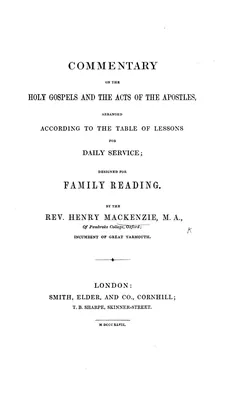
Commentary On the Holy Gospels and the Acts of the Apostles
Pages
This chapter is long, so it is split into 9 parts.
Since then, by the atonement of the cross, the vail that screened us from the view of God has been rent in twain, even from the top to the bottom, so that we have access even to the Holy of Holies through faith therein, let us take a lesson from the rich man of Arimathea, and boldly assume the reproach of that cross, and publicly declare ourselves disciples of Jesus. Let not the sneer of the worldly, nor the revilings of the unbeliever, retard us from the performance of that which is our highest privilege as well as our co* Tenanted duty. Let us sorrow with him over the crucifixion of our Master, and like Him we shall be gladdened with the joyfril assurance of that Master's blessed resurrection.
A^lrf«^^««MM^^«^^^fW^K«^>M^^^>«A^^^«^i^A^^M«MM
February 16— June 16— October 13.
ST. MAEK, Chap. 16.
What a Sabbath must that have been which was passed by the mother of Jesus at the house of the beloved disciple, and by the other Marys, Salome, and Joanna, in tears of mournful sympathy! We
cannot but admire their strict obedience in the observation of the Sabbath that kept them from (82)
performing the pious ceremonies for which they were prepared until the following morning; and yet herein we may trace the wisdom of God^ inasmuch as thus it was^ that the human tabernacle of Christ was preserved from enduring that pollution which attaches to corruptible flesh in the last funereal rites.
This early visit of the pious mourners had moreover a farther eflfect of a somewhat important character^ for it was the means of giving intimation of the Besurrection almost as soon as it had taken place.
The vision that met the wondering gaze of the afflicted mourners at the sepulchre was indeed sufficient to bring trembling and amazement upon them, but the tidings given them to convey to " His disciples and Peter " are calculated to teach a lesson to us as well as to them. These words bring to us a sense of Christ's forgiveness to the disciple who denied Him; and while as a gentle rebuke they seemed to upbraid his want of feith, as a special message they convey to him the assurance, that unworthy as he was of his Master, that Master still bore him in affectionate remembrance.
So satisfied were the disciples of the termination of the course of their Lord, that it seems they neither believed the * testimony of the women who had seen the angelic messenger, nor of Cleopas and a fellow disciple who had broken bread with the risen Saviour at Emmaus. What a lesson does this teach of the danger of scepticism in the present day; if the refusal of the testimony of these five or six witnesses was sufficient to bring down the rebuke of the Lord upon the eleven who had seen Him die, how much sorer must the rebuke fall upon those who, " compassed about with the great cloud of witnesses" that bear testimony to His revelation, still turn a deaf ear to the preaching of Jesus and the resurrection.
(83) G 2
F<4. IS—y-w I6J »AII1LT BBADINQB. [Oefoier IS
The commission to teach all nadons is recorded in this cloeing chapter of St Mark's Gospel. May we have grace to feel that it is one of those portions written afore-Ume for our learaing; and while under the teaching of Christ's spirit, we, baptised and believing, receive tlianliiully the assurance of salvation i may we be taught likewise to strain every endeavour to fulfil the Lord's purpose in the former part of the commission, that the Gospel may be preached abroad to every creature. The word that has come nigh to us, even in oui mouth and in our heart, we are bound to speak in the ears of others; and each of U8, in his appointed station in God's Church, is bound to shine forth as a light to the world, holding forth the Word of life.
KND OF THE OOHUKHTAKT
GOSPEL ACCORDING TO ST. HARK.
COMMENTARY
ON TBI
GOSPEL ACCORDING TO ST. LUKE,
February 17— June 17— October 14.
ST. LUKE, Chap. I. (v.v. 1 to 38 inclusive.) A STRIKING testimony to the necessity of a written word is advanced by St. Luke in the opening of this Gospel: when he states to Theophilus that his object is to make known the certainty of matters previously taught, we are instructed by implication that the oral teaching of the Church would have been insufficient to evangelize the world, had not the supplementary aid of the New Testament been vouchsafed as a perpetual and irreversible text-book of reference and standard of doctrine.
It is worthy of remark, that each of the Evangelists introduces us to the knowledge of the Lord Jesus Christ through a diflFerent channel.
St. Matthew commences his Gospel by tracing the descent of the Saviour from the Patriarchs: St. Mark, by showing the
announcement of His forerunner by the Prophets; St. Luke, by exhibiting a similar connection with the law of Moses. Thus He, of whom Moses in the law and the prophets did write, and who was Himself promised to the Patriarchs, is introduced to us (85)
Feb. n^Junt \7] FAMILY READINGS. [Odobor U
severally by His inspired historians in connection with each of thescj so that Jew^ Samaritan, and Gentile should each have a testimony to the Messiahship of Jesus of the character which most he needed: a striking and harmonious consent, calculated by its variety in unity to bring conviction to every searcher after truth!
The angelic announcement to the &ther of the Baptist is not noticed in the writings of the Evangelists Matthew and Mark. It is especially interesting as the record of God's earliest visible intervention in the service of the temple after the withdrawal of the spirit of prophecy, which had not been exercised for more than four hundred years previously; and must have re-kindled hopes of the Divine Blessing, and of a renewal of the Divine Presence, in Zacharias and the faithftd worshippers among whom he ministered, which had long lain dormant Though the faithful could not have doubted the promises of God, yet the long-delayed coming of the Messiah must have made them ill-disposed to expect His appearance in their own day ; just as we find that the flood found the then-inhabitants of the world unprepared for the foretold event that had been delayed, and as it is prophesied that it shall be with the world at the Second Coming of the Son of Man!
But hopeftil as was the Mission of Grabriel to Zacharias, far more so was that gracious Annunciation, still devoutly recognized by the Church in her services as a cause of gratitude, which the same Angelic Being bore to the espoused Virgin, the highly-favoured Mary.
The promise, in the faith of which Abraham, Isaac^ and Jacob had lived and died, was now to be fulfilled: the fulness of time had come: God was about to bring a clean thing out of an unclean: that Holy
Thing which was to be called the Son of God was now an-(86) nounced as about to be mysteriously and miraculously made fleshy and to dwell on the earth among men!
How shall we sufficiently admire the mystery whereby mercy and truth were thus made to meet together? The perfect obedience that the justice of the law demanded, the mercy of the Law-giver provided. The pure atonement for sin which was required to blot out the hand-writing of ordinances which recorded a broken covenant, was provided by One who, being conceived and bom under the special influence of the Spirit of sanctification, never knew sin, except as " being made sin," that is, becoming a sin-offering, for the race He redeemed by His blood I Wonderful, and gracious as won-derftd, was this holy work of God! Let its marvellous goodness sink deep into our hearts; and when we read the record that the Holy Child Jesus was so named ^' because He should save His people from their sins," let us adopt and apply to ourselves in heartfelt gratitude the language of the pious Virgin, " Behold the servants of the Lord—be it unto us according to Thy word! "
February 18— June 17— October 16.
ST. LUKE, Chap, 1. (v,v. 39 to the end.)
The annunciation to the Virgin Mary containing as it did an allusion to her cousin Elizabeth, who had hidden herself for the previous five months, would seem to have brought her with haste into the hill country, to learn if those things were true which had been told her.
One part of Revelation was thus tested by another: an example that leads us to study Holy Scripture as its own interpreter in the
(87)
present day^ ''comparing spiritual things with spiritual/' even as the Blessed Virgin satisfied her own mind of the truth of the annunciation made to herself by examining into that which was already capable of demonstration.
The corroboration she needed must have been more than provided^
when the salutation she offered was responded to by the glad greeting of Elizabeth^ who hailed her as " the mother of her Lord "—
a wondrous address, and in itself a fresh testimony to the reality of the beatific vision which had been vouchsafed to her!
The song of thanksgiving uttered by the Virgin on this occasion has been preserved in the daily services of our Church as a perpetual expression of thankfulness for God's fulfilment of His recorded promises, and for the gift of the Gospel—^whose opening lesson is, ''
Blessed are the poor in spirit, for theirs is the kingdom of Heaven."
In the account of the birth of the Baptist is recorded an exact fulfilment of the sign of Gabriel, who had foretold to his father Zacharias that he should be dumb, and not able to speak '' until the day that all the things prophesied should be performed."
Accordingly, when the Virgin had left them, and Elizabeth had brought forth the promised herald of the Lord, and the period for giving him a name had arrived, the speech of the dumb man was miraculously restored to enable him to praise the God who had bestowed such mercies upon him. No wonder that the people marvelled, and laid up in their hearts the remembrance of what had taken place, and inquired among themselves, ''What manner of child shall this be?"
To this inquiry the inspired Priest gave in some sort an answer when, filled with the Holy Ghost, he prophesied of the future. Equally with his wife Elizabeth, he recognized
(88)
the Blessed Virgin as the mother of the unborn Messiah. He announced that the promise given to their father Abraham nineteen hundred years before^ that in his seed all the nations of the earth were to be blessed^ was now to be fulfilled; and declared in glowing language^ that the infant before them was to be the forerunner of that high Mission that was to bring light out of darkness^ and reveal rest and peace to the feet of the wanderer.
This marvellous series of events, now first recorded by St. Luke, is calculated to impress the mind with a sense of God's wondrous care for His people, and of the minuteness of His providential dealings with His creatures. A heathen ^oidd write that the deity cared for the greater concerns of life, but left the lesser to themselves: the christian is herein taught that the domestic matters of a private family, no less than the regulation of an empire's destinies, are objects of the watchful government and providential interference of the God and Father of us all.
February 19— June 18— October 16.
ST. LTJKE, Chap. 2.
The way in which the will of man is made to subserve the purpose of GrOD is very strikingly evidenced in the circumstances attendant on the birth of Christ. The residence of the Virgin mother was at Nazareth of Galilee, in the northern part of the Holy Land. The edict of the Roman governor set the population of the whole Jewish province in motion, and brought her, with the husband to whom she was espoused, to Bethlehem of Judaea in the South; the native place of her family, and therefore the proper place for her (89)
taxing or enrolment. Thus the City that was '* little among the thousands of Judah'* sent forth the fiitare ''Buler of Israel^ whose goings forth were from of old, from eyerlasting;" and no sooner had she with travail brought forth, according to ancient prophecy, than angelic messengers brought the good tidings to watching shepherds,
who were thus established as the earliest witnesses to the glories of the infant Christ.
The circumcision of the infant Saviour is not mentioned by either St.
Matthew or St. Mark: and in the performance of this rite we find a farther connection between St. Luke's preaching of Christ and the law of Moses, which has been already noticed as existing. This fulfilment of the covenant of adoption in Him who was already a Son by eternal generation, should teach us not to despise those external observances which have been enjoined upon us by competent authority, because we do not see the use of them. Mary and Joseph, who had already had such wonderful attestation to the power and dignity of the mysterious infant, might well— if any might—^have urged that ritual obedience was needless for Him: and if He thought it becoming that He should fulfil all righteousness, it surely holds out a holy pattern of obedience, that those of '*the one forgiven family"
who are named after Him ought devotedly to follow.
May we not also trace in the joyous testimony of Simeon and Anna a sign of the favour of Gob upon the faithful fulfilment of enjoined ordinances? Apart from the greater question of Christ's perfect obedience to the law of Moses, it is clear, that if He had not been brought for presentation in the temple at the appointed time, these appointed testimonies would not have been raised to Him: for it is specially stated of Simeon, that He came ** by the Spirit" into the Temple, and of Anna that she came in *^ in that instant;" thus showing how the grace of God gathers, as it were, round the ordi-
(90)
nances of His own appointment^ and teaching to all who wUl receive it, that tKey who fulfil in faith what He has enjoined, YnH assuredly meet with a blessing manifested on their obedience.
The fortieth verse of this chapter contains an extraordinary condensation of doctrine as to the person of Christ: *^ Growth"
proves His bodily increase according to the laws that govern the human frame; " strength of spirit" (not of The Spirit) his accession of life, and vigour of character; ^^ fulness of wisdom" the enlargement
of mental power:—"The Grace of God" (the only time the expression is used in the Gospels,) the eminent witness of the Holy Spirit which was given to Him without measure.
Our Lord's visit to the Temple, when He stayed behind His parents in Jerusalem, was probably for the purpose of beinff made a Son of the Precept;—a rite in the Jewish Church analogoustothatofconfirraation intheChristianChurch. His reply to His mother upon this occasion, "
Wist ye not that I must be about my Father's business?" seems to have had reference both to His divine and human nature: in the former sense, signifying His desire of sanctioning by example a necessary duty; in the latter, conveying a mild reproof to Joseph, as it should have been the care of the parent, and not of the child, to see that this duty was duly performed.
In the closing verses of the chapter, we have Christ set before us in our families, specially as an example to youth; a pattern indeed of filial obedience, but remembering that the highest filial devotion was due to the unseen Father.—Let the younger members of our families be actuated by this principle, and we shall find them, like their great Example, increasing in wisdom as in stature, and in favour with God as well as with man! (91)
February 20— June 19— October 17.
ST. LUKE, Chap. S.
The teaching of the Holy Baptist, who came to prepare the way of Christ on earth, is more folly given by St. Liike than by any other of the Evangelists. This teaching was essentially practical in its character. He first roused the people to a sense of their danger, and when He hkd awakened a desire of improvement, taught them in
their respective classes what they were to do. His first instruction to the people at large was a warning against selfishness. This warning, calculated doubtless for the benefit of all ages, was never more needed to be impressed upon men's minds than in the present: an age of luxury heaps superfluities around the wealthy, and cultivates a tone of selfish indulgence even among those who walk in inferior stations of life. The ten-dency of this is manifestly hurtfol to the simplicity of the Christian character: and he who came to herald the way of the self-denying Redeemer, struck a fatal blow at the principle of accumulating superfluities, when he bade the multitudes divide that which they possessed among such as were in need: '^ he that hath two coats let him impart to him that hath none; and he that hath meat let him do likewise.''
A peculiar feature in the Baptist's teaching is its accurate fitness for the persons to whom it was addressed. The native publicans, who farmed the taxes from their Roman masters, were, as a class, unjust and extortionate; and on them consequently the forerunner of Jesus imposes the lesson of justice and moderation. The soldiers of that day, who were neither
paid nor clad as the military of the present age, were much (92) given to violence, oppression^ and discontent: on them consequently he enjoins the duties of gentleness, probity, and order. It is no wonder that a teacher so gifted and so successftd should have excited among many the idea that he might have been the promised Messiah himself: but when questioned on this point, John made it an occasion for bearing awful testimony to the dignity and power of the coming Redeemer. Did we but bear his testimony in mind, and remember that when the triumphant Jesus purges His floor the wheat alone will be gathered into His gamer, but the chaff burned up with never-ending flame, how much more careful should we be to do those " good works meet for repentance " to which John exhorted, and which Christ Himself subsequently enjoined! Did we but more really feel the prayer that we constantly offer^ that His Kingdom may come, and remember that at that coming the final separation of the wheat and the chaff must take place, we should assuredly be
more watchful than we now are in walking worthy of the vocation wherewith we are called I
The faithful preacher in public was also we learn equally faithful in his private ministrations: he who taught virtue to the multitude at large would not refrain his voice when he found vice needing rebuke in the private dwelling. For this boldness he endured immediate imprisonment and subsequent violent death: and he who spent his life in striving to " turn the hearts of the disobedient to the wisdom of the just," was content to close it beneath the hand of the executioner, and by a bloody grave to win the martyr's crown.
^^I^>^»^^*^^»^»^t^»^*^^^^^*^»^t0^f^^^^0%^^^^0^^0^^
t0^^^t0^^^^k
(93)
/•e6. 21—J«IM? 20] FAMILY READINGS. [October IS
Fkbruary 21— June 20— October 18.
ST. LUKE, Chap. 4.
It is one of our great comforts in looking up to Christ as our Lord and Saviour, to feel that we have not an High Priest which cannot be touched with our infirmities, but one who was in all points tempted like as we are. A sympathy is thus established between the Head and the members which could not have been felt, had we to bow before the unapproachable God apart from the Manhood which is common to both of us. This chapter sets forth the endurance of the Son, who learned obedience by the things that He suffered, as a glorious pattern for His brethren to follow. The flesh, the world, and the devil assailed Him as well as us. Self-denial, obedience, and the testimony of the written word, enabled Him to resist them all. Will not the same weapons, aided by the Spirit of Grace, equally stand us in good stead during the same conflict ?
Notwithstanding the eloquence and power which our Lord displayed in the towns of Galilee, and that even the testimony of His admirers was echoed by those who heard the gracious words which proceeded
out of His mouth at Nazareth, there was a manifest unwillingness on the part of His own townspeople to receive instniction from one whom they had been accustomed to regard as occupying an inferior station in society. The acceptable year of the Lord, the true jubilee, was not received with gratitude by those to whom it was preached.
The implied rebuke, contained in the reference of Jesus to the Sidonian and Syrian, converted their hesitation into anger and opposition.
Perhaps this reference requires some explanation. Our Lord meant to show to His hearers, that their hardness of (94) Feb. 21—June 20] FAMILY READINGS. [October IQ
heart would lead to their rejection and the substitution of others in their place: that even as the widow of Sarepta was selected in the days of Elijah, and the leper of Syria in the days of his successor, so should strangers and foreigners receive those favours from God, of which they, by their wilful rejection of Him, proved themselves unworthy.
After our Lord escaped safely from the wrath of the Nazarenes we find Him again exhibiting miraculous power at Capernaum. The miracle here recorded of casting out the unclean spirit, was in fact the third which Galilee had experienced at his hands: for both the converting the water into wine, and the healing of the nobleman's son, had taken place prior to that recorded in the present chapter.
His fame arising from these circumstances is alluded to in the twenty-third verse; but that fame must have been vastly increased when the many gifts of healing were dispensed, which axe described in the conclusion of the chapter.
May we not learn from the healing of Peter's wife's mother, to admire the affectionate care with which Christ watches over personal and domestic suffering, and with which He regards the social and domestic relationships of Ufe. Should not such miracles of mercy as these bind us closer in the bonds of personal affection to Him, who is
not less the guardian and the friend of our social life^ than the Bedeemer and the Saviour of our undying sovl ?
J i _ruTJT-njTj~ij'Tj'xr'tJ~ii~<<"> <"■"■"
■"■"■~i*v*""'""""'""^'"^^* * ^** *^*
(95)
Ftb. ga-^iat 3}] FAMILY RKADINoa. {OtHaber 19
Pbbruabt 22— ivsK 21— October 19. ST. LUKE, Chap. 5.
Thb simple mode of our Lord's teaching seems to indicate the class for vhom His instruction was generally intended. Had His especial miBsion been addressed to the noble and the dignified, it does not seem probable that He would have chosen the labourers of Tiberias for His auditory, or the deck of a fishing-vessel for His pulpit: but thus it was, that the intention of the Father was to be fulfilled, that "
the poor should have the Gospel preached unto them;" and that these, the weak of the world, should by their moral power overthrow the things that were mighty.
The proof of Christ's miraculous power seems suddenly to have wrought in the mind of Peter a conviction of his own unworthiness.
Such a phenomenon is not uncommon in the present day. The mind first awakened to a sense of God's omnipotence is apt to shrink back in fear when it contemplates the contrast of its own littleness: and highly blessed is such contemplation to the eoul of each who is thus led to feel in earnest that conviction of siniidness which Peter expressed to his Lord I Without it, we may indeed do service to the Lord as a recognized superior, but we cannot dedicate ourselves to Him with that entire devotion, which a sense of redemption from the deaUi which is the wages of sin can alone inspire.
The promise which St. Matthew records to have been given both to Andrew the first-called and his brother Simon, is mentioned by St. Luke as addressed to St. Peter alone.
s would naturally arise from his having been the one to ress the conviction of his sinfulness; but the words in the
^el passage in the Evangelist Matthew make it clear, that (96)
Ft;&. 22—Jiintf 21] FAMILY READINGS. [October \9
in SO far as they contained the promise of success in evangelizing the world, they were equally applicable to Andrew as to his brother.
The injunction given by our Lord to the cleansed leper to show himself to the Priest, is one of the many instances whereby He confirms the divine authority of the law of Moses. Until the great Atonement was oflFered, in which all the legal types were to find their anti-type, it was the duty of every Israelite to walk in all the ordinances of the law blameless: and hence we find on all occasions before His crucifixion, that our Lord inculcated obedience to the authority of the Scribes and Pharisees; though the great sacrifice was scarcely consummated, ere the Apostles, under spiritual guidance, forbade the heavy yoke of ceremonial ordinances to be laid upon the neck of the disciples.
The connexion* of the latter verses of the chapter does not appear quite clear with that which precedes it, but the comparison of the new piece of garment being put upon the old, and the new wine being put in old skins, appears intended to teach the same lesson: that is to say, that the old dispensation as " waxing old, decaying, and ready to vanish away," was not to be patched up or mended, but entirely superseded by the new : and that as the goat-skins in which wine was kept, if much used, were too weak to contain new wine under the process of fermentation ; so the Jewish polity, which was intended for a peculiar and isolated people, was too strait and feeble to restrain within its bounds all the people, nations, and languages to whom the Gospel of Salvation was to be universally extended !—But even while setting forth this truth, our Lord seems desirous to tell His disciples of the opposition which He foresaw arising. In the
observation contained in the last verse (recorded, it may be noticed, solely by St. Luke)
(97) H
F<6. 2d-^iuie 22] FAMILY RBADINGS. [Octo&er 20
He announces the coming exhibition of the power of prejudice. Nor is the objection, " the old is better," peculiar to the Jew. Each succeeding age has seen evil defended on the ground of its antiquity.
Let us avoid this too common error, and learn, from Christ Himself, that prejudice must yield to Tbuth !
February 23— June 22— October 20.
ST. LUKE, Chap. 6.
How solemn a lesson is that taught to us by the night of devotion spent by Christ immediately preceding His choice of the twelve Apostles ! There seems to be a very prevalent idea that the Apostles were the twelve whom Christ called to attend upon Him, and whom therefore He sent out to preach when He determined to disseminate His Gospel abroad. So far from this being the case, it would rather seem to have been an object of prayer to the Father, to direct Him as to which of His disciples He should send out on this great mission.
We read in this chapter, first, that He "continued all night in prayer to God," and afterwards, "when it was day, called unto Him His disciples, and of them," that is to say, out of the whole number, how many soever they were, "He chose twelve." And this idea of their being a selection of the whole, and being called to a special office apart from the rest, is confirmed by the fact of our Lord giving them a peculiar title; for we read that He named them "Apostles," a word signifying "Missionaries," or "men sent forth."
This example of our Lord of previous prayer before the solemn duty of sending out his Ministers was followed by the Church, when Barnabas and Saul were sent together to the Gentiles; and again by these same Apostolic men when
(98)
i^«6. 23—Jiine 22] FAMILY READINGS. [October 20
thej "ordamed them elders in every Church" in Lystra, Iconium^ and Antioch^ and other places: and under the influence of this teaching and example it is^ that the Church of tlie present day sets apart the solemn season of Ember weeks, immediately after which the ordination of new Ministers is appointed to be held.
The blessings of the poor, the needy, the despised, and condemned, which our Lord pronoimces in this chapter, are calculated to convey as much consolation to Christian sufferers in the present day as they were to sorrowing believers eighteen centuries ago; and assuredly the warning against riches, worldly fulness, and human adulation, is not less needed now than then.
The words of Christ teach us most powerfully the probationary character of the present existence. His code of principles is calculated to form the character for eternity, and to look upon the passing period of time as at least comparatively unimportant. The whole character of His teaching leads the mind through the world inobservant of the things around, as compared with the eager watchfulness bestowed upon the things beyond it. We are to walk by faith and not by sight; but the law of faith is not to interfere with the law of charity towards others; neither is the law of charity to be lost in indolence or allowed to interfere with active holiness in ourselves.
Consistency moreover must mark the Christian career. If we address Christ as our Lord, we must do the things which He ordains.
The closing remark of our Lord, wherein He likens the doer of His sayings to one who built his house upon a rock, but the mere hearer to one who built upon the sand, conveys a very striking illustration to the mind. We should think him httle less than insane who built a house without a foundation ; and yet, in defiance of this simile of the Lord, how
(99) H 2
/«6.24—June 23] FAMILY READINGS. [October 2\
many there be who call themselves believers, and week by week at least, if not more frequently, hear the words of Christ, who yet content themselves with a formal recognition of His name, and never think of glorifying Him truly by renouncing the world to do Him service. The covenant whereby they "put on Christ," and were grafted into His body, is forgotten or despised; the world manifestly, the flesh more secretly, control those whose life should be hid with Christ in God; and the temptations of the Devil bend beneath a willing yoke the soul that continues externally to recognize the vow which pledges it to imitation of the self-denying Redeemer.
February 24— June 23— October 21.
ST. LUKE, Chap. 7.
One of the most touching passages in the whole of Scripture occurs in this chapter, in the record of Christ^s raising from death the widow's son at Nain. We learn not whether the bereaved mother were a disciple, but from the vicinity of Nain to Capernaum, where our Lord had already performed many miracles, it is probable that she was not unacquainted with the fame of Jesus ; while, from her being accompanied by much people of the city, we may learn that she was worthy for whom He should do this. Even however if she were not a believer, if the Word had not until then been revealed to her, we can imagine no circumstance more likely to summon up the secret sympathies of a nature even merely human (and how much more, then, the mercy of one divine ?) than that of a bereaved parent mourning for an only child.
Now though it is not allotted to us to enjoy the intense feeling of gratitude which must have been experienced by the (100)
Fc6.24—y«ne 23] FAMILY RKADINGS. [October ^\ bounding heart of the widow, when he that was dead was delivered to her alive again, yet many of us ought at least in some degree to have participated in it, when we have watched with almost expiring
hope by the sick bed of a friend or relative, and have at last seen the one that was dear to us restored to the enjoyment of health. A lamentable experience convinces us that such gratitude is felt among men far less than it ought to be. The hand of God is far less recognized in sickness and recovery than is consistent with professed faith in His continual providence. In words we acknowledge Him; in thoughts and in facts we too often contradict our words.
The raising of this youth is the earliest instance of the great power of restoration to life being exercised by Jesus; and no sooner do we find it exercised, than it is advanced by Himself as a proof of His Messiahship, in answer to the two inquiring disciples of John the Baptist. " The dead heard the voice of the Son of God, and he that heard lived." Let us then bear in mind that our natural state is one of death —that by inheritance of an evil nature we are dead in trespasses and sins—and that we too must hear the voice of the Son of God, if we desire to be partakers of His endless life! If with His word in our hands we persist in despising or even neglecting it, shall we not be like the "Pharisees and Lawyers " of whom we have just read, who rejected the counsel of God against themselves ?
When our Lord compared the unteachable spirit of the age in which he lived to the frowardness of children which was averse to every proposal made to them, and would listen to neither one kind of instruction nor another. He held out a warning against the same disposition to cavil in all future time. Austerity is condemned on the one hand, social familiarity on the other: the best will have some fault found with them to
(101)
/U. 25-^MM S£5] FAMILT READINGS. [Octo6«r22
wUch-ever side they may incline. May ve not learn a double lesson from hence? First, not to condemn others, when we see that censorionsness is a fault to be avoided: secondly, not to heed the opinions of worldly men as regards ourselves, knowing that if such cavilled at our Master, we ourselves cannot hope to be free from their censure. When Jesus was reviled He reviled not again; when He
suffered. He threatened not, but committed Himself to Him that judgeth righteously: this example, and not worldly opinion, is that which is to be our guide.
^^i^^>^^0*f^^^^0*0^0^^^^0*0^^^^^^0^m0^^^^0^0^0^i^
^m
February 25-^uns 25— October 22.
ST. LUKE, Chap. 8.
The opening of this chapter instructs us as to the progress the Gospel was making among the people of Syria. It was only the first year of oar Lord's ministry, but, nottrithstanding. His preaching was extended throughout every city and village; while the number and rank of the attendants who followed Him (for one of these was the wife of the Steward of the Royal household) show that the knowledge of Christ was no longer limited to the poor and mean in station.
The healing of the demoniac of Gadara, while it shows the power of Jesus over the agencies of hell, seems intended also to convey a warning against the sin of covetousness. The legion-like spirit that was cast out seems to have anticipated that the time of his final judgment was come, and in trembling belief to have asked for a reprieve. The reprieve however that he sought Involved the destruction of considerable
property which was illegally held ; and though we may (102) Feb. 25^-June 25] FAMILY READINGS. [October^
readily acknowledge that the undoubted right of Christ as proprietor of the universe entitled him to destroy this by the exercise of His sovereign will, yet it seems more in accordance with His general dealings to suppose that He allowed the destruction of the herd of swine as a punishment for the covetousness of the Jew, who, for the sake of gain, kept an unclean animal contrary to the injunctions of the law.
The concluding part of the chapter records a double miracle—the one performed by the Lord on His way to perform the other. How admirable encouragements are herein held out to an humble and watchful faith! When the woman who was healed on touching Jesus instantaneously of that calamity that for twelve long years had afflicted her, she was told to " be of good comfort," and to *' go in peace," for that " her FAITH had made her whole:" and while these consoling words were being uttered, and the servant of the ruler (who waited we may well believe in anxious impatience at the delay) came to tell him that the tardy arrival of the Great Physician had made their last hope expire before His coming, he too was taught to hope against hope by the wondrous words, ** Fear not; believe only and she shall be made whole!"
Surely when we read these records, our faith, hope, and love should be alike encouraged. The Saviour whom we have learnt to know through His blessed word, is One who can cast out evil Spirits, control principalities and powers, heal sickness, and raise the dead.
Unlike the Prophets of old time, who wrestled in a fearful contest before they could bring back the spirit to re-animate the corpse, the Saviour proves a Sovereignty by the mere utterance of His word of power, which is heard and obeyed amid the world of unseen spirits!
And let us not fail to feel that that same Sovereignty exists as (103) jFc6. 26—Jimtf 26] FAMILY READINGS. [Oc£o6er 23
perfectly now as when He proved its possession to the ruler of the synagogue. Let us walk ever as in the presence of this unseen power; so living, as we know from His revealed will that He would have us live ; and so dying, that our joyful spirits may be prepared to hear the tones of His welcome voice, " I say unto thee, arise!"
^t0t0^0i0^0m^0^^^*^i0^^^^0^'^*0^0^0^0*0^^^^0^0*0*^m
^^t0^m\m
February 26— June 26— October 23.
ST. LUKE, Chap. 9.
Much that is recorded in this chapter has been commented on in reading the previous Gospels of St. Matthew and St. Mark. It is however from St. Luke alone that we learn the subject of conversation between our Lord and the glorified beings who spoke with Him during the transfiguration. That Moses and Elias spoke with Him is mentioned by both St. Matthew and St. Mark, but that their conversation was of His decease that he should accomplish at Jerusalem, is only recorded in this Gospel. In listening to this revelation of the mystery, the three favoured Apostles seem to have experienced a great advantage over their brethren of the twelve; yet notwithstanding (if we except the fidelity of the loving John) it does not appear to have had the effect of strengthening their faith beyond that of the rest.
The transfiguration however has not been without its uses as a witness for Christ, apart from the spiritual lessons derived from it by those who beheld and by those who read of it. It is used as an evidence by St. Peter in his second epistle, to prove that they had not followed cunningly devised fables in making known the power and coming of the Lord (104) _j
F<?6. 26—^an« 26] family READINGS. [October 03
Jesus Christ. He advances his own personal testimony, and quotes that of his brethren as eye-witnesses of the Majesty of Jesus.
There is much to instruct us in the record of our Lord's rejection by the Samaritans. First, as to the system of His own instruction; " He sent messengers before His face : ** teaching us that even spiritual things may be done more successfully, if done in an orderly and methodical manner. Next, in the intolerance and unkindness of the Samaritans, " they would not receive Him because His face was as though He would go to Jerusalem : " and consequently they lost the
heavenly blessings His presence and instruction would have conferred, by the indulgence of a weak and malevolent prejudice.
Thirdly, in the equal intolerance and rash vehemence of the apostles James and John; they received a deserved rebuke from our blessed Lord, because they were indulging a feeling of personal indignation, rather than obeying the dictates of a holy self-denial and a universal charity.
May we not profitably ask ourselves, in reading this record, " do we know what manner of spirit we are of? " It is very awful to reflect upon the revelation made by St. Paul, that " if any man have not the spirit of Christ he is none of His." Yet how rarely in our daily intercoiirse with the world, or even in our domestic relationship with our families, do we find the spirit of Christ bearing the sway it ought!
Let these words of Christ, addressed to His indignant disciples, dwell in us richly in every temptation to anger, hatred, malice, or uncharitableness. " I say unto you that ye resist not evil," was shown forth in Christ's life, as well as uttered by His lips ; and as He was, so should we be in this world : called by grace to be His brethren by adoption, we should show forth to
the world a fraternal resemblance between our life and His. (105) Fed. 27—June 27] FAMILY KB AD INGS. [Ocfoier 24
And how awfully are we stimulated to such perseyerance in well doing by the closing verse of this chapter : " No man having put his hand to the plough and looking back is fit for the kingdom of God."
As we have begun so we must continue ; and if we did but remember more consistently the solemn pledges of our covenant^ whereby we are vowed to a death unto sin and a new birth unto righteousness^
we should strive more earnestly than most of us now do to adorn our profession^ and to realize the truth of that new life whereto Jesus hath revealed Himself as the only way!
^•^i^k^«ri«^M«^«^i^«^«^^lM^k^^^«^^««k^«««^<^I^IA^«^i
^i^«^l^h^l^^
February 27— ^June 27— October 24.
ST. LUKE, Chap. 10.
The twelve Apostles would seem to Have been insufficient to work the works for which they were sent: the seventy therefore were added, and sent forth more widely through the cities and villages of Syria, to prepare the way of the coming Saviour. Somewhat similar instructions to those given to the twelve were now bestowed upon this more extensive band of Missionaries, and the great increase of means thus brought to bear upon the extension of the Gospel, led our Redeemer to read an awful lesson upon the responsibilities of such as hear the truth without being influenced by it. The woe denounced against the disobedient and rebellious was just in proportion to the amount of privilege they had slighted; and if we apply this to modern times, may we not fear that our towns and villages, possessed of the written word, and all echoing the glad tidings of the preached Gospel, are far
(106)
Feb.27-^Jime^] FAMILY READINGS. [October 24
more laden with responsibility with reference to Chorazin and Bethsaida, than they were with reference to Tjn^e and Sidon of old.
We cannot wonder that the seventy rejoiced in the miraculous powers bestowed upon them by their Lord; but though this is a joy beyond our sympathy, we are enabled to recognize and participate in that greater joy, when Jesus announced to them that their names were written in Heaven. We, like them, have been called to be heirs of God and joint heirs with Christ. The Way, the Truth, and the Life have been set before us. The only Name under Heaven whereby man can be saved, is revealed to us as freely as it was to them; and if we, having received it, continue faithful therein, we shall as assuredly as they receive the end of our faith, even the salvation of our souls!
And this simple unhesitating reliance that He which hath begun a good work in us will perform it until the day of Jesus Christ, seems to be taught in those following words of our Lord, where He thanks the Father who had revealed unto babes those things which were hidden
troxa the wise and prudent. It is not by searching that man can find out God ; and hence the wprldly-wise and the subtle have at all times failed in their search after divine knowledge, because they have sought it merely as a result of philosophical investigation. The knowledge of God and His attributes comes to man by Eevelation.
He is too far below God ever to be able to ascend into His holy hill without assistance. He, therefore, who would know the most, must in humble docility look upwfurd for aid, and in faith and patience wait for guidance from above.
When the Lawyer tempted Christ in asking what he should do to inhcfrit eternal life, our Saviour made use of the (107) Fi*. 27-Jirit* 27] KAMILY READINGS. [October 24
law of Moses to bring out conviction of Ein. " This do and thou shall live," under His searching glance penetrated the inquirer's soul, and convinced him that he had not done that which would entitle him to live. Which of us could answer such a queetion in the affirmative ?
Have we always loved God above all things ? Have we always loved our neighbours as ourselves ? Alas! had we done so, selfishness had not been the characteristic of the world, and of each of us, as it is!
Thus, in the conviction of his own conscience by the law, came the knowledge of sin, and it assumed the aspect of a schoolmaster to teach him the need of a Saviour.
Still however willing to justify himself, he asked a farther question, and thus elicited that instructive parable of the good Samaritan, which rebukes alike indifference and bigotry, and opens at once the heart and hand to the distressed and needy of every nation and every creed.
But even this lesson fails in importance before the closing instruction of the chapter which the holy Saviour gave to the over-careful Martha. " One thing ie needful." May we have grace to receive from that blessed teaching the lesson that was intended to be conveyed!
And if we acquire that pure knowledge—the knowledge of Divine Love —then neither Death nor Life, nor things present nor things to
come, "'■"" ^" able to separate us &om the love of God which is in esos GUI Lord t
/«&. 2a—^Tunc 28] FAMILY READINGS. [October 25^
February 28— June 28— October 25.
ST. LUKE, Chap, 11.
It is not enough that we know how to pray: we must also use our knowledge rightly. When our glorious Master had given a perfect form of prayer to His disciples. He taught them also the necessity of earnestness and perseverance in its use. The want of the former would seem to be more prevalent than that of the latter amongst us.
Numbers are ready enough to repeat their prayers day by day, but comparatively few of them offer them as realities before the throne of grace. We are here taught to pray as those who will not be denied, while we are encouraged to ask for the very highest gifts, even the gifts of the Holy Spirit, because our Father in Heaven is at least as ready to bestow blessings from above, as our earthly parents are by nature to give us those things whereof we stand in need here below.
We have in this chapter a very striking testimony to the blessedness of those who hear the word of God and keep it, when she who brought the Saviour into the world, and of whom it was revealed that all nations should call her blessed, is not more exalted in her blessedness than these. Her blessedness was not denied by Him in Whom she rejoiced as God her Saviour, but a more important announcement than her blessedness was that of all who heard God's word in faith, and kept it in obedience.
The purity of those who profess and call themselves Christians, is well indicated by the warning to take heed lest the light which is in us be not darkness. The kingdom of God does not depend upon outward profession or anything (109J
i%6. 28—JiiM 28] FAMILT READINGS. [October 25
that is merely external. It is within ns. It is righteousness and peace and joy in the Holy Ghost. If these things be in us, and abound, then will our whole life and actions be fidl of light, having no part dark.