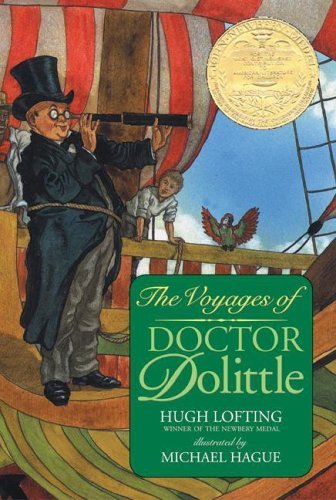
The Voyages of Doctor Dolittle
Hugh Lofting
The Voyages of Doctor Dolittle came out in 1922 and won the Newbery Medal the following year, the first sequel ever to do so. The narrator is no longer the omniscient bedtime-story voice of the first book but a ten-year-old cobbler’s son named Tommy Stubbins, who has become the doctor’s assistant and tells the entire story in retrospective first person. That choice changes everything. Voyages is much longer than The Story, much richer in detail, and considerably stranger.
Tommy and the doctor sail south on an expedition to find Long Arrow, the legendary indigenous naturalist of the floating island of Spidermonkey Island. Along the way the book introduces Miranda the purple bird of paradise, the great glass sea snail, the entire culture of the Popsipetel and Bag-jagderag peoples, and a memorable courtroom case Dolittle defends back in England on behalf of a dog. The novel does more anthropological imagining than the original, and Lofting clearly took the Newbery seriously as license to write at scale. For many readers this is the best of the entire Dolittle series. Read it after The Story.
About the Author
Hugh John Lofting was born in 1886 in Maidenhead, England, and trained as a civil engineer at MIT and the London Polytechnic. He worked on railway and mining projects in West Africa, Cuba, and Canada before settling into a quieter life in the United States,…
See all books by Hugh Lofting →