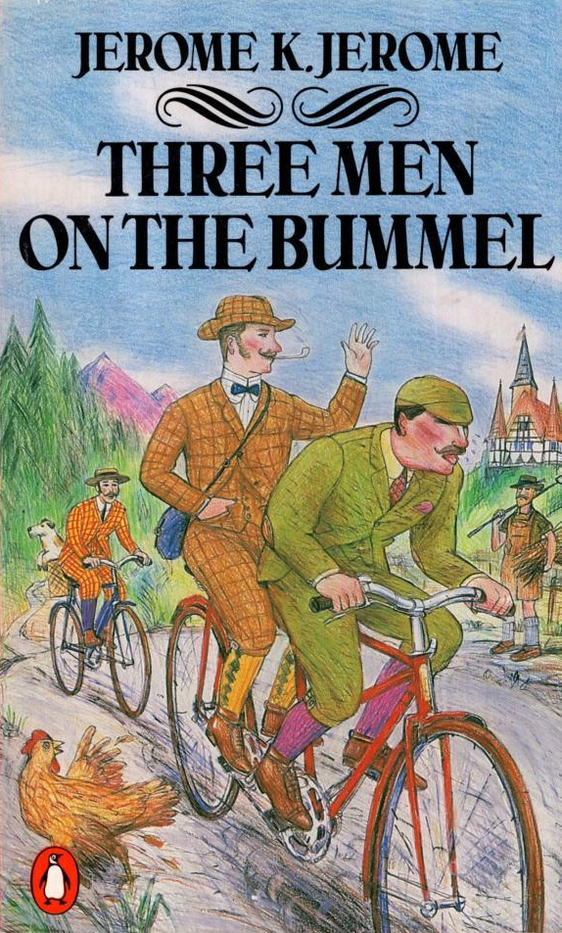
Three Men on the Bummel
Three Men on the Bummel is a comic novel by Jerome K. Jerome, published in 1900. It is the sequel to Three Men in a Boat, with the same three friends, J, George, and Harris, now a decade older, married in two cases, and taking a cycling tour through the Black Forest and other parts of Germany. The dog Montmorency is not in the book, which Jerome handled in a brief explanatory note. The bummel of the title is a German word that Jerome translates loosely as a journey, long or short, without definite destination.
The three friends decide they need a holiday from family and work, persuade or deceive their wives in various ways, and set off by train and ferry to start their cycling tour in Hamburg. The trip takes them through Berlin, Dresden, Prague, the Black Forest, and various smaller German towns. The comedy works as a series of set pieces, much like Three Men in a Boat, with extended digressions on subjects like the German habit of orderliness, the German railway system, the German student duelling clubs, and the peculiarities of German cycling. Harris attempts to converse with locals in German that he has memorised from a phrasebook. George loses his bicycle. The narrator gets into difficulties at customs.
The book is not quite as good as its predecessor. Jerome is older and the easy boyishness of the boating book is harder to recover when the three men are now respectable middle aged citizens. But the comic timing is intact and the observations about German life are still funny. There is a passage near the end that has become slightly famous in retrospect, where Jerome reflects on what might happen if the German habit of discipline and order were ever turned to military purposes by the wrong leadership. He wrote that in 1900 and it reads now as one of the unintentionally prescient passages in late Victorian comic literature.
The book runs about three hundred pages and works either on its own or as a sequel to Three Men in a Boat. For readers who finished the first book and wanted more, this is the obvious next stop. It pairs naturally with the Diary of a Pilgrimage and with the comic sections of Stage-Land.
About the Author
Jerome K. Jerome was an English writer and humorist, best remembered for the comic travelogue Three Men in a Boat, a much-loved classic of English humour.
See all books by Jerome K. Jerome →



Listen to Three Men on the Bummel Audiobook Free
Listen to Three Men on the Bummel by Jerome K. Jerome free online. The full audiobook (6 hr 37 min, 14 chapters, read by Peter Yearsley) streams free on this page.
Three Men on the Bummel (1914) is a public domain work.
| # | Chapter | Length | |
|---|---|---|---|
| 1 | Chapter One | 26:34 | |
| 2 | Chapter Two | 25:26 | |
| 3 | Chapter Three | 26:51 | |
| 4 | Chapter Four | 34:17 | |
| 5 | Chapter Five | 30:53 | |
| 6 | Chapter Six | 30:36 | |
| 7 | Chapter Seven | 22:12 | |
| 8 | Chapter Eight | 30:29 | |
| 9 | Chapter Nine | 33:31 | |
| 10 | Chapter Ten | 25:04 | |
| 11 | Chapter Eleven | 28:44 | |
| 12 | Chapter Twelve | 27:15 | |
| 13 | Chapter Thirteen | 30:38 | |
| 14 | Chapter Fourteen | 24:24 |
Prefer reading? Read Three Men on the Bummel online free or download the PDF and EPUB above.