
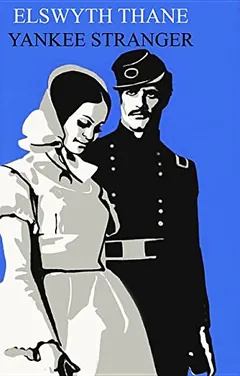
Yankee Stranger
I: October 29, 1860
This chapter is long, so it is split into 4 parts.
They danced without self-consciousness, absorbed in the dip and sway of their own young bodies, moving together as one. Sedgwick held her devotedly, a half-smile on his lips, seeming to regard his own graceful presence in the dance as mere background, seeming to eliminate himself as a performer so that attention should rest entirely on the girl in his arms. And she, surrendered to him with such confidence, her small satin slippers lighting so surely within what appeared to be millimetres of where his own foot would fall, was lost to everything but the rhythm they kept and the touch of his guiding hands.
Ransom was soon conscious of an ache in his throat as he sat watching, and Felicity saw them through a blur, and even Eden’s eyes were grave and tender—they were so young, so gloriously, obviously young, that it hurt to look at them. Lafe, who had assisted at some of the endless rehearsals in his own drawing room, was observing the finer points with satisfaction.
Dabney, who had waltzed in all the capitals of Europe, looked on with indulgent approval, Fauquier with admiration, Barry and Myrta with envy.
And Grandmother Day, even while she delighted in her latest birthday gift, was plagued by trying to remember what it was about Sedgwick….
When they finished, the applause was spontaneous and hearty. Then Dabney sprang up and caught his cousin Sally by the hand.
“Play it again, Aunt Louise!” he called. “Let’s have the same one again.
I heard it last in Vienna.”
The music began again, Eden dared to steal a look at Cabot Murray’s face and found it unguarded and smiling, his eyes still following Sue and Sedgwick who had begun the new waltz almost without a pause, laughing at each other in high satisfaction that the surprise had gone off so well, entirely willing that Dabney should do better if he could. And so Susannah, too, could take the kinks out of him just as Gran had done, Eden thought, and teach him that smile without a dagger in it.
“You are still looking at our darling,” she said softly. “We think, quite fatuously, that there was never anybody anywhere so perfect as our Sue. It’s a wonder she isn’t completely spoilt and conceited, but she doesn’t even know.”
“They are so pathetically in love with each other,” he said, as though to himself, “that one can hardly bear it for them.”
“In love!” she repeated, laughing. “Oh, nonsense, they grew up together!
They’re cousins, you know.”
Grandmother Day smothered a small sound of dismay which was covered by the music, anyway. Cousins. It was what she had been trying to come at in her own mind. Sedgwick mustn’t be in love with Sue because they were double first cousins. And that wasn’t all, either. Giles Day had married St. John Sprague’s niece only the generation before. It was one of those family intricacies which so baffled Myrta. Dorothea Sprague and the French husband she married after Yorktown had sailed for France in 1788
to settle his estates after the death of his father. They expected to return within the year, and though they took with them their first-born, a son, little Annabelle was considered too small for the voyage and was left behind in the household of her uncle St. John, who had a baby daughter too. The ship never reached France and was never heard of again. When Anabelle was seventeen she married Giles Day and became the mother of Ransom. So because of Annabelle and Giles, Sue had Sprague blood three times over. It would never do again. Such a possibility had not occurred to anyone in the family, of course—it took this observant stranger to see how they felt about each other and bring her own vague forebodings to a point. Not even Eden took him seriously now, simply because he was a stranger. But he was right, and this was what she had been feeling in her bones lately. Eden mustn’t be allowed to think twice about it. Not yet. If only Felicity had not noticed—if only no one said anything—if only Sedgwick himself wasn’t jostled into realization—but to what end? If it went on as it was everyone would be aware of it soon. Postponing that wouldn’t help much. Or would it?
Couldn’t she think of something, at her age? Should they send Sue off to that school in Richmond after all? Shouldn’t Sedgwick be made to go abroad, now that Dabney had come back in such form? But she knew in her bones that all this anxious scurrying would be futile and too late. Cabot Murray had seen what the rest of them were blind to. It had already happened.
All this had gone through her mind with the speed of lightning, and she spoke before Cabot could reply to Eden.
“If I were a few years younger,” she remarked, with her eyes on the two revolving couples, “I would see to it that Mr. Murray asked me to dance.”
“Oh, but Gran, I—–” Eden was blushing.
Mr. Murray gathered in his long legs, rose, and made her a bow.
“Will you do me the honour—?” he suggested, and extended a formal elbow.
“A—a waltz?” Eden faltered, looking up at him helplessly.
From under a lifted eyebrow he glanced at the other four.
“It’s all in the family,” he said, and his white teeth gleamed beneath eyes which were—yes—quite friendly and kind.
Eden stood up, a little diffidently, for she had never waltzed with anyone but Dabney and Sedgwick, and she was not even wearing gloves—She felt Cabot Murray’s right hand go behind her waist and caught at his shoulder as he swung her masterfully into the waltz. Their hands met in mid-air. She looked up at him, as though to ask for quarter, and found his dark face very near, looking down. He danced well, with a strong lead and a pronounced rhythm which made him easy to follow. Eden was unable to take her eyes away from his, now that they were so near.
“Thank God I’m not a cousin!” she heard him murmur, just above the music.
“Why—Mr. Murray! That’s an odd thing to say!”
“Is it?” He reversed her expertly so that her swaying hoop brushed Myrta’s knees where she sat enthralled at the edge of the floor. “Is it odd to be glad I start with a clean slate to-night and my own way to make? It’s to our advantage, I think, that you never slapped my face when I wore petticoats, and I never saw you with a front tooth out!”
Eden laughed, her eyes on his.
“Perhaps. But if I had known you in petticoats I should never have let you grow up to be so—” She stopped, looking over a brink of words, breathless in his arms.
“So—?” he insisted curiously.
She laughed again, and felt the warm blood flooding up to her hair.
“I can’t find the right word for you,” she admitted. “I don’t understand you, I think.”
“Good,” he said with satisfaction. “I can see right through you. But I like it. Ail of it. You’re the first woman I ever knew that I liked all the way through.”
“H-have you known a lot of women?” She could not resist the question.
“Quite a lot,” he said, grinning. “But I never saw one before that I wanted to marry.” Her startled eyes went absolutely round, and he tightened his hand possessively on her waist, and laughter shook him silently.
“Scared, aren’t you!” he noted. “Well, don’t be. It might not be so bad.”
Eden was speechless. They danced all the way down the room without speaking again, and her heart was beating somewhere up at the back of her throat, and her head was going round, and the warmth of his ungloved hand which held hers tingled all up her arm, while her feet followed obediently the pattern set by his.
“Maybe I shouldn’t have said that,” he offered at last. “All right, then, cross it out. I take it back. Feel better now?”
She looked up at him briefly and away again. She was not altogether sure she wanted him to take it back. At least—he might have left her time to refuse. Well, yes, she had had time for that, while they danced. Perhaps he was afraid she would accept. Didn’t he know that one was supposed never to accept the first time one was asked? Maybe you had to be quick, up North. Not that she would ever accept a Yankee. At least not the way things were now. And certainly not such an unpredictable, confusing, domineering sort of Yankee as Cabot Murray. And yet—he knew how to behave with Gran. And he knew that Sue was sweet.
“And you are the first woman I ever knew,” he was saying beneath the music, “who won’t talk unless she knows what to say.” A smile touched Eden’s lips, but she kept her head averted from him. “Look at me,” he demanded softly, and his fingers tightened on hers. Against her will she obeyed, and endured his probing, pitiless stare without flinching. “It was time I came to Virginia,” he said then. “High time. I had begun to think there wasn’t anybody like you.”
The music stopped. They stood still where they were and his hands left her reluctantly.
“Why are you so—bruised?” she whispered.
“That’s a queer word to use,” he said.
“It’s a queer way to be.”
“Yes, I suppose it is—in your experience. That’s why I take back what I said a few minutes ago. You’ll be better off without me. We’ll let it go at that, shall we? And thank you for the waltz.”
He made her a bow. She had no choice but to take his proffered arm and let him lead her back to the chair at her grandmother’s side.
VII
In not much more than a week’s time the last doubt about the election vanished. Many would have said the last hope. Mr. Lincoln was going to be the next president.
In the late afternoon of the eighth of November Eden sat alone in the drawing room with her knitting. It was a grey, cloudy day and a small wood fire had been lighted. The house was very quiet. Felicity was making calls and had taken Sue and Myrta with her. Dabney had left two days ago to visit the Charleston cousins, Fauquier had gone back to the Institute, Ransom and Barry were at the school.
Eden was just wondering if Gran would like a cup of tea to keep the chill out when Pharaoh, the black butler, opened the door gently and announced, “Mr. Murray callin’ to see you, Miss Eden.”
She had encountered him several times since the birthday party—at church, in the street, and when he had called again to hear more about slavery from Gran. Lafe had not asked him to the big house in England Street where the Spragues lived. President Ewell was well known to have no sympathy with Secession and was therefore out of favour in some quarters—and now his guest was said to be an out and out Lincolnite. It distressed her that prejudice should close some doors to Cabot Murray. She wanted him to like Williamsburg and feel at home there. She found herself being a little extra nice to him always to make up, though perhaps he had not noticed any lack of hospitality in the town. At least he gave no sign. She rose now to greet him and gave him her hand with an unself-conscious warmth of welcome.
“How very nice of you to come today,” she said. “I’m all alone and boring myself to death!” And then she wondered if she should have called attention to the fact, like that, that she was alone, and took her hand back rather suddenly, and motioned with her knitting to the armchair on the other side of the fire from the sofa where she had been sitting. “Sit there, and toast. Uncle Phare, bring us some tea, please, and something good to eat.”
She resumed her place on the sofa with a rustle of spreading skirts, and
Cabot sat down obediently where she had indicated, with his feet towards the fire.
There was a moment’s silence while her needles flew. His eyes rested thoughtfully on her hands, small and white and busy, with a tight white wristband between them and the ballooning sleeves of her blue merino gown. A narrow white crocheted collar framed her slender throat, her hair gleamed ruddy in the grey room.
“And I find you knitting socks,” he remarked.
“For Fauquier. I sometimes think the Institute must drill them without their boots on, the number of socks a cadet needs! Gran thinks she is the only one who can knit socks good enough for Father, but I notice she’s quite willing to leave Fauquier to me!”
“It seems to me that the men of this household must be outrageously pampered,” he said with what sounded like envy, and Eden’s curiosity stirred as it always did at any hint of what might be the background of his own life.
“Gran said you mentioned a sister,” she suggested cautiously. “Doesn’t she knit your socks, or isn’t she old enough?”
‘I should have said half-sister. She’s twelve or thirteen. I don’t think she knows how to knit.”
“That’s very remiss of somebody,” she said lightly. “I could knit quite well when I was twelve.”
“Could you, my dear? That must have looked very charming.”
She glanced up quickly to see if he was jeering, and was quite unable to read his face as he sat watching her, lounging in the armchair, his legs stretched out towards the fire. Her eyes retreated at once to the sock. The silence drew taut between them.
“Eden,” he said softly. “I want to say it once before I go. Eden, my dear.”
“Before you go?” The needles had faltered. She bent her head above them. Of course he would go. Some time.
“Charleston. There’s going to be trouble there.”
“Do you—look for trouble?”
“I’m afraid I do.”
“You could have travelled down with Dabney. He went two days ago.
We have cousins there.”
“More cousins?”
“My great-aunt Lavinia married a Middleton, no less. And then her daughter married a Rutledge. They have a big house on the Battery and entertain a great deal—ever so much grander than we are. Dabney is such a snob he couldn’t wait to pay his respects to them!”
“Don’t you ever go to Charleston?”
“I haven’t since I was a child. We went to a wedding there once—I’ve forgotten whose.”
“And didn’t you like being grand?”
“No. I like our way better. When do you go?”
“Tomorrow.”
Again the silence.
“I’ve dropped a stitch,” she said, her head bent, her fingers not quite steady.
“Even tomorrow is too late. I never thought to feel about any woman as I feel about you—today. I’m not going to make love to you, Eden—I’m not going to ask you to marry me, do you hear? But you’ve got a right to know, I guess, what you’ve done for me. I don’t know quite how to say it, either.
There were things I didn’t believe in. I do, now. I’m not very good at words, and I haven’t got any sort of farewell speech prepared for you—I had no idea I’d have a chance like this to make one, I came mostly just to look at you once more, I guess—”
“Oh, please don’t sound as though you were never coming back!” she cried, and dropped the knitting and put her hands up before her face.
For a moment he stared at her from his chair, his expression a mixture of regret and tenderness. Then he got his long legs under him and rose and crossed the hearthrug and pushed aside her skirts so that he could sit down on the sofa.
“I can’t come back,” he said. “I’m a Lincoln man, and before long I shall be very unwelcome anywhere in the South. This thing is bound to get worse before it gets better.”
“Then why do you go to Charleston?”
“Because I must.” He took her wrists in his big fingers and drew her hands away from her face. “I shan’t ever forget you, Eden, whatever comes.
You’re not like anybody I ever saw before—or am likely ever to see again.
But you’re not to think of me, I tell you.”
“That seems a very—one-sided arrangement.”
“You’ll be better off without me,” he said doggedly, his hands holding hers.
“You said that before. Why do you say that? Why are you so sure?”
“I know myself. I’m not for you, Eden. I’m not your kind.” He bent his head. She felt his lips hard against her hands. He laid her hands back in her lap and rose, with a long sigh. “Besides—there are bad times coming.”
“Gran says maybe it will blow over.”
He shook his head, and walked away from her on to the hearthrug.
“Sooner or later,” he said, “somebody’s got to be licked. South Carolina has been spoiling for a fight for years. She’s going to get it—one way or another.”
“Why don’t you go home, then?”
“Home?” He looked at her oddly, as though the word had no meaning for him.
“Where do you live?”
“Trenton. New Jersey. It’s not a very cheerful place.” He hunched his shoulders in a derisive sort of shudder. “Let’s not think about it. I’m leaving now, Eden—before it gets any harder. I’ve seen you by candlelight, and midday, and firelight—and in a thunderstorm. And if I were struck blind as I stand here I would see you till I die as you are now, with tears on your cheeks, by God, because I don’t take you in my arms and fight the whole damn’ boiling of them for you! It’s not because I don’t want you, Eden—I want you till I can’t eat or sleep—I want you morning, noon, and night—
and in the dawn, that’s the worst time, Eden, but you wouldn’t know about that. I’ve no right to talk to you like this, have I—I never meant to, it isn’t the way a Virginia man would tell you that he loved you, is it! Maybe it’s not what I’d be saying myself if I stood a dog’s chance of having you for my own and damn the war! But we’re done for, Eden, right here, right now, and will you for God’s sake try to forget me, for your own sake, and as soon as ever you can! Promise me that, before I go.”
She sat very still, very straight, her hands lying together in her lap and tears on her cheeks.
“I shall never hear a thunderstorm again,” she said quite steadily, “that I don’t think, ‘What a lovely day!’”
The door opened gently after a soft double tap.
“Ole Mistis says will you all gib her de pleasure o’ takin’ yo’ tea upstairs wid her,” said Pharaoh.
VIII
She had seen him from her window, as he came through the gate. She knew that he would find Eden alone today—the first time they had ever been alone together. And for a little while she sat frowning at the dreary day outside, trying to sort herself out on this Cabot Murray.
Why had she taken to him so, she asked herself. What was there in him that she responded to, not instinctively, as Eden did, but deliberately, wilfully, enjoying the sensation? He was a difficult man, an unruly, contrariwise, suspicious man—none of those things she was accustomed to.
He was also an unhappy man. Well, there were lots of those, probably. She couldn’t at her age go round gathering up miserable people and dusting off their knees and telling them they weren’t really hurt. And yet she had definitely gathered up Cabot Murray and kept him to supper with the family and made him waltz with Eden. And now she was pleased, obtusely pleased, that Eden must receive him alone and deal with him somehow, unless she herself chose to interrupt or unless Eden fled to her for protection. It would do Eden good, she heard herself thinking, with surprise.
And suppose Eden fell in love with him, what then? Do her good, she thought again, and was astonished at herself.
The man was a Yankee. If there was a war, he would be on the wrong side. Well, she had seen all that before. Julian, of course, had ended up on the right side. We’re wrong this time, she thought. Not him. We’re wrong if we take to acting like South Carolina. But we won’t. Washington is part of Virginia State, after all. I remember when they made it. He’s not a New Englander, anyway, not by the look of him. Why do I like him so, she ruminated, frowning. He’s nothing like Julian. And yet—I wonder. Julian had no people, nothing to love, when he came here. And this man is loveless too. How do I know that? In my bones. He takes it differently from Julian, that’s all. He minds it worse, and he hates minding. Julian was sort of—resigned to it. This man is fighting it, he wants something he hasn’t got, and he despises himself for wanting it and tries to think it’s not worth having. Well, why hasn’t he got it, I wonder. He said he had a sister, so
there must be some kind of home. What’s his mother about, I wonder. Or is she dead? A dead mother wouldn’t turn a man sour like that, though, not unless there was something else. A love affair? It could be, I suppose. Some woman who wasn’t worth caring about, perhaps. He’s got his knife into Sally’s kind, all right. But he knows Eden is different, that’s the queer part.
Felicity would think I am throwing Eden to the lions, but I’m not so sure—
He would be a fine, masterful man to love, if you could tame him, she thought. More like St. John Sprague than like Julian, I suppose, but nothing had ever hurt St. John, he was a darling of the gods. This man has been knocked down and rolled in the dust by something, and he’s all hurt pride and prickles, he doesn’t trust you. Julian never quite lost his trustfulness, somehow, I hadn’t such a hard job as Eden will have. Eden has got to give him back his faith in—something. If I was a good, careful grandmother, I’d shoo him away before she falls in love with him. Only I’d be too late now.
The harm was done that first day in the thunderstorm. It happens that way sometimes. This will mean losing Eden, when he takes her up North. How can I be so sure he wants to? I feel it in my bones.
But I’m not to blame for it, any more than I can stop it now, she thought.
Ransom will try to stop it, I imagine. Ransom and Felicity won’t be able to see how Eden can be in love with a man she hardly knows. But my Lavinia did it, down there in Charleston. Lavinia never looked back, it was beautiful, you couldn’t be sorry to see her go when she had got what she wanted. Where will he take Eden, I wonder. He will take her, I feel it in my bones, it’s no good trying to keep her now, she’s already as good as gone. I must make Felicity see that somehow. And he will be good to her, too. How can I be so sure, and he such a headstrong, high-strung, passionate man—
like a colt that’s been brutally broken. Who’s to blame for that, I wonder.
Because he can be tender too, if you know how to come at him—Eden knows how—Eden is the first to know how—I feel it in my bones….
After a bit she roused herself and rapped with her stick and gave her orders about tea. Felicity and the others would be home soon. The two in the drawing room would be better off up here with her.
They came very promptly, and Eden left her no time for conjecture.
“Mr. Murray has come to say goodbye, Gran,” she announced rather breathlessly as they entered the room. “He’s off to Charleston tomorrow to see the war.”
Cabot’s eyes met Tibby Day’s as he bent to kiss the hand she held out to him—he looked guilty to her, and the hard lines around his mouth were etched deep. Eden was decidedly pale. Refused him already, thought her grandmother. Cowardy-cat. Her sympathy flew instantly to Cabot Murray and wrapped him round with jealous indulgence while she dispensed tea and hot biscuits with honey and told him all about her daughter Lavinia who had fallen in love at first sight with Phineas Middleton once when they were all visiting in Charleston, and had never even come back home to Williamsburg before the wedding because she simply couldn’t bear to part with him at all, and now she had a married daughter, Caroline, and lived with her in a big house on the Battery.
“You remember your cousin Caroline, Eden,” she prodded, for neither of them seemed to be attending very well. “You were quite a big girl the last time we went to Charleston—the year before Myrta was born, wasn’t it?”
“Yes, Gran, I remember.”
“Caroline was very lovely then,” she went on, pretending not to notice their preoccupation. “Dark—not much like the rest of us. Dark, with a heart-shaped face. Dear me, she’s been married ten years now, I wonder what her two little boys are like. You must go and see Caroline, Mr. Murray, so you can tell me how everything is when you come back.”
“Mr. Murray isn’t coming back here, Gran. His home is in New Jersey.”
“Is it,” she said placidly. “I felt it couldn’t be in Massachusetts, in spite of his Christian name.”
“I believe I was named, ma’am, not for the Boston Cabots but for the English navigator Sebastian. My father has made a hobby of the Northwest Passage story—he’s been writing a book about it for the last thirty years or so.”
“My husband wrote books,” she remarked approvingly. “I used to copy them out for him. I wrote a very fine hand in those days. I daresay your mother helps with the copying too?”
“I have no mother, ma’am,” he said briefly. “My father has married a second time—his housekeeper. Her duties leave her very little leisure, it appears, to spend at a desk.”
“I see,” she said. “In those circumstances, you must be a comfort to him.”
He gave a short, hard laugh, as though it had been jerked out of him against his will.
“As a family,” he said, and the old, black look was on him, “we don’t seem to comfort each other much. Poor Melicent—that’s my sister by his second wife—would hardly know what to make of the free and easy way Myrta behaves with her father.”
“What a pretty name,” she said. “Melicent.”
“It was my mother’s.”
“Your—” She sat a moment, contemplating this fantastic glimpse into his life. The child of the housekeeper was named for the first wife—and she was afraid of her father. They were all afraid of him. How do I know, she wondered. In my bones.
“You see, ma’am,” he went on with some difficulty, looking down into his teacup, “as I was trying to tell Miss Eden downstairs—coming to this house has been for me rather like being at a play. Something that never really happened to me at all. Something I saw, from outside a fourth wall, for a few hours, until the curtain dropped. Something I shall always remember with pleasure and—and gratitude. But something I have no part in—any more than I would have among the actors in that make-believe world on the stage.”
“Dear me,” she murmured, seeming not to notice the stricken look Eden turned on her, a look which said so plainly, Do something—don’t let him feel that way. “Dear me, that sounds very—final.”
“I put things badly, I know,” he said restlessly. “Either I say nothing at all, or else I sound as though I was making a speech. Up where I come from we haven’t the gift of putting our feelings into words.” He set down his cup and rose, and took one of her little hands in his. “You have been very kind to me, ma’am—I can’t think why—and I only wish there was some return I could make.”
She laid her other hand on his and squeezed them together.
“Come back and tell me how things are in Charleston,” she coaxed. “I will give you a letter to Lavinia—Pharaoh will bring it round this evening.
Promise me to go and see her, and take her my love.”
He hesitated.
“Does it occur to you, ma’am, that a Yankee will be even less welcome in Charleston just now than here? Mightn’t she find me a trifle
embarrassing?”
“Nonsense, she will be glad to see anyone I send her! And Dabney will vouch for you. How long do you expect to be in Charleston?”
“It’s hard to tell. Perhaps until I am kicked out. I have no plans, except to go to Washington for the inauguration in March.”
“What about Christmas?” she inquired, looking up at him, holding both his hands in hers. “Won’t your family expect you at home, or don’t you keep Christmas in New Jersey?”
“I’m afraid I never thought much about it, one way or the other,” he confessed. “Melicent just says she wants a book or a doll or a muff, and her mother buys it for her, and that’s the end of it.”
“What a wicked way to do!” she cried, and flung his hands away from her reprovingly. “I never heard of such a thing! You come back here for Christmas, Cabot Murray, and see how it is done—and mind you bring me a gift from Charleston!”
He stood above her, half laughing, half puzzled, and his eyes sought Eden’s inquiringly. She nodded, smiling.
“If you never saw a Virginia Christmas, it’s high time you did,” she said.
“I’ve half a mind to take you up on it,” he murmured.
“I shall be very displeased if you don’t,” Grandmother Day told him severely. “Mind you, it isn’t as though the Spragues still kept open house at Farthingale and we could do it in plantation style as we used to when I was young. And Lavinia will try to keep you in Charleston, but don’t you take any notice of her. We still do it better in Williamsburg. Promise?”
“If I keep Christmas at all,” he promised, “it will be here with you.”
IX
It wasn’t much to go on, but it was better than she herself had been able to do with him, Eden reflected as the November days crawled by. She never told Gran what had been said that afternoon in the drawing room, but she had a comforting suspicion that Gran guessed how things were and sympathized.
She had plenty of time now to contemplate what had happened to her.
Suppose there wasn’t a war after all, and Cabot Murray came back from Charleston at Christmas time and asked her to marry him—she would never
have the will power to say No to him, but how about the courage to say Yes? What did he mean, about not being her kind? What dark things was he hinting at when he said, I know myself. Had he—her innocent mind fumbled among elusive dreads—had he done something to be ashamed of, something like, well, like forging somebody’s name for money or—
stealing? Or was it something dim and disgraceful about a woman? Her good sense indignantly rejected all such things. He was honest and he was honorable, she was sure. Gran was sure too, or she would never have opened her heart to him. What then? What had made him the way he was, moody and grim and solitary, but—this was the strange part—so quick to see and to need what he apparently lacked?
What sort of life would it be, she wondered, in Trenton, New Jersey?
Would he expect her to live in the mysterious household of second wife and half-sister, with no Christmas presents and no—no comfort? Even Gran seemed to sense something— unusual, something almost sinister in the house which had obviously never stood for the things her own home stood for to its children. But other people’s mothers died and their fathers married again. Could it be that the housekeeper wasn’t, perhaps, quite nice? Again her maiden thoughts came to a blank wall of ignorance and swerved aside.
Even if he asked her, could she bear to leave Gran, and Sue, and the rest, and go out into the unknown with a man she hadn’t yet seen a dozen times, but who when he went away to Charleston had taken all the sparkle and the zest of life with him? You couldn’t miss a man you scarcely knew. And yet she missed Cabot Murray, desolately and drearily, so that things which had heretofore been enlivening and important were now as dust and ashes, and all the young men she knew bored her, especially Grafton Crabb.
Dabney’s letters from Charleston indicated that he had been badly bitten by Secession now, and his father began to look grave and worn. Everybody said President Buchanan was simply muddling along until he could dump the whole mess into Lincoln’s lap next March and escape all responsibility.
Then they would see. It would be up to Lincoln then.
Early in December a letter came from Caroline to Gran, who sent for Eden at once and handed it to her silently and sat looking into the fire while she read it.
“Your Mr. Murray is very presentable, for a Yankee,” Caroline had written, “but I must say, Gran, it is asking a good deal to expect me to take him under my wing in Charleston just now! In the first place, he hobnobs continually with the garrison at Fort Moultrie, and while they are, of course, received everywhere in town that is largely because Major Anderson in command at the Fort is from the South himself and is known to sympathize with our Cause, even though he is in the Federal Army. Whereas Mr. Murray is so unwise as to try to preach the gospel of Lincoln and patience—patience for what?—and has the sublime impudence to imply that even if we do start a war, we can’t win it!
“But it really was the last straw when Madeleine Morell—who is just back from Washington a few days ago—showed me the enclosed article in an old Philadelphia paper, signed by CABOT MURRAY! Your protégé, Gran, is a journalist, did you know? Of course I told Madeleine I was sure you had no idea, and she said she thought I ought to tell you, before he abuses your confidence further. And I may as well tell you also that Yankee journalists are regarded here as just next-door to spies, and I really feel very uncomfortable to think that I have introduced him at several of my receptions and dinners to my most intimate friends, even though I did so in good faith and because you had sent him to us.
“I am sure you will quite understand, Gran darling, and Mother entirely agrees with me, when I say that I really cannot ask the man inside the door again, and I have had all I can do, as it is, to prevent Dabney from trying to call him out with pistols. Of course that is perfectly absurd, as it is well known that Northerners won’t fight duels anyway, and he probably couldn’t hit the side of a house if he did, but all the same I had to squash Dabney very firmly and try to hush the whole thing up. No one will ever learn from me who and what he is, but I don’t at all trust Madeleine, it would be just like her to give it away. And anyone may see his hateful name signed to something more, anywhere, ANY MINUTE!…”
And so on.
When Eden had come to the bottom of the last page, her grandmother reached out and took the letter from her with the tips of her fingers and tore it daintily into shreds and leaned forward to toss them into the fire. Eden
said nothing, but sat watching the blaze, her hands lying idle in her lap, her knitting on the sofa beside her. Her shoulders drooped, she looked drained of life and hope. She looked very young, her grandmother thought with a twinge of pity, and her own needles began to click briskly on a sock for Ransom.
“It’s easy to see,” she remarked, “that Caroline is a goose. But I must say I am surprised at Dabney going off half-cocked like that.”
“Aren’t you surprised at Mr. Murray?” Eden inquired, and nothing but her lips moved as she spoke.
“Are you going back on him, just because he writes for a Philadelphia paper?”
“Have you—did you read the article she sent?”
“I did. It’s there on the table.”
Eden made no move towards it. Then she seemed to change her mind and reached for it, and read it in silence to the end.
“I don’t see anything so very terrible about that, do you?” her grandmother remarked then. “It’s exactly the sort of thing he said when he was here—and most of it makes very good sense.”
“Yes, I suppose it does.” Eden picked up her knitting. “Gran—why do you like him so much?”
“Blessed if I know,” admitted Tibby Day cheerfully. “But I do. I don’t care what he does for a living, I like him. Don’t you?”
“Yes,” said Eden faintly, knitting.
“We needn’t say anything about Caroline’s letter, I suppose,” her grandmother reflected. “And we could burn the clipping too.”
“Dabney knows,” Eden reminded her.
“That’s right, he does. I reckon he’ll raise a rumpus about having Mr.
Murray here for Christmas now, by the time Caroline has finished with him.
And that will start your father off. Lafe is bad enough already. I never could see why a man’s politics should affect his social life. Lots of perfectly charming people were Tories when I was a girl, and you’d have thought they were suddenly turned into thieves and murderers overnight to hear the Patriots talk! Your grandfather Julian was a Tory once,” she observed above her needles. “But it never made any difference to the way I felt about him.”
“But he was with Lafayette!” Eden objected, surprised.
“Finally. Anyway, that was a different thing altogether from this. You can’t dress Secession up and call it Revolution, it’s plain anarchy. It couldn’t happen with a man like George Washington in the White House.
South Carolina is just working itself up again. We all know that slavery is wrong. And South Carolina wants to fight just to prove she’s got a right to go on doing wrong!”
“Why, Gran, you sound exactly like Mr. Murray!”
“Most of the time he knows what he’s talking about, Dee. And those new Cotton States are worse than South Carolina, even. They moved heaven and earth to get themselves into the Union, I can remember! And now, because they can’t have it all their own way want to get back out again and set up for themselves. But where will all this seceding stop? Pretty soon South Carolina will want to secede from Alabama, and then Charleston will be seceding from South Carolina—it will make us a laughing-stock abroad if we don’t hang together now.”
“Well, I wish Uncle Lafe could hear this!” cried Eden. “Why don’t you write articles for the Philadelphia paper?”
“Maybe I could,” she said complacently. “Wouldn’t Dabney be surprised!”
A few days later Dabney wrote to say that if his father permitted he would like to spend Christmas in Charleston this year. And a few days after that came a brief note from Cabot to Gran, regretting that he would be unable to come back in time to see a Virginia Christmas after all. In the house in Williamsburg they looked at each other with anxious, questioning eyes. What was going on down there in Charleston? They had done without Dabney last year because he was in London. But Ransom sighed and refused to order him home. Dabney was old enough, said Ransom, to decide things for himself now.
And so, on the twentieth of December Dabney rushed into the Charleston drawing room waving a flimsy placard. “We’ve done it!” he shouted at the two women who sat there. “We’ve begun!”
As he spoke all the churchbells in Charleston began to ring wildly, and scattered shouts were heard in the street outside the house, and running feet, and then the stutter of drums.
Caroline snatched the paper from him. THE UNION IS DISSOLVED, it said in tall black letters.
“We’ve seceded, mother,” she announced quietly, and her face was white. And, “Oh, God help us all!” moaned Lavinia, and burst into tears.
Dabney stared at them.
“But I thought you’d be glad!” he said stupidly. “I thought you all wanted to secede!”
“The forts,” said Caroline, staring at the paper in her hand. “What about the forts? They belong to us now. What will Major Anderson do?”
“Anderson will submit gracefully on any terms he can get,” said Dabney.