
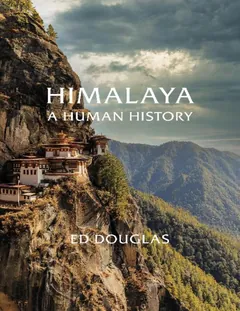
Himalaya: A Human History
Picture Section
1. A photograph of Everest, centre frame, taken looking south from Space Shuttle Atlantis in November 1994. The peak’s vast east face is lit with morning sunlight while the north face remains deep in shadow.
2. A rock sample collected from the summit of Everest in 1956 showing fossilised fragments of a crinoid, or sea lily, proof that it had once been under the sea.
3. Part of the jawbone of what paleo anthropologists believe is a Denisovan hominin from the Middle Pleistocene, found on the Tibetan plateau in modern Gansu province. Genetic analysis suggests that the evolutionary adaptations of Tibetan peoples to the hypoxia of high altitude may have originated in Denisovan DNA.
4. The fortified palace of Yumbu Lhakang above the Yarlung Tsangpo river, a hundred miles south of Lhasa and the focus of the Yarlung dynasty. Most probably constructed in the late seventh century, it was badly damaged in the Cultural Revolution, the structure having since been restored.
5. The Diamond Sutra, the world’s earliest printed book for which we have a date: May 868. It was found in the Mogao or ‘Peerless’ Caves near the city of Dunhuang in modern China’s Gansu province. Tibetan manuscripts found in the caves transformed our understanding of early Tibetan history. The Diamond Sutra is among the most important scriptures for the Mahayana form of Buddhism practised in the Himalayan region.
6. Freddy Spencer Chapman’s photograph of the Dalai Lama’s palace, the Potala, taken in 1936 from the Chakpori monastery. Construction began in 1645, part of the Dalai Lama’s effort to re-establish Lhasa as the capital of a reunified Tibetan nation. It was completed in 1694, twelve years after the Great Fifth’s death.
7. A view of Jomolhari from the Tibetan plateau taken by Freddy Spencer Chapman as the British mission returned to India in 1937. This was the peak Sir William Jones had spotted from the plains of India in 1784, suggesting the Himalaya’s immense altitude.
8. A photograph from the 1870S by the British photographers Bourne & Shepherd, of Kathmandu’s Durbar Square.
9. Crowds gather in Kathmandu to celebrate the birthday of Prithvi Narayan Shah, founder of Nepal, born in Gorkha on II January 1723. This statue has also been the target of demonstrators protesting for ethnic minority rights.
10. Six furlongs to the mile: the first known map of the Kathmandu valley; drawn from surveys carried out by Charles Crawford, later surveyor general, who commanded the detachment accompanying the Knox mission of 1802.
11. Jung Bahadur with his senior queen Hiranyagarbha Devi, two daughters and attendants, photographed by Clarence Comyn Taylor, who had been badly wounded in 1857 and turned to political service, arriving in Kathmandu in 1863 as assistant resident. These were the first photographs of the valley; part of a wider British effort to document the peoples of India.
12. Christ Church in Simla, completed in 1857 and designed by John Theophilus Boileau of the Bengal Engineers. The Simla district Boileaugunj is named for him.
13. Born in County Sligo in 1821, Eliza Rosanna Gilbert spent her early years in India and later found fame as ‘Lola Montez, the Spanish dancer’. She was the lover of Ludwig I of Bavaria, wielding great influence, and Jang Bahadur, de facto ruler of Nepal.
14. The Tibetan aristocrat Lungshar, left, with the four Tibetan boys sent to Rugby for education, Mondo, Ringang, Kyipup and Gongkar, after being presented to George V at Buckingham Palace in June 1913.
15. The viceroy of India Lord Curzon stands over the tiger he has just shot, during his visit to Nepal in early 1901, shortly before the coup that brought the more reliable Chandra Shamsher to power.
16. The young Chandra Shamsher, maharaja of Nepal from 1901 to 1929.
17. Sir Joseph Dalton Hooker, botanist and close friend of Charles Darwin, four years after his landmark three-year visit to the eastern Himalaya.
18. Reflecting the sudden influx of labour, a group of Nepalis and Bhotias in Darjeeling, photographed in the 1860s by Samuel Bourne, partner in the well-known Simla studio Bourne & Shepherd. ‘Bhotia’ was a colonial term used by the British as a catch-all for ethnic groups with their roots in Tibet living on the Indian side of the mountains.
19. The plant explorer William Purdom, dressed as a brigand, in Tibet in 1911.
20. Francis Younghusband in his greatcoat surrounded by staff officers on the bloody and quixotic British invasion of Tibet in 1904. Two future frontier cadre officers stand behind, Eric ‘Hatter’ Bailey with the cane and Frank O’Connor with hands in pockets.
21. Ugyen Wangchuk, governor of Trongsa in Bhutan. In 1907 he was crowned king with support from the British: reward for his support during their invasion of Tibet. Until this point, following defeat by the British and the Treaty of Sinchula in 1865, Bhutanese politics had been fractious. The photo was taken by John Claude White in 1905 as he invested Ugyen with the insignia of Knight Commander of the Order of the Indian Empire.
22. The political officer for Sikkim Charles Bell sits with Thubten Gyatso, the thirteenth Dalai Lama. Standing is Sidkeong Tulku Namgyal, crown prince of Sikkim. Educated at Pembroke College, Oxford, his reign was brief.
23. A bronze image of Buddha from the late eighth century made in Kashmir or Gilgit. He rests on a stylised interpretation of the cosmic mountain Meru, often identified as Kailas, pictured above.
24. The fabled eleventhcentury poet Milarepa, a major figure in the history of the Kagyu school of Buddhism, and associated with Kailas. His life story; as told by his fifteenth-century biographer Tsangnyon Heruka, helped underpin the lineage of Kagyu teachers.
25. A complex series of rock art symbols from Tibet’s protohistoric period including a swastika, crescent moon, the sun, trees, a bird of prey, yak and other wild herbivores and possibly a hunter, reflecting the venatic (hunting) lifestyle. Some of these symbols were adopted into the symbolism of Tibetan Buddhism, although hunting was antithetical to it.
26. A stone pendant of malachite and a cylindrical bead of turquoise included on a string of beads dating back to the middle or late Neolithic, some four to five thousand years ago, found at the archaeological site at Kharub, near Chamdo, in eastern Tibet.
27. The Tang dynasty emperor Taizong receives the Tibetan envoy and general Gar Tongtsen, sent in 641 by the Tibetan king Songtsen Gampo, at his capital Chang’an.
28. An image of Padmasambhava, the eighth-century Buddhist master who helped found Tibet’s first monastery at Samye. Born in modern Pakistan’s Swat valley, he is also known in Tibet as Guru Rinpoche.
29. Tilly Kettle’s painting The Teshu Lama Giving Audience, painted around 1775. The Scottish explorer George Bogle, emissary of the East India Company and dhe first Briton to visit Tibet, presents a kada, or ceremonial scarf, to Lobsang Palden Yeshe, the sixth Panchen Lama.
30. The great Buddhist teacher Atisa, born into royalty in Bengal, then the focus of the Pala Empire. Brought to the Guge kingdom in western Tibet by its king Yeshe O, Atisa was instrumental in the second diffusion of Buddhism in Tibet in the eleventh century.
31. The fortress of Tsaparang in the upper Sutlej valley, once capital of the Guge kingdom, responsible for a Buddhist renaissance in western Tibet during the eleventh century.
32. A thirteenth-century bronze sculpture of the goddess Tara, emblematic of the immense sophistication and skill of the Kathmandu valley’s N ewari artisans under the MalIa kings who ruled the valley for six centuries.
33. The fifteenth-century Tibetan engineer and spiritual master Tangtong Gyalpo, known as Chakzampa, the iron-bridge builder, whose structures can still be seen in Bhutan but who operated across the Himalaya.
34. The princess Choekyi Dronma, born into the royal family that ruled the small Tibetan kingdom of Mangyul Gungthang, was the consort of Tangtong Gyalpo, who recognised her as the reincarnation of the eleventhcentury female tantric adept Machig Labdron. Despite her short life, she established convents and founded the most important female lineage in Tibetan Buddhism: the Samding Dorje Phagmo.
35. Copperplate after George Stubbs’ painting The Yak of Tartary, modelled on the first yak to reach Britain, a male brought back by the second mission to Tibet led by Samuel Turner. When it perished, the yak was stuffed and exhibited at the Ethnology Court, a kind of anthropological exhibition held at the Crystal Palace in 1854.
36. One of eight engravings depicting The Pacification of the Gurkhas, a collaboration between Chinese artists and Jesuit missionaries in China, with engravings done in Paris. The images commemorate two campaigns to expel Gorkha troops from Tibet, part of the Manchu dynasty’s Ten Great Campaigns (including two against Tibetans in Sichuan) that expanded the Qing Empire, but at great fmancial cost.
37. A miniature watercolour of the Gorkhali prime minister Bhimsen Thapa, who effectively ruled Nepal for over thirty years in the early nineteenth century. Dated 1839, the image was probably painted after his downfall and suicide but portrays him at the height of his powers.
38. This coloured aquatint of Gorkhali soldiers was made from a plate in James Baillie Fraser’s Views in the Himala Mountains, published in 1820. Fraser wrote admiringly of the Gorkhali army’s courage and strength. His brother William had been political agent to Major General Martindell during the Nepal war, leading Gorkhali irregulars who had swapped sides.
39. Major General Sir David Ochterlony, painted in the aftermath of war with Gorkha, where he led the only truly successful British column.
40. The diplomat and scholar Brian Houghton Hodgson aged around sixty, in the aftermath of the Indian rebellion and his lobbying for Gorkhali support of the British.
41. A watercolour showing the artist Hyder Jung Hearsey and William Moorcroft meeting two Tibetan traders in the summer of 1812 as they crossed into Tibet on their way to Manasarovar.
42. Rhododendron edgeworthii, still popular in gardens around the world, discovered by Joseph Hooker in Sikkim in 1849 and painted by his father’s regular artist Walter Hood Fitch.
43. Camellia sinensis, the tea plant, smuggled out from China; its ability to prosper in the eastern Himalaya transformed the region’s economy and society.
44. Charles Bruce and Fred Mummery on their way to Nanga Parbat in 1895. Mummery would wear two soft hats, with snow packed between them, to keep his head cool in the hot sun.
45. Frank Smythe’s portrait of the irrepressible Charles Bruce, Himalayan climbing pioneer and leader of the first full expedition to Everest in 1922.
46. The summit of Trisul on 12 June 1907, the first peak over seven thousand metres to be climbed. The successful party included Tom Longstaff, Courmayeur guides Henri and Alexis Brocherel, and a Gurkha, Karbir Budhathoki, who succeeded despite frostbite.
47. The Canadian doctor and Protestantmissionary Susie Carson Rijnhart, whose infant son Charles perished on the Tibetan plateau.
48. Albert Shelton’s photograph of a baptism in the Kham town of Batang, now in China’s Sichuan province. Also a medical doctor, Shelton, born in Indianapolis, ran a mission at Batang between 1908 and 1922 for the Foreign Christian Missionary Society. He was murdered in 1922.
49. Teresa Littledale, the woman who came closest to Lhasa before Alexandra David-Neel. She travelled widely though Central Asia with her husband St George Littledale, but the couple published little and were largely forgotten.
50. The French-Belgian explorer, mystic and anarchist Alexandra David-Neel, in 1924 the first European woman to reach Lhasa, at the age of fifty-five. A Theosophist who influenced the beat generation, she died in 1969 at a hundred years old.
51. Eric Shipton and Bill Tilman became the first mountain explorers to reach the Nanda Devi Sanctuary in 1934, supported by the legendary Sherpa Ang Tharkay, Pasang Bhotia and Ang Tharkay’s cousin Kusang.
52. The anthropologist Bruno Beger measuring a Tibetan woman’s head during the 1938-9 Schafer expedition. Beger was convicted in 1971 for his role in the Jewish skeleton collection.
53. The Nechung Oracle, photographed by the Schäfer expedition. The oracle had been institutionalised under the fifth Dalai Lama, a protector for the new Ganden Phodrang system of government. In 1947 the oracle warned of great danger facing Tibet in the next Year of the Tiger: 1950.
54. Archibald Steele’s 1939 photograph of the young fourteenth Dalai Lama, taken during his assignment to visit the child at the Kumbum monastery in Arndo.
55. The capable Tsarong Dzasa, who despite his humble birth became a major force in Tibetan politics, and the gifted Italian anthropologist Giuseppe Tucci, pictured in 1948 at Tsarong’s home. Tucci was consulting his library.
56. King Tribhuvan stands with Nehru and leading figures in Nepal’s interim government of early 1951, including the new home minister B P Koirala, looking over their shoulders, and Mohan Shamsher to Nehru’s left, the last of the Rana prime ministers.
57. Mao Zedong with the fourteenth Dalai Lama and tenth Panchen Lama in Beijing in 1956.
58. The tenth Panchen Lama meets with the Dalai Lama’s fact-finding delegation of 1979, with Phuntsok Wangyal standing right, a year after his release from prison.
59. The tenth Demo Rinpoche and his wife during a thamzing or struggle session on the streets of Lhasa in 1966. A keen photographer, the tulku’s camera is hung around his neck as a sarcastic admonishment. His work was largely destroyed.
60. The political activist Ngawang Sangdrol.
61. Queen Elizabeth II and Prince Philip, the Duke of Edinburgh, tiger hunting in Nepal in March 1961, weeks after King Mahendra had seized power from a democratically elected government and put the prime minister B P Koirala in jail.
62. The young journalist Liz Hawley.
63. The former Russian ballet dancer, club manager, hotelier and entrepreneur Boris Lissanevitch and his second wife Inger. With his flair for theatricality, Lissanevitch had stage-managed Mahendra’s coronation and the visit of the British royal family.
64. The crown prince of Nepal Birendra and his bride Aishwarya at Frankfurt airport in July 1970. Having acceded to the throne in 1972, Birendra, facing huge popular demonstrations, restored democracy in 1990. He, his wife and two of their three children were murdered by Prince Dipendra on 1 June 2001.
65. Nepali Congress leader Ganesh Man Singh meeting President George H W Bush at the White House in 1990. That year, co-operating with Nepal’s communists, he was at the forefront of the jana andolan movement to restore democracy. Born in 1915, Singh had a reputation for integrity and was arrested with B P Koirala in 1960, spending eight years in jail without trial.
OceanofPDF.com
VINTAGE – home to the world’ s greatest
authors and books. Where new writers are
discovered, bestselling books are found
and yesterday’ s classics revived for a new
generation of readers.
Our authors represent the very best in
creativity and quality and have won the
most prestigious prizes the book world has
to offer including the Man Booker, the
Samuel Johnson and the Nobel.
Born in New York in 1974, and arriving in
London in 1990, VINTAGE publishes
beautiful books with the very best design
for people who love to read.
@vintagebooks
penguin.co.uk/vintage
OceanofPDF.com
OceanofPDF.com
Vous avez terminé Himalaya: A Human History
Ed Douglas
Des livres comme celui-ci
-
 Lempire ottoman
-
 Mémoire sur l'origine Japonaise, Arabe et Basque de la civilisation des peuples du plateau de Bogota
-
 Le Monde hellénistique. De la mort d'Alexandre à la paix d'Apamée (323-188)
-
 Les croisades vues par les Arabes
-
 Dictionnaire historique universel / contenant les Chronologies de tous les Peuples depuis l'antiquité la plus reculée jusqu'à nos jours
-
 Histoire de l'Afrique Septentrionale (Berbérie) depuis les temps les plus reculés jusqu'à la conquête française (1830) ( Volume I)
Après le livre
Pages fournies avec cette édition, gardées ici pour référence.