
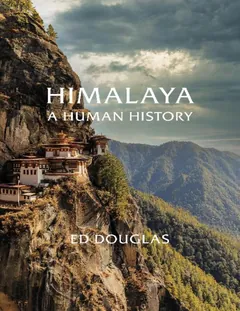
Himalaya: A Human History
4 Lost Kingdoms
4
Lost Kingdoms
As you leave the scruffy frontier town of Saga, seven hundred kilometres west of the capital Lhasa, Tibet dries up like a husk. Travelling the same latitudes as Algeria, you pass sand dunes within sight of white summits. The light at dawn is sumptuous, turning the lower hills the colour of honey and caramel, but it’s hard to imagine anything living in such austerity. Then you spot wild asses, khyang in Tibetan, cropping the meagre white grass struggling out of the stony ground. The air is thin at fifteen thousand feet; everything feels closer, yet the vast scale of the landscape reduces you. It’s easy to see why a philosophy stressing the illusory nature of an individual consciousness, as Buddhism does, might prosper here.
The road west follows the broad valley of the Yarlung Tsangpo river,
which becomes the Brahmaputra when it reaches India, one of the four great rivers of Asia that have their source in western Tibet. To the north are the mountains of the Lungkar Shan, a range that contrasts sharply with those to the south: isolated snowy peaks overlooking broad valleys where nomads watch year by year as the glaciers that feed their pasturelands wither and die in the face of climate change. The Chinese carved a militarily strategic road along this ancient route in the 1950s; it stretches two thousand kilometres between the Tibetan town of Lhatse in the east and the far western province of Xinjiang, crossing the disputed Aksai Chin region along the way. Now tarmacked, the G219 is one of the most spectacular drives on earth.
At Punsum, the road passes a line of three rounded hillocks topped with
prayer flags fluttering in the wind. Ancient trade routes turn south from here to cross high passes into far western Nepal. Then the road climbs towards a pass more than 5,200 metres high, the Mayum La (‘la’ means ‘mountain pass’), on one of the world’s great watersheds, between the Tsangpo flowing east and three other great rivers: the Indus, Sutlej and Karnali.
Late in 1715, Ippolito Desideri and Manuel Freyre, two Jesuit
missionaries, were likely the first Europeans to cross this pass, travelling in the opposite direction: they were on their way from Ladakh in the far west to Lhasa, journeying under the protection of a widowed Tatar noblewoman returning to the capital. Escaping what he called the ‘Great Desert’ of Tibet was a relief for Desideri, a formidable scholar cruelly prohibited from publishing by his own church. A few days before, he had set eyes on ‘a mountain of excessive height and great circumference, always enveloped in cloud, covered with snow and ice, and most horrible, barren and steep, and bitterly cold’. This was Kailas. Staring at this dazzling peak, without any protection for his eyes, had left him blind, the pain alleviated, at his hostess’ recommendation, by rubbing snow in his eyes. The party rested beneath the mountain on the shores of Lake Manasarovar before continuing onto the Mayum La, Desideri speculating shrewdly on the identity of the great rivers whose sources surround the mountain that had temporarily blinded him. So it was that Europeans discovered the axis of the world.
Manasarovar is Sanskrit, meaning ‘the mind’s waters’, the mind in
question being Brahma’s, primal lord of creation in the Hindu tradition. According to legend the lake was placed there to give the followers of Shiva, god of creative destruction meditating atop Kailas, sacred waters with which to refresh their souls. Drink from them and after death you will join him. One of several Tibetan names for the lake is Mapham-pa, the ‘unconquerable one’, denoting the place where Buddha’s mother bathed before dreaming of him entering her womb, from the right side, in the form of a white elephant. The lake’s ninety-kilometre shoreline is a place of pilgrimage not just for Hindus and Buddhists but Jains and followers of Bon, Tibet’s second-most popular faith. More material narratives are now elbowing some room, too. Where the G219 passes the lake’s northernmost shore, there is a new visitor centre fringed with mobile phone towers. A large advertising hoarding features the Chinese president Xi Jinping and a slogan in Mandarin: ‘Don’t depend on the sky, don’t depend on the earth, depend on ourselves to get rid of poverty.’ A few kilometres further west, a spur road leads to Darchen, the starting point for a ritual circuit, kora in Tibetan, of Kailas itself. Darchen was until fifty years ago a small hamlet; thirty stone houses were reported here at the turn of the twentieth century by a visiting Japanese monk. During the Cultural Revolution of the mid 1960s the mountain was almost abandoned but in recent years Beijing has invested heavily in infrastructure, cashing in on a boom in religious tourism, especially among Indians who don’t bother much with acclimatisation, crossing the border in dangerous and sometimes fatal haste to visit the most sacred mountain and lake in the world. A busy main street is flanked with bleak hotels and solar-powered streetlights, seasonal restaurants and souvenir shops. The trail around Kailas itself is marred with garbage and human waste but the peak rises above it all: exquisitely proportioned, a near-perfect cone of searing brilliance. The meaning of the name Kailas is contested, but the Sanskrit word kelasa, meaning ‘crystal’, seems appropriate.
For all its desolate beauty, Kailas, like Jerusalem, is a crowded spiritual
space. The trail around it is punctuated everywhere with shrines and monasteries of many religions and sects. However, it is the Kagyu school of Tibetan Buddhism, which, as we saw in the last chapter, emerged in the eleventh century through mahasiddha like Naropa, that dominates Kailas, thanks to a fabled struggle that took place here between an eleventh-century Kagyu poet and yogi, Milarepa, and the champion of the Bon faith, Naro Bonchung. At stake, according to legend, was the spiritual future of Tibet.
Milarepa’s battle with Naro Bonchung is related in a biography written
several hundred years later, in the fifteenth century, by a Kagyu monk named Tsangnyon Heruka, who wore his hair long and drank from a kapala, or skull-cup. His name translates as the ‘madman of Tsang’, the region of central Tibet he was born in, but his madness was far from pathological. The nyon-pa, the mad or wild ones, practised what might be called ‘crazy wisdom’, wandering as beggars and meditating far from the controlled environment of a monastery. They broke their vows of celibacy, grew their hair and drank alcohol, spiritual vagabonds whose public displays of wild, aberrant behaviour seemed uncontrolled but were part of a disciplined spiritual practice characteristic of the Kagyu lineage. It was a restatement of the concepts that had inspired the Kagyu school in the first place. Milarepa appealed to Tsangnyon because of the way he lived and the things he did, but also because Milarepa was part of the founding lineage of the deeply tantric Kagyu order: there is a direct line of teachers and students that links him with the Indian tantric adept, Tilopa himself.
Tsangnyong’s biography of Milarepa was one of the first books printed in
Tibet using wood blocks and was an instant hit. At every turn, Bonchung is thwarted by Milarepa. When Bonchung breaks a rock with magic, Milarepa cuts it in two with a yogic stare. Having seen his best efforts easily surpassed, the Bon priest acknowledges Milarepa’s superiority but then gambles everything on a final race to the summit. Milarepa’s followers wake early to witness Naro Bonchung sitting astride his magical flying drum, playing on a trumpet made from a human thighbone and dressed in a green cloak. Milarepa is dozing, unconcerned as those around him panic. He merely makes a sign towards his rival that pins him in a holding pattern around the mountain. Then, as the first rays of the sun touch the summit, he clicks his fingers and is instantly transported there. Relic traces of this cosmic encounter are still visible to the faithful on their ritual circuit of the mountain. Thanks to Milarepa’s victory, it was the Kagyu school that controlled the spiritually prestigious Kailas region. Milarepa’s life story is still popular, translated for today’s generation into manga comics and movies; he’s often pictured with green skin, from drinking too much nettle soup. But this fantastical legend also has a historical backdrop, one that raises fundamental questions: about what Tibet’s cultural and spiritual world looked like before the arrival of Buddhism; how that preliterate world was absorbed into the new Tibet; and how regional politics would impact on the new state religion.
*
Kailas has another name that is older than the rest: Tisé. Its meaning is obscure but its etymology lies rooted in another language altogether, that of the Zhang Zhung culture, also written as Shangshung. This language used to be described as Indo-European, as opposed to Tibeto-Burmese, but even that broad categorisation has since been called into question. There are simply not enough written examples to be definitive. Five texts that may yet prove to be Zhang Zhung have emerged from the Library Cave near Dunhuang but the fragments we have aren’t sufficient to reconstruct its origins. Some scholars have claimed Zhang Zhung is related to ancient languages spoken in Indian Himalayan districts like Lahaul and Spiti, immediately on the other side of the Himalaya. Others argue the language of the Zhang Zhung originated in the Chinese and Tibetan borderlands far to the north-east some time in the Neolithic, thousands of years before the great castles, temples and tombs that characterise the later culture were built in the first millennium. This group migrated west, it is argued, in response to a worsening climate of lower rainfall and desertification, forcing people to adopt nomadic practices to survive. Only now is the archaeological work underway that may answer the mystery of the lost kingdom of Zhang Zhung and deepen our understanding of the exceptional bond Tibetans have with their landscape.
In 1962, in his landmark work Tibetan Civilisation, the historian Rolf
Alfred Stein recounted how the growing kingdom of Songtsen Gampo, expanding west in the seventh century into the upper Yarlung Tsangpo valley, ‘encountered a distinctly foreign nation – Shangshung with its capital Khyunglung’. He described Zhang Zhung as the home of Bon, ‘a religion adopted by Tibetans before Buddhism’. That begged several questions Stein couldn’t answer. Just how ‘foreign’ were the Zhang Zhung? Had they originated in the same place as Tibetans? Stein also found it hard to picture Zhang Zhung as an organised state. Yet the first wife of the powerful king Songtsen Gampo, long before the Chinese princess Wencheng and his many other wives, had been the daughter of Zhang Zhung’s king. In return, Gampo had offered his own sister, forming a double bridal alliance between the rulers. Given how shrewd he was in his dealings elsewhere, especially with the Tang, it’s unlikely Songtsen would have wasted the political advantages of his sister’s marriage on an inconsequential band of nomads.
We also know, however, that the marriage was not a success. Songtsen’s
sister is identified in Dunhuang texts dating from the mid ninth century as Sadmarkar. In some of the earliest Tibetan lyrics we have, written from her point of view, she bemoans her situation:
The place that it’s my fate to inhabit
Is this Silver Castle of Khyunglung.
Others say:
‘Seen from the outside, it’s cliffs and ravines,
But seen from inside, it’s gold and jewels.’
But when I’m standing in front of it,
It rises up tall and grey.
She acted as a spy for her brother for a few years of isolated misery until Songtsen sent an army to ambush and kill the king of Zhang Zhung as he travelled with his men north-east towards Amdo: his dynasty then swallowed the vast territory of western Tibet whole. In this way Songtsen the king became an emperor.
Historians writing about Tibet’s emergence have generally focussed on
the arrival of major powers that would dominate future relationships: those from China, from the subcontinent, and nomadic tribes from the steppe. Zhang Zhung has been a footnote, one of many lost Himalayan kingdoms whose very obscurity has bred a kind of esoteric intrigue. It is also associated with Shambhala, the mythical lost kingdom that appears in Hinduism and is mentioned in the Kalachakra, perhaps the best-known and most complex tantric practice in Tibetan Buddhism. Yet modern scholarship suggests that Zhang Zhung played a significant role in early central Asian history, a potential rival to the emerging Yarlung valley kingdom and a culture whose origins stretched back well over a thousand years before Tibet’s ‘dharma kings’ ended its power in the seventh and eighth centuries.
In the modern era, driving west from Kailas on the G219, one looks out
toward a Hindu and largely Muslim world – to the northern Indian states of Uttarakhand, Himachal Pradesh and Jammu and Kashmir, and beyond to northern Pakistan, Afghanistan and Iran – seen from one that is Buddhist. During the putative thousand years of the Zhang Zhung kingdom, that world was widely Buddhist: the vast Iron-Age Maurya dynasty whose most famous ruler was Ashoka, a Buddhist convert; the Graeco-Buddhist zenith of the Gandhara Empire in northern Pakistan; the Central Asian Kushan Empire which in the first century broke like a wave around the bulwark of the Himalaya much as Islam and the British would later. At the time of Zhang Zhung’s fall, Kashmir remained a major centre of Buddhist culture. Given that the Tang dynasty to the north and the Newars of Kathmandu (not to be confused with the modern-day term, Nepalis) to the south-east were also Buddhist, western Tibet can be seen as encircled by what had become an international religion practised by Asia’s elite, which is why a newly ambitious Asian polity like Tibet wanted to adopt Buddhism for itself.
In conquering Zhang Zhung and taking control of the Silk Roads, the
Tibetans plugged into the seventh century’s information highway, carrying goods and ideas between China, Persia and the Christian kingdoms of the eastern Mediterranean. (It’s worth remembering that the people most commonly found along its length were refugees.) Alongside the dominant Buddhist narrative already familiar to Tibetans, they were exposed to new faiths, such as Christianity. The presence along the Silk Roads of the Church of the East, known, somewhat pejoratively, as the Nestorians, would feed into European fantasies about Tibet a thousand years later. Yet, even though Buddhism was adopted among the Tibetan elite, it had not yet taken root outside of the court. Tibet’s indigenous gods still held sway.
The lost world of Zhang Zhung is a good place to look for clues about
those gods, and modern archaeology is discovering plenty of them. Rolf Stein may have argued that Zhang Zhung was just a lofty desert bridge spanning the eastern and western parts of the Tibetan Empire, but new evidence shows that before Tibet took control, Zhang Zhung was a substantial kingdom at the confluence of intersecting long-distance trade routes, a conduit for ideas and cultures from beyond the plateau. In turn, Zhang Zhung had plenty to offer: gold, salt and musk, as well as medicinal plants. Artefacts found in Zhang Zhung cemeteries at Guge in western Tibet have been shown to originate in northern India and beyond, showing that trade was crossing the main Himalayan chain as well as moving east and west. The chance discovery of a tomb in 2006 that contained silk from the Han dynasty shows this trade extended northwards too. In 2016, Chinese archaeologists announced they had found the chemical traces of tea in another tomb in western Tibet dating back to 200 ce, firmly in the Zhang Zhung period, revising our notion of the arrival of tea in Tibet by some five hundred years. The archaeologists speculated that a side shoot of the Silk Roads had run across central Tibet, a notion that chimes with modern China’s ‘belt and road’ initiative. It seems no less likely that tea arrived from the Silk Roads on a prehistoric north–south trade route.
Our knowledge of Zhang Zhung remains both tantalising and frustrating.
In 1933, a group of scholars led by the celebrated Italian Tibetologist Giuseppe Tucci visited the village of Khyunglung, at the head of the Sutlej valley, recording a number of sacred buildings as well as residential areas. They judged these ruins to be the location of Khyunglung Ngulkhar, the ‘horned eagle valley silver citadel’ mentioned in sacred Bon texts and in manuscripts recovered from the caves near Dunhuang. The horned eagle or khyung is a central motif in Zhang Zhung culture, later conflated with the more familiar snake-eating Hindu deity Garuda. Until quite recently, these remains were the only known centre of Zhang Zhung culture, but that picture is now filling out. American and Chinese archaeologists Mark Aldenderfer and Huo Wei excavated several buildings in Dindun, a village of semi-subterranean houses with two cemeteries dated to between 400 bce and 100 bce. Chinese archaeologists led by Dr Tong Tau have identified a major site at Khardong fifteen kilometres or so upstream from the village of Khyunglung and close to the tombs at Gurgyam where the Han Dynasty silk was found. This substantial settlement, Dr Tong believes, is a far more likely location for the capital of the Zhang Zhung kingdom. Khardong is also close to a major Zhang Zhung cemetery at Chunak where excavations have revealed items from all over Asia, including bronze mirrors similar to examples found on the Eurasian steppe and a gold mask linked with similar objects in northern India and Nepal.
Despite all this new material, there is still much to learn. It’s not clear, for
example, whether Zhang Zhung was simply the name given to a far more complex and varied political entity or if it referred, perhaps, to the culture from which that entity grew. The oldest Tibetan texts, dating roughly from the early ninth century, refer to this region more commonly by other names such as Mrayul Thangyye or Tod. We know Zhang Zhung neighboured another kingdom to the east, known as Sumpa, which had some cultural features in common but lacked others. It’s also likely that Sumpa was overshadowed, even controlled by Zhang Zhung, suggesting a wide sphere of influence. Yet the wild country north and north-west of Kailas and Khyunglung is so vast that much remains to be discovered and studied.
The independent archaeologist John Vincent Bellezza has travelled more
widely in this region than any academic before him, recording hundreds of sites, from citadels occupying high ground to temples and tombs; he has also documented ‘warrens’ of small windowless rooms whose architecture contrasts markedly with that of prehistoric eastern Tibet. These are among the highest dwellings constructed in human history. Bellezza has drawn particular attention to the practice of raising stones upright at tombs, often configured in haunting rows in the middle of the plateau or else in mortuary buildings. The most dramatic site is at Yul Khambu where Bellezza saw thousands of these standing stones between three inches and eight feet in height. Nowhere else in Tibet was this done, not even in the neighbouring kingdom of Sumpa, suggesting some kind of cultural watershed. It is perhaps too early to assign these practices to the Zhang Zhung but it’s clear that a very particular kind of culture developed high in the western plateau. They have more in common with cultures in north Asian locations like southern Siberia, the Pamirs and Mongolia than anything in central Tibet or further east.
This pattern is repeated in the stunning rock art discovered all over the
upper reaches of northern Tibet, much of it concerned with hunting game and located at rock shelters found in old encampments. There are also images here of the khyung, the horned eagle so closely associated with the Zhang Zhung. Among more symbolic images, the swastika is a favourite emblem, apotropaic protection to ward off evil spirits and assure long life; the Tibetan for swastika, a Sanskrit term, is yungdrung meaning both ‘unborn’ and ‘undying’. It’s a symbol that could have arrived via the Indus valley or else from the semi-nomadic tribes of central Asia, even Mongolia. Both the clockwise and counterclockwise versions appear: it was only later that these were divided along sectarian lines, the clockwise being associated with Buddhism, anticlockwise with Bon.
So what exactly was the religious tradition that predated Buddhism’s
arrival? The meaning of the word bon in the context of Tibetan religion is complex, even controversial. Bon is used routinely to indicate a wide range of non-Buddhist Tibetan religious practices over the ages, both before and after Tibet’s conversion. The Milarepa saga, for example, is the moment when a landscape sacred to Bon was appropriated for the dharma, the Buddhist spiritual path. Before Buddhism, a supernatural world of spirits and demons was negotiated by bonpo, local shamans involved in rites of propitiation and healing. Such rites, rooted in a harsh natural world that both nurtured and threatened those who relied on it, varied widely across the plateau, and yet were merged together in the popular imagination following the adoption of Buddhism. The indigenous religion, the mi cho or religion of men, responded by reformulating itself, adopting many of Buddhism’s key features, including the role of the lama (the Tibetan translation of guru, or teacher), and ideas of enlightenment, and developing a sacred literature that retrospectively pushed its origins backwards through time, beyond those of Gautama Buddha. This retrofitted sacred narrative became the religion now practised as Bon, but its rites and beliefs are profoundly different to those old ways practised in Zhang Zhung and elsewhere in Tibet.
Under the surface of both this reformulated Bon and Buddhism itself it’s
possible still to trace the shape of Tibet’s original spiritual landscape. Bon absorbed the ideas of the elite’s new religion while keeping its indigenous roots. At the same time, Buddhism, like Christianity in Europe, adapted itself to animist practices that were millennia old. As a result, there is still a myriad of powerful spiritual and cultural tropes that suffuse contemporary Tibetan culture predating the arrival of Buddhism. One example are zi beads, also spelled dzi, patterned agates characterised by lines and dots that form propitious geometric patterns. These have been found in many parts of Asia including Persia and India, but it’s among Tibetan peoples throughout the Himalaya that they have held their fascination – and immense value. The most coveted zi have nine dots or ‘eyes’, mi in Tibetan, nine being a sacred number in Bon. Even in Giuseppe Tucci’s day, those of highest quality were too expensive for him to afford. The origins and even the manufacture of these prized antiques is something of a mystery but it’s now widely accepted that far from being imports, the finest examples originated in Tibet. That Dr Tong and his team of Chinese archaeologists should find them in graves at Chunak is no surprise: the Zhang Zhung kingdom has been mooted as a putative origin for the most precious of these sacred beads.
Another lucky charm that has in recent decades seen its value soar is the
assortment of copper alloy amulets called thokchak, meaning ‘the first metal’. Tang chroniclers acknowledged the excellence of Tibetan metalworkers, whose chain mail was of the highest quality: the elegance of these amulets also attests to that. Some were functional objects, like buttons or clasps; others were more obviously symbolic. Some of the finest that Tucci included in his influential book Transhimalaya were from western Tibet: beautiful representations of the motif so closely associated with Zhang Zhung, the khyung or horned eagle, in some examples looking like a yak’s head on a bird’s body. Like the standing stones of north-western Tibet, many thokchak speak to the influence of nomads from the Eurasian steppe, echoing the stunning metalwork of the Scythians. The influence of India and China on the Himalaya is well documented; this northern strand has yet to be fully assimilated into our understanding.
The amalgam of indigenous local spirits, with all the richness of their
mythologies embroidered into the landscape, and Buddhism, with its moral austerities and political muscle, could provoke conflict: over the killing of animals for meat for example, or drinking alcohol. But the interaction of the two would come to form a culture both unique in the world and rewardingly complex. Nowhere was that more true than here, in western Tibet, which played a critical role in the centuries-long struggle to establish Buddhism in Tibet, in what is known to Tibetans as chidar, translated as the ‘second diffusion’.
At the centre of this resurgence was another lost kingdom, one that
sprang up from the ashes of the collapsed Tibetan Empire in the tenth century in the Sutlej valley, a few kilometres downstream of the abandoned capital of the Zhang Zhung. This was Guge and its influence on the future of a renascent Buddhist Tibet would be immense.
*
On the Indian side of the border with western Tibet, buried in the mountains just south of where the mighty Sutlej meets the Spiti river, is a village called Pooh. Here there is a pillar of stone from around the late tenth century carved with the birth name of the king who would spark Tibet’s Buddhist revival: Khorre, better known by his spiritual name La Lama Yeshe O. This pillar marked the fringes of Yeshe O’s kingdom, a sphere of influence that extended west as far as Baltistan in Pakistan’s Karakoram mountains and Ladakh, the ‘Little Tibet’ within India’s modern border, and east to parts of what is now north-western Nepal, as well as to the northern fringes of the Indian Himalaya. It was called Ngari Khorsum, ‘the three circuits of Ngari’, Ngari likely being a reference to Kailas but implying western Tibet. This forgotten empire would mark a revival in the Yarlung dynasty from which Yeshe O sprang, the glory days of the great dharma kings Songtsen Gampo and Trisong Detsen.
In the middle of the ninth century Tibet had collapsed into chaos and clan
rivalry. In 848, on the Silk Road, Dunhuang fell once more to the Chinese. Monasticism in central Tibet failed; the tombs of the Yarlung dynasty were robbed and desecrated. And so a branch of the family, still devoutly Buddhist, headed west, carving out a new kingdom with its capital at Purang, close to the border of modern north-west Nepal, where the town is known as Taklakot. The family controlled a large swathe of the western Himalaya: Ladakh and Zanskar, Spiti and the upper Sutlej valley. Yeshe O lived between 947 and 1024. He inherited a polity based on the Sutlej valley, the kingdom of Guge, ruling with his brother, a Buddhist monk who took charge of spiritual affairs. Their goals were political survival and spiritual renewal, working together to recreate the visionary world of their great predecessor Trisong Detsen from two centuries before. They made Buddhism their state religion, and in doing so, some scholars argue, provided a model for the synthesis of religious and political power under the Dalai Lamas.
The wider population supported religious institutions with produce and
land; in return they were compensated when children joined the clergy and were given education and military training, the latter a pressing need in the face of Islam’s rapid progress through Central Asia. Yeshe O repressed or co-opted pre-Buddhist cults that would have been familiar to the Zhang Zhung. In the village of Pekar, located near Pooh in the Sutlej valley, but on the northern side of the Himalaya, Yeshe O suborned the local deity, a mythical warrior called Pehar whose origin was likely Central Asian and part of the narrative of the powerful local clan. Pehar’s new role was to control opposing demons, a tutelary spirit for the new ‘faith’ of Buddhism, a role depicted in astonishing and near-contemporaneous temple paintings in what are known as the Caves of Bliss, some thirty kilometres north of Yeshe O’s new capital at Tholing. The depiction of Pehar making an oath of protection to the dharma was in effect to show the old gods making a similar oath to the new king.
What constituted the true path of Buddhism obsessed Yeshe O. Central
Tibet, as we have seen, had become an unruly spiritual frontier, where Indian tantric Buddhism was proving wildly popular, a school known in Tibet as Vajrayana, the thunderbolt vehicle, with its esoteric teachings and challenging ideas. Some practitioners took tantric visualisations about killing animals and even humans or taboo-breaking sexual behaviour literally. That was not what Yeshe O had in mind for Guge. He wanted a return to the supposed purity of Trisong Detsen, not modern heresies. To recapture that essence, he recreated another worthy aspect of Trisong Detsen’s legacy: translation. And to that end he sent twenty-one bright young men to Kashmir, still a centre of Buddhist learning in India, to bring back sacred texts to be translated from Sanskrit to Tibetan, and in doing so herald an age of spiritual renewal.
Such translators, lotsawa in Tibetan, are venerated in Buddhism, since
the act of translation requires a profound understanding of the texts. The greatest of these at Yeshe O’s court was Rinchen Zangpo. He was born in 958 in Ngari, possibly in the village of Reni, also in the Sutlej valley, which in Tibetan is called the Langchen Tsangpo. As a two-year-old he was seen tracing Sanskrit letters in the dirt and despite his parents not being Buddhist was ordained as a monk at just thirteen. He spent many years in India studying tantric and non-tantric Buddhist texts in Sanskrit. When Rinchen Zangpo finally returned, he came to the attention of Yeshe O, according to legend, after winning a duel of magic with a charismatic trickster, whom Rinchen Zangpo swiftly exposed as a fake. How many of the stories that surround him are true isn’t so important; they simply illustrate that Rinchen Zangpo was a man of preternatural gifts dedicated to the true path of the dharma in a world where everyone and his yak thinks they’re a spiritual master. Yeshe O made him court chaplain and set Rinchen Zangpo to work translating Sanskrit texts, later sending him back to Kashmir, this time in some style, to gather more. The influx of this new scholarship, funded by Guge’s access to gold mines in the Indus valley and the musk trade with the Arab world, informed and developed Tibet’s understanding of Buddhism.
Rinchen Zangpo was also charged with recruiting artists for the
substantial building programme Yeshe O initiated. In 996 he laid the foundations for four great temples: Tholing at the centre, Tabo to the west on the Spiti river, Nyarma to the north in Ladakh and Khorchag to the east, close to the former capital of Purang. Tholing was the mother temple, known as the Tsuglakhang, and among the cultural apogees of Tibetan art. It was from Tholing, as Giuseppe Tucci wrote following his visit in 1933, that ‘a crowd, today almost unknown, of thinkers and ascetics shed over the whole of Tibet a spiritual light which is not yet extinguished’. A British trade representative called Gerard Mackworth-Young who visited before the Great War captured the immense drama of Tholing’s location:
The riverbed is here a scorching waste of rocks and dust about a mile wide … The monastery of Tholing stands opposite, on a shelf overlooking the Sutlej. Its long crimson walls, set off by a few brilliant poplars in full leaf, its rows of white pure stupas, Buddhism’s signature hemispherical structure, high above, its gold roof sparkling in the haze, struck just that crowning note of unreality which the whole scene demanded.
Mackworth-Young’s vision is no longer there. Almost all of what time had spared of Guge’s early artistic glories was destroyed during the Cultural Revolution, robbing the world of the brilliance of this remote Buddhist renaissance. Among the very few survivors are temple caves in the Khartse valley, where Rinchen Zangpo died a venerated figure in his nineties, decorated with exquisite illustrations of the lotsawa and his king, Yeshe O, both men painted with immense skill in the fourteenth century: their collaboration had transformed western Tibet and their legacy survived in the unique development of Tibet as a nation governed through the prism of spiritual faith.
For most of the eleventh century, Yeshe O’s successors maintained
Guge’s spiritual vision and extended its political control, reuniting the various parts of the family’s kingdom from the capital Tholing. Most importantly, at least for the future of Buddhism in Tibet, when Yeshe O abdicated in favour of his nephew Changchub O, the new king made it a priority to persuade the dazzling Buddhist scholar Atisa Dipamkara to visit Guge. By now the Karakhanid Turks had spread east along the Silk Roads, converting its Buddhist centres to Islam and, so the legend has it, taking Yeshe O hostage. Rather than use his gold to pay off the Turks, Changchub spent it instead – at his uncle’s request – in prising Atisa away from his monastic university. This was Vikramasila, located in what is now the Indian state of Bihar but was then the Pala Empire, which stretched the length of the southern limit of the Himalaya – the final major Buddhist polity on the subcontinent.
Atisa’s arrival would be critical in the emergence of Tibet’s monastic
tradition. One of many Indian scholars at work in Tibet in this period, he remains, like Guru Rinpoche, venerated for his role in establishing the nation’s spiritual identity, known by his Tibetan name Jowo Je. Born in 982 to a noble family, most probably in Bikrampur in modern Bangladesh, he was called Candragarbha before he arrived in Guge, where Changchub O hailed him as Atisa, meaning ‘lord’. By then, the year 1042, Atisa was widely regarded as one of the finest Buddhist scholars in the world, having spent a dozen years teaching in Sumatra before burnishing his reputation at Vikramasila. He was impressed by the Tibetan students he encountered there, sent to India from Guge to deepen their learning. The head of his institution was reluctant to lose his best teacher to ‘that yak pen’ of Tibet, making him promise to return in three years. Instead, Atisa would spend the remaining thirteen years of his life there.
While living at Tholing, Atisa wrote his greatest work, A Lamp for the
Path to Enlightenment, and dedicated it to Changchub O. It was written in response to the Guge kingdom’s uncertainty about tantric practice. How should its complexities be reconciled? How did it relate to established methods? How should its shocking imagery be interpreted? Atisa’s great gifts, as related in Tibetan religious histories, were his depth of understanding and his humility in illustrating it. In Tholing he encountered the great translator Rinchen Zangpo, then in his mid eighties; it was he who had recommended Atisa be brought to Tibet. Despite being the older man, it was Rinchen Zangpo who learned more from the encounter, Atisa showing him how to break through the surface of the multifarious tantras to reach their single unified root.
After three years in Tholing, Atisa left with a group of his students for
central Tibet and the border with Nepal, heading for home as he had promised. When they were delayed on the way, an argument broke out among his followers about which direction Atisa should take. Nagtso, the Tibetan translator who had persuaded him to come on Changchub’s behalf, thought Atisa should honour his promise to return. Another student, Dromton, who came to Guge to hear Atisa teach, persuaded him instead to come home with him to central Tibet, where monks from the north-eastern region of Amdo had been reformulating monasteries after Tibet’s dark ages. Discovering the library at Samye, with its huge resource of Sanskrit texts, Atisa understood the depth to which Buddhism had penetrated Tibet: it was too good an opportunity to miss. Over his lifetime, he wrote and translated more than two hundred books.
When Atisa died near Lhasa in 1054, his student Dromton established a
new monastery at Reting to continue his teaching, which became known as the Kadam school, ka meaning ‘scripture’ and dam meaning ‘precept’. The Kadam-pa (-pa being a suffix that means ‘people’) were known for their asceticism and intellectual rigour, and their legacy is found not just at Reting but in the cave frescoes in Guge. In time, the Kadam school would evolve into a new school of Tibetan Buddhism, the Geluk, that of the Dalai Lamas. It was through Atisa and Dromton in the eleventh century that Avalokitesvara, bodhisattva (meaning ‘enlightenment seeker’) of compassion, became a protective spirit of Tibet, known there as Chenrezig, and that the Dalai Lamas would come to be regarded as incarnations of Chenrezig, thus making the Dalai Lamas an indivisible part of Tibetan identity.
*
Despite its long dedication to the dharma, there would be no lasting monastic legacy in Guge. When Giuseppe Tucci arrived in 1933, Guge was desolate, the few inhabitants barely conscious of the great glories that had existed in their midst. In the 1100s, Turkic raiders overran the Guge kingdom, which fractured once more into its constituent parts. Its former capital Purang alone seems to have escaped the chaos, expanding into the north-western districts of Nepal. It was a monastic order from central Tibet, the Kagyu, that eventually established itself in the west, captured in legend with Milarepa’s famous triumph at Kailas. In the thirteenth century, Tholing’s holiest temple, the Tsuglakhang, was donated to the Kagyu, who renovated it in their central Tibetan style while keeping some of the Kashmiri aesthetic that had been the hallmark of Guge in its glory days.
When the Mongols arrived in the thirteenth century a different Buddhist
lineage became pre-eminent: the Sakya, the only major school in Buddhism that is hereditary. As Mongol influence on Tibet faded in the fourteenth century, Guge enjoyed a magnificent renaissance. During this period, the reformist followers of the new Geluk school were invited to Guge, a natural fit for them given their origins in Atisa’s teachings. Tholing remained a great spiritual centre but Guge’s capital now moved elsewhere, to an astonishing palace fortress called Tsaparang. The openness to new ideas that had characterised Guge’s first golden age would be repeated in the second. And it was this willingness to engage with outside influences that explains in part how western Tibet experienced a concerted effort to be converted by a religion almost wholly foreign to it: Christianity.
Tibet’s elite must have been aware of Christ before Buddhism became
the established religion. By the 700s, followers of the heretic archbishop of Constantinople Nestorius, having broken with Rome in the 420s, had established themselves among the Christians of Persia and expanded along the Silk Road, where Syriac was then the lingua franca, and into China. They flourished under the Tang dynasty; a famous Nestorian stele erected in 781 in Chang’an (now Xi’an) quotes the imperial edict from 635 that authorised Christ’s teaching: ‘The way has no unchanging name, sages have no unchanging method.’ The missionary who won that concession to preach the Gospel, Alopen, is named on the stele, and out of this striking example of Chinese ecumenical curiosity came the so-called Jesus Sutras discovered in the Dunhuang caves, a blend of Buddhist, Christian and Taoist philosophy, connecting the Buddhist concept of sunyata, loosely translated as ‘emptiness’, with Christian negative theology, the mystical ‘unknowability’ of God’s nature. The Nestorian patriarch in 781 was Timothy I, born in modern Iraq and elected in Baghdad; a great supporter of missionary work, he wrote that there were Christians in Tibet and intended to appoint a bishop there. Indeed, hints of Christian worship from this period have been found inside Tibet, but if it was practised, it didn’t gain a foothold. The stele at Chang’an was buried as Christianity was suppressed in China: Buddhism was the only ‘foreign’ religion permitted.
That there were many Christians in the further reaches of Asia, marooned
behind a Muslim curtain, was well known in Europe if poorly understood. Concocted versions of a letter supposedly written to the Byzantine emperor Manuel I by the Christian Prester John, ‘supreme ruler of the Three Indies’, circulated in the courts of Europe in the latter part of the twelfth century. The letters supposedly described Prester John’s homeland, a place of immense wealth and no disease, blending familiar images of Eden with fantastical creatures and men from the works of Herodotus. What prompted most interest was Prester John’s offer to use his army to liberate Jerusalem, this in the aftermath of the failed second crusade. Although a forgery, the letter was set in a geographical context that had a foot in reality. Scholars have linked the myth with the military conquest in 1141 of the Seljuk Turks by the Central Asian Kara-Khitan tribe. Though largely Buddhist, their number included many Christians.
Such legends coincided with a growing appetite for travel writing. In the
late thirteenth century Marco Polo satisfied that market at both ends of the Silk Roads, entertaining Kublai Khan with exotic yarns about Europe before returning to Italy to do the same about the Mongol emperor. An earlier traveller than Polo, the Franciscan William of Rubruck, published Itinerarium, a memoir of his mission for Louis IX in 1254, undertaken reluctantly, to deliver a letter to Kublai’s predecessor Mongke Khan at his capital of Karakorum. He was shocked at Mongke’s courtly entertainment: a three-way religious debate between Muslims, Buddhists and Nestorians. The notion of religious tolerance was unbearable to Rubruck, yet he gives us the first European reference to the sacred Sanskrit phrase om mani padme hum: most usually translated as ‘hail to the jewel in the lotus’, although its true meaning is both complicated and contested.
From the start, Europe’s discovery of Tibet was enmeshed with
missionary intent. It was Franciscan friars who brought Europe many of the first descriptions of the country. In 1245 Giovanni da Pian del Carpine, a companion of St Francis of Assisi, was the first European to report back on the Mongol court in his Ystoria Mongalorum, having been sent east by the pope in the aftermath of the Mongol invasion of Europe. Like Marco Polo he noticed the Tibetans there, an intrinsic element in the spiritual life of the elite, and described aspects of their lives, including jhator, usually described in the West as sky burial, although not a term from Tibetan, the ritual dismemberment of the dead for consumption by carrion. (The origins of this practice are obscure but some have seen links with Persian Zorastrianism, from a common route in Central Asia. Tibetan kings were buried; lamas were cremated and their ashes incorporated into sacred architecture.) Another Franciscan, Odorico Mattiussi, better known as Odoric of Pordenone, included a whole chapter on Tibet in his account of visiting China in the 1320s: ‘Concerning the Realm of Tibet Where Dwelleth the Pope of the Idolators’. Odoric’s claim to have visited Tibet may be true, but much of his material was clearly gleaned from encountering Tibetans outside the country, and the suggestion he visited Lhasa is widely discounted.
It was the Jesuits, however, with their pragmatic zeal, who really got
stuck in towards the end of the sixteenth century. Jesuits at the Mughal court of the emperor Akbar were well aware of Tibet. Rodolfo Acquaviva, shortly before he was butchered in Goa during the Cuncolim Revolt, wrote of the land of ‘Bottan’, meaning Tibet, beyond the Himalaya in 1582. In the Mongolicae legationis commentarius of 1591, Rodolfo’s companion Antonio Monserrate wrote of lost vestiges of Christianity hidden in the remote valleys of the Himalaya where priests read from the scriptures and distributed the bread and wine, although he discounts the possibility that these were Tibetans, whom he describes as being governed by magicians. Jesuits discovered the existence of Lake Manasarovar and of a city nearby: Monserrate’s book is accompanied with a crude map showing the lake with the legend Hic dicuntur Christiani habitare: ‘here there are Christians said to be living.’
It would be easy to overstate the scale of the Jesuit interest in the lost
world of Prester John. Tibet was mostly a footnote to their main concerns: China, Japan and India. In 1596 Matteo Ricci, leader of the Jesuit mission to China, did call for an exploration of the lands between the Mughal and Manchu empires. And Monserrate’s description of a lost Christian congregation living in the Himalaya certainly inspired the Portuguese António de Andrade, head of the Jesuit mission in the Indian city of Agra. Andrade joined a party of Hindu pilgrims to Badrinath, in the modern Indian state of Uttarakhand, travelling with his fellow priest Manuel Marques up the Alaknanda river towards the Tibetan border. Leaving Marques behind, Andrade followed the valley, travelling in the shadow of the mountain Kamet, only twenty-five kilometres north of Badrinath, to reach the Mana Pass at 5,600 metres. Suffering from snowblindness and the ‘noxious vapours’ Andrade believed were the source of his altitude sickness, he saw before him the high barren plateau of Tibet: the first European to describe the wearying reality of Himalayan travel. He must have thought himself in some sort of purgatory.
Andrade returned to Badrinath and after a month retraced his steps, this
time with his companion Marques, entering Tibet to witness the dying embers of the Guge kingdom. Much of its power had by now drifted east to Lhasa and west to a resurgent Ladakh. The king of Guge was nevertheless open to the idea of Christianity. It was possible, Andrade argued, that bodhisattvas might have arisen in the West. And since truth could not harm truth, why shouldn’t he preach the gospel in Guge and challenge the teachings of Buddha? Andrade returned home and in 1625, with permission and funds from his superior in Goa, established a chapel at the palace fortress of Tsaparang, the astonishing citadel and monastic complex in the Sutlej valley. A small number of priests struggled to keep the mission going through the late 1620s and their accounts provide valuable insights into the religious and economic life of Guge. Andrade was intrigued at how closely the Tibetan monastic orders resembled Christian ones. Yet their efforts were in vain. In 1630, Tsaparang fell to the great Ladakhi king Sengge Namgyal. He enslaved the few hundred converts the Jesuits had made including two of the priests: it took a concerted diplomatic effort to extract them from his palace at Leh. The kingdom of Guge now began its swift and final decline into the obscurity Tucci witnessed in 1933. Climatologists have recently discovered that the monsoon weakened considerably in the early seventeenth century, plunging western Tibet into a period of desertification, suggesting Guge’s failure was as much a consequence of climate change as invasion. The last king of Guge died in 1676. When the East India Company became aware of western Tibet and its lucrative wool trade into Kashmir, that trade was controlled through Leh in Ladakh. The ancient Guge kingdom had faded into near-oblivion.
*
Jesuit attempts to convert Tibet might have come to nothing, but there was a curious legacy. In February 1627, two more missionaries, Estêvão Cacella and João Cabral, became the first Europeans to enter Bhutan, where they were soon robbed and thrown in prison. They did, however, encounter the first king of Bhutan, the Kagyu monk Ngawang Namgyal, and following Antonio Monserrate’s lead, asked about neighbouring regions in hopes of locating any lost communities of Christians. They were told about Shambhala, which they mistook as being Cathay, whose location was a question of burning geographical interest to Jesuit missionaries across Asia. (Was Cathay the same as China? Or somewhere else?) So it was that their account of their journey included the first reference from a European to the mythical paradise of Shambhala, its origins in the half-forgotten shamanic past of western Tibet.
This lost world of perfection, such an obvious parallel to Eden, and the
tenuous linking of Christianity and Buddhism, would become a compelling subject to adventurous spiritual seekers in the late nineteenth century. Switched on to Tibet by growing academic and philosophical interest in Buddhism – Hegel was fascinated by the notion of emptiness – new-age mystics climbed on board the bandwagon, including the Theosophist Helena Blavatsky, whose concocted band of enlightened beings, the Masters of the Ancient Wisdom, she claimed to have met in Tibet. All these disparate strands coalesced in James Hilton’s 1933 novel Lost Horizon, whose exotic setting is the hidden world of Shangri-La where moral and spiritual perfection endure: for some in the West it’s an idea that almost defines the Himalaya.
Hilton’s hero Conway and three companions are kidnapped on board an
aircraft, which crash-lands near the remote monastery of Shangri-La. Its mysterious head ‘lama’ is in reality a Christian missionary priest who arrived in the early eighteenth century and has achieved immense longevity. The setting, a lost world of moral purity, is largely emblematic. Hilton’s novel has little to do with the reality of Tibet and more to do with its reputation as somewhere unexplored. None of the central characters are Tibetans: they are almost exclusively cast as servants and characterised as noble savages. Almost nothing of Tibetan culture emerges from its pages. In the monastery’s library, Conway finds some of the books Hilton drew on in his research in the British Library, including Andrade’s account of Tsaparang and the lost kingdom of Guge. The sacred mountain Hilton locates near Shangri-La bears close comparison to Kailas. But the mystical order who inhabit the monastery echo Theosophist fantasies. Lost Horizon is not about Tibet at all; its themes are moral exhaustion after one world war and anxiety about the next, and a critique of consumerism. Yet the notion of a hidden sanctuary promising spiritual refreshment and healing resonates in Tibetan culture, represented in the idea of beyul, sacred valleys whose secret locations are concealed in texts waiting to be read by spiritual masters. There’s a need for Eden, or Shambhala, in all of us.
The fictional Shangri-La’s status as a refuge from modernity’s
consumerist values didn’t stop the Chinese government renaming Zhongdian, a small town two thousand kilometres east of Tsaparang in Yunnan province, as Shangri-La City. They spent $200m on this spiritual Disneyworld, building an airport and other infrastructure in the lush and forested mountains of south-west China. The palace fortress of Tsaparang, on the other hand, stands aloof in its arid, remote valley, dramatic testament to the true story of Tibet. The sacred sites in nearby Tholing are being slowly restored, although to what standard is hard to say. The temple complex still feels like a broken fossil from a lost epoch. The village itself has become a garrison town for the People’s Liberation Army, forward post for the latest dynasty controlling the ancient network of trade routes across the Himalaya.
OceanofPDF.com