
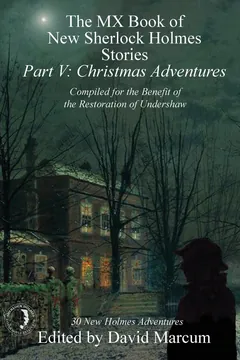
The MX Book of New Sherlock Holmes Stories - Part V
The Adventure of the Empty Manger
The Adventure of the Empty Manger by Tracy Revels
The adventures of my good friend Sherlock Holmes were vast and diverse.
In his many years of active practice, he came to the assistance of titled nobility, decorated military heroes, and industrial tycoons. He recovered stolen art and artifacts of incalculable value, tracked down assassins and world-famous felons, and prevented scandals that would have disgraced royal dynasties on three continents. Yet, in glancing back over the hundreds of cases which I have never published, I often find that the small problems my friend resolved were more fascinating than the cases which brought significant financial reward and the gratitude of monarchs. Crimes which took only moments to unravel were, in their way, as exciting as mysteries that required months of strenuous activity on Holmes’s part. And as the years of retirement creep steadily upon me, I recall my friend’s dignity and kindness far more than his celebrity. Indeed, the memories that are most intense to me are not those of breath-taking escapes or dramatic revelations, but of the times when the heart, as well as the mind, of Sherlock Holmes was revealed. Therefore, I offer to my long-suffering readers this brief account of an incident that gave me a startling insight into the very soul of Sherlock Holmes.
It was Christmas Eve of the year that Holmes returned to London. I had, at his insistence, abandoned both my medical career and my home, and resumed residence in that famous suite of rooms on Baker Street. While the young Doctor Verner had purchased my small Kensington practice, I did, on occasion, receive a summons from a former patient and could not in good conscience refuse to come to his aid. Lady Amelia Hildeborne was one such sufferer, a chronic invalid - at least by her own diagnosis - who would admit no other physician to her bedchamber. The note that she was dying from a hemorrhage had roused me from a winter’s nap and sent me scurrying to her mansion in one of London’s more fashionable neighborhoods. The lady proved to have only a slight nosebleed, and I was just buttoning my coat and shivering in the bitter wind on her doorstep when a sharp halloo caused me to turn my head. There, bundled in a long
coat and muffler, smoking a cigarette with an air of nonchalance, was my friend.
“Holmes? This is a strange coincidence.”
He favored me with a look of impatience. His scowl asserted he had once thought more highly of my intelligence.
“It is not a coincidence, Watson,” he said, flicking away the cigarette. “I am here because I followed you here.”
“But how?” I demanded. “I received the note from Lady Hildeborne at seven, long before you were awake. And do not tell me that you had my destination from Mrs. Hudson, because the note she brought up to me was sealed, and I tossed it into the fireplace before I left Baker Street.”
Holmes smirked. “There is no great mystery to the thing at all. When my friend Watson is roused from hibernation at such an ungodly hour of the morning - and I am made well aware of this fact because I can hear his muttered army oaths even through the walls of my own bedchamber - and then carelessly shaves and departs on a medical errand, it can mean only that he is destined for this fine address.”
“I confess I hurried but-”
“You clattered on the stairs and slammed two doors. There was blood on the razor and in the basin, and there is spot of plaster on the left side of your jaw, just where I suspected it would be. Your medical bag, which you leave near the sofa, was missing. There was no other possibility.”
“But why this address?” I asked. “I could have gone to any of the patients who remain rather inexplicably attached to me. You knew only that I was off on a medical case.”
“That, I confess, was a subtle calculation,” Holmes said, with a low chuckle. “But it is Christmas Eve, and just yesterday I heard you complain that you wished you had more funds for holiday libations. A particular bottle of French wine prominently displayed at Number 3, St. James Street, was mentioned. And I know that of your half-dozen former patients, only Lady Hildeborne rewards you in cash when your services are rendered.
Knowing also that she is, in your own words, a ‘miserable hypochondriac’, but one whose ‘payments are princely’, it was easy to imagine that such a summons would be very hastily answered, especially since the desire for a holiday treat is upon you.”
I shook my head in amazement. I had not realized just how much I had missed Holmes’s gift for making fantastic actions seem so obvious. “You make it all simple.”
Holmes shrugged, then turned and gestured to a waiting cab. “Life is appallingly simple, for those with sharp eyes and well-honed brains,” he said, without a trace of modesty.
“But there remains a bigger question,” I noted, as Holmes opened the door and then slid in beside me. “Why did you follow me?”
Holmes gave the driver orders to take us to Oxford Street. Leaning back in the seat, he frowned, mulling over my statement. For an instant, he appeared oddly puzzled, as perplexed as one of his own clients. “I can only assume that I wanted company.”
I tried not to let my amusement show. Holmes could make all the deductions he pleased, work his magical trick as often as the opportunity presented itself, but I felt that in this one area I was the more observant partner. In the months since he had returned, I had noticed a change in him.
He was less likely to disappear for long evenings, or to spend endless hours brooding over his index, or simply smoking his pipe in somber reflection.
Instead, he had more frequently insisted that I come along with him, whether for a ramble in Regent’s Park or to attend a concert of violin music at St. James’s Hall. Every case that had come his way, no matter how insignificant or obvious, had required my assistance. It had become the exception, rather than the rule, for one of us not to be at the table when the other was seated. In my view, the deduction seemed rather straightforward.
Whatever Holmes had been doing in the three years that the world presumed him dead, it had been a lonely occupation. He had returned to London almost starved for companionship and spiritual connection. His brief accounting of himself given on the day of his return - a tale of covert travels in Persia and Tibet, of wondrous explorations made under the name of Sigerson, and of painstaking work in a chemical laboratory in Montpellier - had never been mentioned again. I had come to believe that my friend was purposefully lying to me about his adventures, but I easily forgave him any falsehood that was required to maintain his dignity.
Whatever had happened, it was clear to me that it had been a harsh time for
him, and that my duty as his closest associate was to help him resume as normal a life as possible.
“So you plan to do some Christmas shopping?” I asked, as our cab rattled toward London’s famous commercial district.
Holmes shook his head. “I plan to do some watching. The combination of holy days and heathen capitalism is always amusing and occasionally instructive. Or would you prefer to return home?”
“No, I’ll accompany you. I’m certain that I can find something to spend my ‘princely payment’ on,” I said, patting my waistcoat pocket and feeling the weight of the coins within it.
Holmes began to talk of other things, and I lost track of both direction and time. But suddenly there was a sharp cry and a black robed figure came dashing out of an ancient, grime-covered edifice. The man’s shouts and squawks, along with the way he waved his arms and danced about at the edge of the street, gave him the appearance of an ungainly and agitated crow.
“Help! Robbers! Thieves! Help!”
Holmes twisted and gave me a predatory smile. Then, with the agility of a hound over a hurdle, he sprang from the cab. By the time I paid our fare to the startled and swearing driver, Holmes had the hysterical gentleman in his grip, shaking him firmly.
“Courage! Calm yourself.” The elaborate cassock clearly denoted the hysterical gentleman as an Anglican priest of the High-Church persuasion, but Holmes showed little respect for his holy status until the clergyman ceased screeching and began to take deep, steadying gasps of air. “Now,”
Holmes ordered, “tell us what has happened.”
The clergyman blinked, as if just awaking from a nightmare. He peered from one to the other of us with tiny, watery blue eyes. He was a diminutive person, barely over five feet tall, with small tufts of white hair just above his ears. A pair of silver spectacles swung from a chain on his neck, clanking against an ornate gold cross. His bald scalp glistened with sweat, and his thin lips trembled as he struggled to master coherent speech.
“Are you detectives?”
“Something of the sort,” Holmes answered. “You say you have been robbed?”
The clergyman twisted his boney hands together. “Yes. It - it will be a scandal. A disaster! The parish shall never recover. Oh, how could it have been stolen? Why did I ever walk away, turn my back, leave the door unlocked?”
“What has been stolen?” I asked. Our new client raised trembling hands.
“Our Lord himself. The holy infant of Bethlehem! The Christ Child!”
I noted how one eyebrow rose skyward on Holmes’s face. His lips twisted into an expression of chagrin. For just an instant, I thought he would turn on his heel and leave the man babbling on the sidewalk. But instead, Holmes heaved a martyr’s sigh.
“Come... you must show us the scene of the crime,” Holmes said, and the priest motioned for us to follow him inside the sanctuary.
“My name is Morley,” our new client gasped as we stepped into the deep shadows of the central aisle. “I have been the vicar of St. Rita’s Parish for almost twenty years. Never have we had such a catastrophe. Whatever will I tell the faithful, when they arrive for services tonight?”
As the clergyman continued to whine, I took in our surroundings. Though small, the church was lavish, with exquisite stained glass windows and plush carpeting. The smell of bay-scented candles mingled pleasantly with the aroma of ancient woodwork. Just beyond the pews were ancient marble crypts, complete with effigies of knights and ladies. I guessed that sometime in the distant past, this sanctuary had been the private chapel of a noble family. Though the neighborhood currently surrounding it was unmemorable, the little church clearly had a distinguished history.
The vicar led us to a spot just to the left of the altar. There we beheld a remarkable sight of the holiday season: a nativity scene housed in a hut made of paper and plaster, populated by nearly life-sized dolls. Each figure, from Mary and Joseph to the shepherds, wise men, and angels, was constructed of cloth and held in a realistic pose by nearly invisible wires.
Animals, including a donkey and lamb, were likewise cleverly crafted from wool and burlap and positioned in attitudes of adoration. While the shepherds and the holy family were clad in simple tunics and drapes, the wise men glittered with cloaks of gold and silver tissue, their diadems winking with false gems. I was so amazed by the display’s novelty and artisanship that for a moment I missed the central problem it posed.
The manger was empty.
“It is a special gift,” the vicar explained, “from Mr. Harold Whitestone.
Perhaps you have heard of him? No? He owns the Whitestone foundries and mills, in Yorkshire. He was born and raised on this street, a poor lad, but very devout. Since he made his fortune in trade, he has become a generous patron - he paid for our new windows and all the carpets. Just last week he presented us with this tableau.”
“It is certainly a striking decoration,” I said. The vicar’s blue-tinged lips pulled tight in a painful rictus, the expression of a man awaiting the dentist’s drill.
“Yes, it is, but such trouble for us - not that I am ungrateful, heaven forbid. Mr. Whitestone has been most kind! But, you see, Mr. Whitestone felt that we should keep the sanctuary open around the clock. He believed that people should be able to admire his gift at all hours - to aid them in their Advent meditations. But, of course, that meant my curate and I were forced to take shifts, to guard it carefully, lest someone be tempted into devilment.”
I could not resist a slight chuckle. “Surely making off with the Christ Child is more of a choirboy lark than a serious felony.”
The poor vicar’s trembling returned with such severity that I thought he might pitch himself onto the stone floor. “Oh no! This is not a prank! A thief has taken the doll for his eyes!”
Holmes had been slowly circling the scene, inspecting the thin wines that kept several of the characters upright. He halted beside the manger. “What was unique about the figure’s eyes?” he asked.
“They were sapphires, sir. True gems, not bits of paste. They were perfectly matched and said to be worth a thousand pounds each. That is why we have guarded our tableau so carefully. Everyone in the parish knows about the beautiful eyes of the baby.”
Holmes cut a sharp glance at the vicar. “And the rest of the doll?”
“It was of no particular value. It had a porcelain head, but the body was cloth, stuffed with sawdust and fragrant herbs. It was wrapped in a blue silk gown.”
Holmes dropped to his knees and pulled his lens from a pocket of his coat. He began to crawl around in the straw, closely examining the floor
beneath the figures. “Tell me what precautions you took,” Holmes said.
“Clearly they failed, for such a theft to occur.”
The distraught clergyman began to whimper. “I or Mr. Jones sat in the pews whenever the doors were unlocked. I watched the scene all morning -
a few ladies and gentlemen came by, and I was forced to shoo away some rapscallion children. An hour ago, Mr. Jones was to relieve me, but he was running late and I fear I had a case of... indisposition.” He clutched his belly, his face turning purple with shame. “I had no time to lock the doors, and I was in the washroom for nearly ten minutes. When I returned, the Christ Child was gone. Sir... sir, what are you doing?”
Holmes had dropped completely to the floor and appeared to be working at the cracks of an ancient burial slab that the nativity scene surmounted. I suspected the vicar was regretting allowing a clearly insane man to try to help him.
“Aha,” Holmes called, “we are in luck! The babe has sprung a leak!”
“What?”
“See here - the traces of sawdust and the scattered herbs. For us, the trail will go cold within a few paces, but for another... Watson, would you be so kind as to hail a cab and once again pay a visit to my old friend Mr.
Sherman at Number 3, Pinchin Lane?”
“Shall I ask for Toby?”
“No, I fear that Toby’s best days are behind him. Request Patches instead
- it is time that he proved his worth in the field.”
I set off immediately on my task, recalling with some humor the journey I had made to Mr. Sherman’s odd menagerie during the adventure of the Sign of the Four. It took me well over an hour to reach my destination and return, for the streets were horribly congested with last-minute shoppers, carol singers, snowball fights between street arabs, and general holiday mayhem. As I rode along, I tried to apply Holmes’s methods and reconstruct the scene in my mind. Holmes had frequently recommended employing one’s imagination in the early stages of detective work, and I gave mine full rein.
Clearly, the thief had learned of the doll’s value, either while attending worship or from the idle talk of parishioners. The vicar struck me as a man who would brag about the value of a patron’s gift, especially as the
neighborhood around the sanctuary was a poor one and the benefactor of the dolls had once been among the lowly of his flock. But how had the thief succeeded? Had he lurked in the shadows or somehow hidden himself beneath a pew? The church was exceptionally small, making such a concealment unlikely. The vicar seemed to believe his curate was trustworthy, but was he? Could the vicar himself be a criminal? For an instant my mind ran wild, considering the web of illegal activities organized by the late Professor Moriarty. Had Holmes failed in his task of bringing them all to ground? A man who would despoil a church had no respect for any creature, and might be the most desperate character imaginable. I suddenly found myself wishing that I were carrying my revolver instead of my medical bag.
Patches proved to be a dog of promiscuous pedigree. He had the long, trailing ears of a basset, the general compact body of a beagle, and the soft, curly coat of a spaniel. His eyes were bright, and his tail wagged madly. He was clearly eager to be released from his kennel and showed no concern for the inclement weather as we returned across the city. The vicar of St. Rita’s gave a sharp cry when we entered the sanctuary, protesting the dog’s presence.
“Very well, we shall retire,” Holmes said. “Do give my best to your patron, and be sure to explain to him that his gift could have been found, if not for your refusal to allow Patches a small sniff of the evidence.”
With an annoying whine, the vicar stepped back and motioned for Patches to approach. The dog dropped his nose to the straw, sniffing eagerly. He then whirled and made an unholy braying. I tossed the leash to Holmes, and we were off.
Respectable Londoners cleared a path as we sped down the street.
Patches tugged hard, and Holmes was pressed to keep up with the canine. I, likewise, had difficulty keeping up with Holmes. More than once I slipped on the ice and toppled into a dirty snowbank, but I was always able to find my companion’s trail by the harsh looks and murmurs of outrage from offended pedestrians.
A man sitting among a collection of spilled packages alerted me to the fact that “a crazy fellow with a dog” had turned the corner. I followed, just
in time to spot Holmes ducking into an alleyway. Gasping for breath, I picked up my pace, dipping into the lane behind them.
I suddenly was in a new and repulsive environment. Gone were the cheerfully decorated streets, the warmly glowing windows. I had entered a warren of dingy alleys and narrow pathways, a hive of grim and stench.
Walls were dark and stained, filth of all descriptions was piled near narrow doorways. We were stranded among some of the most squalid tenements of London, trapped in a vast rookery of disease and vice. Spectral figures wrapped in rags and cast-off coats hovered around fires set in barrels, and a sharp-ribbed, feral dog growled at Patches as our strange procession passed. I felt the weight of angry stares, the bitterness of resentment in the lean and dirty faces that turned as we moved through them. Patches stopped before a door that was half off its hinges. He squatted down and gave a sharp bark.
“I think we have reached our destination,” Holmes said. “My apologies for such a brisk jog, Watson. I trust your leg has stood the test.”
I glanced over my shoulder at a party of ill-clad men who had drawn together, whispering and staring at us. “I am much more concerned for my back. In this neighborhood, I might find a knife in it.”
“Not a scenic area of our great city, though I hear that tours are regularly organized for the curious - a pastime quaintly referred to as ‘slumming’.”
I could hardly share Holmes’s wry amusement at our predicament. At that moment, however, the flimsy door opened and a young boy emerged.
Much to my horror, he was barefoot, despite the bitter cold, and was in the process of applying a match to an old pipe.
“Excuse me, young man,” Holmes said, “but could you tell me if you have seen a girl enter this house only a few hours ago, carrying a rather large doll?”
The boy favored Holmes with an appraising look. “What’s it worth to you, Guv’nor?”
Holmes held out a shilling. The boy raised his hand and waggled his fingers, indicating a demand for more. Holmes started to place the coin back in his pocket.
“Wait! I know her! I can tell you!”
Holmes dropped one shilling into the boy’s grubby palm. The coin disappeared with the speed of a conjurer’s trick.
“That’s Betsy - she’s third floor, in the rear. What’s she done? Are the blue bottles after her?”
Holmes shook his head. “Thank you for that information. If you will be so good as to watch my dog for a few minutes, there’s a guinea in it for you.”
The boy eagerly seized Patches’s leash, squatting down to call the pup to him. In the ways of dogs and boys everywhere, Patches began to lick the lad’s face, perhaps the first good scrubbing that countenance had known in months. Holmes signaled for me to follow.
“Holmes,” I said, as we began ascending a narrow flight of stairs in almost total darkness, “how did you know it was a girl who took the doll?”
“Elementary, Watson. There were some indications of a small, delicate boot-print on the sanctuary carpet around the nativity scene. But even before I saw those marks, I theorized that it was a young girl who committed this crime.” He turned as we reached the door of the final flat in the rear of the building. “Who else would impulsively steal a pretty doll?”
Holmes knocked gently. After a moment, the door swung open, revealing a girl who was no more than ten. Her pale face and sharp cheekbones spoke of a life of suffering. Her greasy brown hair was fixed in long, unkempt braids, and her dress and smock were ragged. Great holes gapped from her torn stockings, and her little boots were held together with pieces of string.
“Yes?” she whispered, clearly alarmed at the sight of two official-looking gentleman at her threshold. Holmes removed his hat. His entire persona changed in an instant. Gone was the stern enforcer of justice, the apprehender of felons; Holmes was suddenly a paragon of benevolence.
“Miss Betsy, we have been asked to come here by the vicar of St. Rita’s church. We believe that there has been a terrible mistake made, and that you have taken something from the sanctuary that did not belong to you.”
The girl gasped and stepped backward. Her chin lifted and moisture filled her eyes, but she made no attempt to deny her actions.
“I only took it for Ellen. It was all she wanted, a dolly for Christmas. I went to church, to pray for her. She’s so sick, and there’s no money, and Father is gone and Mother...”
The child dissolved in tears. I started to speak, but Holmes signaled for silence. The girl gasped against her sudden emotion.
“I didn’t think... the Christ Child would mind if I took him. Ellen is so sick. I thought maybe... having a dolly... would make her better. Like a miracle.”
“Miss Betsy,” Holmes said, “my friend is a doctor. Will you allow him to treat your sister?”
She sniffed and stared down at her twine-laced boots. “I can’t. There’s no money.”
I held up my bag and quickly borrowed a phrase from Holmes. “My dear little girl,” I said, “my work is its own reward.”
She looked up, the skepticism of a hard existence making her momentarily wary of my offer. Then she grabbed my hand and towed me into the only other room in the flat, a close and miserable chamber with a mattress on the floor. An even smaller girl was laid upon it, covered in an array of thin blankets and scarfs. The Christ Child was tucked beneath her arm, held as tightly as her pitiful strength would allow. Betsy reached down and gently removed the doll, passing it to Holmes with a murmured apology and then making room for me to kneel at her sister’s side to begin my examination.
Holmes’s way with children was always remarkable - his tone was firm, yet kind, and in no way scolding or patronizing. In just a matter of moments he was able to coax the girl’s story from her. Her father, it seemed, had died from an injury sustained in a local factory, forcing her mother to go to work at an unwholesome sweatshop. The girls were left alone, and they tried to help their family by mud larking. Ellen had fallen ill while climbing about in the dregs of the Thames, looking for whatever bits of cast-off junk the children could sell. Their mother was at work, and Betsy had slipped away to the church while her ailing sister napped, at first to pray but then, upon spotting the vicar, to ask for aid. The clergyman had ordered the girl out of his sanctuary, but the moment his back was turned she had returned and stretched out along a pew. When he made his brief exit to the washroom, she scampered up to the altar and purloined the doll from the manger.
“I knew it was wrong,” Betsy said, “but I couldn’t stop myself.”
The little sister had a high fever and was congested, but I felt that we had arrived in time to save her. I was about to say as much when I noted the expression on my friend’s face. I had never seen him look so troubled.
“Watson, I must step away for a few moments. Miss Betsy, do pay attention to the good Doctor and do all that he requires.”
She nodded solemnly. From long experience, I knew better than to inquire where Holmes was going or what his sudden errand might be. For almost an hour, I schooled the little girl in how to best care for her sister, instructing her on when to administer the medicine I provided, and how to prepare some plasters to keep her chest warm and aid her breathing. We gave her a quick wash, then changed her coverings and her meager gown, wrapping her properly. By the time we finished our tasks, Holmes appeared in the doorway.
“Ah, I see that the sickroom has been cleared of debris,” Holmes said.
“And this, I think, shall cheer it up.”
He removed a package from inside his coat. It was wrapped in bright red and green paper, and topped with a spring of holly. Betsy stared at it.
“Sir, what is that?”
“Something you and your sister will enjoy. No, no, you must not open it until Christmas morning! You cannot wait? Very well. Ah, and I see that my trusty porters have arrived!”
As Betsy freed the box from its paper, a small troop of young boys and girls followed Holmes inside, each carrying a paper bag filled with groceries. One child tripped, spilling out a sack of oranges and nuts.
Holmes merely laughed, rewarded each of his helpers with a shiny coin, and herded them out through the doorway.
I heard Betsy gasp. At last the box was open, and inside was the loveliest doll I had ever seen. It was a perfect replica of a young girl, complete with a pink satin dress and embroidered Chinese silk slippers. It had bright blue eyes, and its brown hair was set in enticing curls. I was struck by how much it would resemble Betsy, if life and circumstances had treated her with more kindness.
“Oh, she is wonderful! Ellen will be so happy!” Betsy’s gaze took in all of the foodstuffs as well. “But - we cannot pay you.”
“Father Christmas never expects payment,” Holmes said. “I am merely his delivery man.”
Betsy was old enough to know the truth of such matters. Yet she nodded sagely and agreed to tell her sister that they had been visited by Saint Nicholas. Holmes handed the girl a card.
“On Boxing Day, you must come to this address. A kind lady named Mrs. Hudson will give you more treats, which you will share with your sister and your mother.”
“But sir,” the girl sighed, “shouldn’t I be sent to jail? I did a bad thing.”
Holmes knelt, meeting her gaze at her level. “It is true, you did a naughty deed, but Christmas is the season for forgiveness. I think you have learned an important lesson today - and perhaps taught a greater one to two old sinners.”
The girl nodded solemnly, then bobbed a curtsey. Holmes reclaimed the Christ Child doll, which had been pushed against a wall. We chuckled when we noticed that a seam along its right leg had opened, spilling out sawdust and herbs, withering the limb until the infant Jesus was lamed by his adventure. Holmes wrapped the doll in his coat, then we descended the stairs and reclaimed Patches. Holmes paid his helper, who was somewhat loathe to surrender his charge, as he had been training Patches to fetch a stick. We journeyed first to Pinchin Lane, where Mr. Sherman required a recounting of our adventure, and Patches was duly rewarded for his services with a large bone. We returned to St. Rita’s at a much slower pace than we had departed it, and found the frantic vicar waiting for us at the door.
“Thank heavens! By all that is wonderful, you have saved me!” He seized the doll from Holmes’s hand and raced to return it to the manger. “I cannot imagine the damage that would have been done. My career, my reputation would have been ruined. But... but who took it? How did you find the villain? Is he under arrest? Where should I go to file the charge against him? Tell me his name and I will have him prosecuted to the full extent of the law!”
“You will do no such thing,” Holmes snapped. “You hired me only to retrieve the figure, not to find the thief.”
“But-”
One icy glare silenced the clergyman. Holmes folded his arms. “Now, there is the matter of my fee.”
“Fee?”
“Do you think I race around London for my health? Do you think that solving mysteries, producing stolen articles from thin air, is some variety of magic trick? Of course I demand compensation.”
The vicar’s brow became a virtual Niagara. Sweat streamed over his bushy eyebrows, dripped from his chin, and stained his collar. He pressed clenched hands against his breast.
“Oh, of course. How... how much, sir? What will it cost me?”
“Some human compassion,” Holmes said. “I demand that you show some care for the people who live at this address. They are to receive food, clothing, and medicine for their sick child.” Holmes thrust a card into the clergyman’s hand. The vicar peered down at the address and gave a gasp of recognition.
“I know them. The father died of drink, I believe, and the mother is a harlot - the oldest girl will be a slut as well, in time. Surely there are more worthy recipients.”
In a sudden motion, Holmes seized the wretched clergyman by the front of his cassock. The vicar’s feet quivered in mid-air. “This family will receive aid, or your patron will be informed of how his gift was nearly lost by your irresponsibility. Is that clear to you?” Holmes hissed.
The clergyman bobbed his head. Holmes dropped him to the ground and bid him good day. We departed just as the first of the Christmas Eve worshippers came streaming into the sanctuary.
Later that evening, Sherlock Holmes fell into a black mood. He barely exchanged words with me over dinner, other than to complement the choice of vintage wine that I had purchased on the way home. He stood smoking his pipe, staring out the window onto Baker Street.
“Watson,” he said, “are you familiar with St. Rita, the worthy for whom the church was named?”
I confessed my ignorance as I poured myself another glass of wine and joined him at the window. Outside, a few intrepid carolers were making their rounds, and more than one obviously intoxicated reveler staggered
down the sidewalk, bobbing from doorway to doorway and trying without success to hail a cab.
“She is a patron saint of impossible causes. I am beginning to think that it is all impossible... or at least pointless.”
A fresh, heavy snow began to fall, forcing those of goodwill and too much holiday cheer to abandon the street. Holmes withdrew his pipe. His face was a mirror of sadness, and his eyes seemed not to be gazing out at the snow, but deeply into the past.
“What kind of world do we live in, Watson?” Holmes asked. “What type of man would create gilded statues and dolls sewn with gems while ignoring starving orphans in the shadows? What kind of faith would place more emphasis on the letter of the law than the spirit of compassion? We say we live in an age of progress, but what progress have we really made?”
Something in his stance, his tone, brought me to a powerful realization.
My friend was hiding something beneath his innate brilliance. Over the years, I had caught glimpses of it in the way Holmes treated his Baker Street Irregulars and in his general comradery with children. It illuminated him whenever he fought for justice for the weak and oppressed. My friend had never refused a case for lack of payment, and he could be as gallant to an old charwoman as to a duchess. In that very moment, as Christmas Eve became Christmas Day, I began to wonder if what little Holmes had told me about his youth might be as much of a falsehood as I suspected the tales of his hiatus were. What secrets was he protecting? What might have been his true origin?
But I dared not voice my suspicions. Holmes’s sudden despair alarmed me, and I tried to draw him out of his dark thoughts. “Where did you find the doll that you gave to Betsy and Ellen?”
“In a toy shop not five blocks from where those poor girls resided. They must have passed it on display in the window, every day on their way to the Thames.” He turned and went to the fireplace, knocking out the debris on his pipe into the grate. “I have never set foot in such an establishment. No wonder parents dread this season. Do you have any idea of how much such a babble costs?”
“Yet you did not hesitate to pay it,” I said. Holmes made a face and provided a pithy description of the nearly murderous crowd in the store, all
squabbling over dolls and trains and sets of building blocks. Perhaps it was this sudden spark of humor, or possibly it was the second glass of wine that I had consumed, but something caused me to blurt out the thoughts that his amusing tirade inspired.
“Holmes - you do the world a disservice by remaining a bachelor! You should marry and become a father. Your talents with children are exceptional - imagine how rewarding a family would be.”
“A family! Then heaven help London!” Holmes said, with an excess of alarm. “Can you envision the Holmes tribe set loose upon the metropolis?
Running amok, trying to solve every puzzle and unravel every mystery among the juvenile set? My children would be inquisitive little savages with magnifying glasses and cloth caps and pipes - even the girls! They would make the Baker Street Irregulars look like angels. No, my friend, the offspring of Sherlock Holmes would be a story for which the world would never be prepared!”
I laughed fully and poured yet another libation for us, passing a glass to my friend and thinking that, of all the gifts of the holiday, the best one of all was to have him back. “Happy Christmas, Sherlock Holmes.”
OceanofPDF.com