
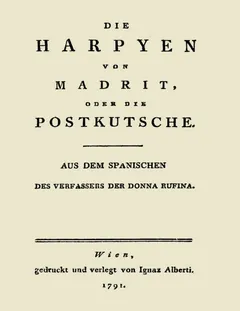
Die Harpyen von Madrit, oder die Postkutsche, Aus dem Spanischen des Verfassers der Donna Rufina
Vierte Spazierfahrt.
Dorothee, welche nun die Reihe traf, ließ vier Monathe verstreichen, bevor sie
eine neue Unternehmung wagte, damit sich unterdessen das Gerücht vom
Kapellenbaue verlieren möchte. Auch benützte man diese Zeit, um den Wagen
wieder anders zuzurichten, und Kutscher und Pferde zu wechseln. Endlich fand
sie es räthlich, in Gesellschaft ihrer Mutter, und der alten Banuelos zu Madrid
einzuziehen. Sie nahmen ihre Wohnung dieß Mahl zur Abwechslung in dem
Martinsviertel. Nach einigen Tagen begaben sie sich mit dem neuen Escudero,
den sie aufgenommen hatten, unter das Thor von Quadalaxara. Als die jungen
Herren, die auf dem Markte herum spazierten, einen Damenwagen an einem
Kaufmannsgewölbe halten sahen, liefen sie wie Hasen davon, um nicht etwa in
die Verlegenheit zu gerathen, wenn es eine von ihren Bekannten wäre, aus
Artigkeit oder Tändeley ein Geschenk anbiethen zu müssen. Dorothee ließ sich
eine goldener Tabatiere, und etwas von Frauenputz an den Wagenschlag bringen.
Mit einem Mahle kam ein fremder Cavalier, der erst unlängst aus Andalusien
angekommen war, und nun hier den Zusammenfluß der Madriter schauen wollte,
an dem Wagen vorüber. Die schöne Dorothee fiel ihm auf, und als ein Mann von
Welt, machte er ihr sogleich seine tiefe Verbeugung. Er mochte beyläufig sechs
und zwanzig Jahre haben, war klein von Person, aber niedlich gebaut, und ganz
fertig, ein Gespräch mit feinen Wendungen und drolligen Einfällen zu würzen;
dabey war er aber von ungemein verliebter Stimmung, und sein Kopf war vom
Romanenlesen ein wenig angebrannt. Dorothee bemerkte den raschen Eindruck,
den sie auf ihn gemacht habe, und begegnete seinem Blicke vorsetzlich einige
Mahl. Er ward muthiger, trat an den Wagenschlag, und sagte: „Schöne
Unbekannte, diese Waare ist schon bestellet.“ „Das thut mit leid,“ antwortete
Dorothee. „Indessen,“ fuhr der Andalusier fort, „wenn sie Ihnen gefällt, bin ich
bereit, sie mir abhandeln zu lassen, und will sie als förmlicher Kaufmann in Ihre
Wohnung bringen, die Sie mir zu sagen belieben werden.“ Hiermit steckte er
dem Kaufmann, was die Waare beyläufig werth seyn mochte, in die Hand.
„In der That,“ sagte Dorothee, „wenn ich Sie kennte, würde ich Ihnen
vielleicht mit eben dieser — wie will ich sagen — Freymüthigkeit, oder Zudringlichkeit, wenn Sie wollen, in Ihren Ton einstimmen; so aber“ — sie hatte
sehr gut gesehen, was vorgegangen war — „bleibt mir nichts übrig, als die
Waare wieder dahin zurück zu stellen, von wo ich sie bekommen habe. Gnädiges
Fräulein,“ sagte er, „denn Frau können Sie doch unmöglich seyn; Sie scheinen
ungehalten: seyn Sie es aber nicht. Ich bin ein Mensch, der niemand auf Erden,
am wenigsten aber eine Dame beleidigen will, und der nur manchmahl den
Rechnungsfehler begeht, daß er meint, man würde seine — ich kann es mit
gutem Gewissen nur Lebhaftigkeit nennen, eben so gerade aufnehmen, als er sie
äußert. Bey uns in Andalusien wird mir so etwas zu Gute gehalten; ich erwartete
denn, daß ich hier, wo ich erst zwey Tage bin, ein anderes Andalusien finden
werde.“
Dorothee merkte nun, daß sie ihren Mann gefunden habe, und fand es für
gut, an der Stelle eine nähere Bekanntschaft zu gründen. Sie frage denn: „Mein
Herr, das ganze Waarenlager werden Sie doch nicht aufgekauft haben,“ stieg aus
dem Wagen, und ging in das Gewölbe; Der Andalusier ihr nach.
Sie ließ sich Federn, Bänder, und Seidenstoff für beyläufig hundert Escudo’s
vorlegen, und behandelte den Preis. Sie bemerkte, daß er vom Kaufmanne
heimlich die Rechnung fordre, und sagte daher: „Mein lieber Herr, ich habe vor
Tische noch einige Besuche vor mir: Sie würden mich verbinden, wenn Sie mir
alles nach Tische in meine Wohnung schickten; dann werden Sie auch gleich das
Geld dafür erhalten.“ Der Kaufmann fand sich sehr bereit, und Dorothee sagte
ihm ihre Wohnung. Der Andalusier sprach nur: „Gnädiges Fräulein, ich weiß
nun Ihre Wohnung: wie würden Sie sich wohl benehmen, wenn ich unartig
genug wäre, Sie zu besuchen?“ „Fürs erste,“ antwortete Dorothee, „halt’ ich Sie
nicht für so voreilig; und wenn Sie es wären, würde mir nichts übrig bleiben, als
daß ich durch ein artiges Betragen Sie zu bessern suchte.“ Sie ging fort, und fuhr
nach Hause. Nach Tische kam der Diener des Kaufmanns, brachte die Waaren,
und als sie sich anstellte, als ob sie bezahlen wollte, schlug er es unter dem
Vorwande aus, daß die Summe noch zu klein wäre, um eine Rechnung zu
machen, und daß sie ihr noch mehr zu verkaufen dächten. Es währte nicht lange,
so war auch unser Andalusier da. Dorothee empfing ihn in Gesellschaft ihrer
Duennen sehr artig, und er erzählte ihr, daß er Don Thadeo de Sylva heiße,
eigentlich aber Don Thadeo Tristan de Lorgenes, nach einem Oheime, der das
Abgeschmackte dieses Nahmens mit einer ansehnlichen Erbschaft wieder gut
gemacht hätte; Dorothee vertraute ihm dafür, daß sie mit einem Ritter
verheirathet sey, der sich in Indien befände, und so unglücklich gewesen sey, in
Lima gefangen zu werden; nun erwarte sie aber ihn und ihr ganzes Vermögen
mit der nächsten Flotte. Don Thadeo both ihr feyerlich alle Dienste an, die in seinen Kräften ständen, indem er wohl wisse, was sich für Schwierigkeiten
fänden, wenn man am Hofe Forderungen machte. „Es ist wahr,“ erwiederte sie;
„aber zum Glücke hab’ ich doch immer genug gehabt, um zwey Dienerinnen,
einen Escudero, und meinen Wagen zu halten.“ Nun war es Zeit, sich zu
entfernen, und Thadeo empfahl sich.
Dorothee suchte nun nähere Erkundigung über seine Umstände einzuziehen,
und alle Nachrichten waren nach Wunsche. Seine Besuche wurden immer
häufiger, und seine Neigung immer heftiger. Dorothee suchte seine Schwächen
aufzufinden, unter denen auch die Vorliebe für Lieder und Melodien, die er
selbst verfaßt hatte, war, und suchte sie auf’s Beste zu benutzen; kurz, er ward so
verliebt, als noch kein Liebhaber ihrer Mitschwesterchen gewesen war.
Dorothee, die eine sehr schöne Stimme, und einen hinreißenden Vortrag hatte,
sang von der Stunde an kein Liedchen mehr, das nicht Thadeo verfertigt hatte,
und verlangte selbst noch Unterricht auf der Guitarre von ihm; dafür liefen sich
seine Bedienten mit Küchengeschenken müde, und er selbst brachte beynahe
jeden Tag irgend eine kostbare Kleinigkeit zum Putze mit. Dorothee hatte jedes
Mahl einen Vorwand bereit, unter dem es ihre Bescheidenheit erlaubte, seine
Großmuth nicht zurück zu schrecken. Auch hatte sie sich schon zwey Mahl
einen Kuß auf die Lippen gefallen lassen, von denen sie den letzten sogar — wer
hätte sich’s von Donna Dorothea träumen lassen? — mit schamhaftem Erröthen
erwiederte.
Den folgenden Tag kam Thadeo nicht, und Dorothee war in sichtbarer
Unruhe: sie konnte sein Außenbleiben nur mit der strengen Witterung
entschuldigen; denn es war mitten im Winter. Sie hatte sich auch nicht getäuscht;
denn er kam den andern Tag: indessen war es ihr doch ein Fingerzeig, daß sie
ihn noch nicht genug in Bewegung gesetzt habe. Sie suchte daher alles Mögliche
hervor, was einen Mann fest halten kann: sie schmollte; sie bezeigte ihm bey
jeder Gelegenheit Aufmerksamkeit, und es gelang ihr auch, ihn bald so zu
kirren, daß er mit Leib und Seele an ihr hing, und nun weiter nichts mehr fehlte,
als eine gute Gelegenheit, um sein Vertrauen und seine Liebe so ergiebig als
möglich zu benutzen.
Während Dorothee in Illescas wohnte, war ein Student aus Toledo dort
angekommen. Er hieß Don Basil, war ein erzarmer Teufel, übrigens aber so
schön und wacker gebildet, und so aufgeweckten Geistes, daß Dorotheens
Standhaftigkeit selbst so vielen Reitzen nicht widerstehen konnte. Sie wurden
bald bekannt, noch geschwinder vertraut, und es war bald so weit gekommen,
daß sie ihm sogar gestattete, ihr nach Madrit zu folgen, unter dem Bedingniß’ aber, daß er ihre Unternehmungen nicht im geringsten stören sollte. Er ging es
darauf ein, und lebte denn auch in Madrit in dem besten Einverständnisse mit
ihr, ohne sich von Eifersucht plagen zu lassen. Alles wäre gut gegangen; nur
wollte sich noch keine besonders vortheilhafte Gelegenheit zeigen.
Endlich traf es sich, daß einer von Thadeo’s Freunden heirathete. Thadeo
sagte Dorotheen, daß die Vermählung bey San Sebastian mit einer seltnen Pracht
gehalten werden würde, und daß er selbst in einem Glanze erscheinen werde, in
dem sie ihn noch nie gesehen habe. „Wenn ich in der Kirche erscheinen soll,“
sagte Dorothee, „so verlange ich ohne dieß, daß mein lieber Thadeo die übrige
Gesellschaft übertreffe. Wenn Sie mir aber dann gefallen, bin ich nicht zufrieden,
Sie nur in der Kirche bewundern zu können; ich will Sie bey mir im Hause
haben. Sie werden sich doch gewiß um eilf Uhr vom Spiele los machen können;
und bis dahin will ich mit dem Abendessen auf Sie warten.“
Thadeo sagte es ihr heilig zu, und so schieden sie aus einander. Die
Vermählung ging vor sich, und Dorothee erstaunte über die Pracht ihres
Geliebten. Er war im prächtigsten Stoffe gekleidet, und schien alle Juweliere von
Madrit ausgekauft zu haben. Knöpfe, Ketten, Agraffen, Ringe, alles war von
Brillanten. Er kam auch um eilf Uhr des Abends voll Vergnügen zu Dorotheen,
und erzählte ihr, daß er so glücklich gewesen sey, gegen zwey tausend Escudo’s
zu gewinnen. Sie speisten; es wurde immer später; Dorothee war ungemein
gefällig, und sagte endlich, daß sie ihn heute nicht mehr nach Hause lasse: denn
wenn irgend ein Schurke seinen Schmuck gewahr würde, könnte er ein Unglück
haben. Sie werde ihm daher ein Bett anweisen, und sie nehme durchaus keine
Widerrede an.
Thadeo meinte, nun schon den Gipfel seines Glücks erstiegen zu haben, und
war beynahe ausgelassen vor Freude. Er trank ein Glas ums andere; aber
Dorothee hatte ihm einen besonders köstlichen Trank bereitet, dessen Wirkung
er nicht vermuthet hätte. Es war zwölf Uhr, und Dorothee wies ihm das Bett in
dem Zimmer an dem ihrigen an. Er kleidete sich hastig aus, hatte sich aber im
Bette kaum ein wenig erwärmt, als der Trank seine Wirkung that, und der
verliebte Ritter so laut zu schnarchen anfing, daß man es auf die Gasse gehört
haben würde, wenn ihm seine treuen Wärterinnen nicht die Bettdecke über den
Kopf gelegt hätten.
Nun ward alles, was er an dem Leibe gehabt hatte, sammt dem beträchtlichen
Spielgewinne, mit Hülfe des Studenten aus Toledo, und des Kutschers
zusammen gepackt, und nach ihrer einstimmigen Schätzung auf mehr als
vierzehn tausend Escudo’s angeschlagen. Es war nichts mehr übrig, als was sie mit Don Thadeo anfangen sollten. Er hatte ein zu schönes Spitzhemd auf dem
Leibe, als daß es ihm der Student aus Toledo hätte gönnen sollen; er zog es ihm
denn ab, und bekleidete ihn dafür mit einem Unterrocke der alten Banuelos.
Vorn unter das Kinn band er ihm ein Tuch, wie einem kleinen Kinde, und an eine
Schnur knüpfte er verschiedene Sachen, wie man den Kindern anzuhängen
pflegt; ein Füßchen von den Hasen, den er des Abends noch gegessen hatte; eine
Elendklaue, wider das Augenweh; einen kleinen Mörserstößel, und eine kleine
Glocke. In diesen Aufzuge setzten sie ihn auf einen großen Korb; der Student
und der Kutscher trugen ihn fort, hingen ihn an den Balcon eines armen
Indianers, und eilten nach Hause, um sich mit der übrigen Gesellschaft in
Sicherheit zu setzen.
Thadeo schlief in seinem Korbe fort, und träumte sich in den Armen der
schönen Dorothee. Mit Anbruch des Tages stand der Indianer auf, schlug die
Fensterbalken auf, und nahm den Korb wahr. Er setzte die Augengläser auf, und
sah zu seiner größten Verwunderung dieses große Kind in dem Korbe liegen.
Sein erster Gedanke war wirklich, daß es ein Findelkind sey, das man ihm vors
Haus gebracht hätte, und er rief seinen Bedienten, daß er es herab nehmen, und
vor ein anderes Haus legen solle. Der Bediente konnte nicht sehen, was im
Korbe wäre, weil der Korb so hoch hing, und schnitt den Strick ab, um den Korb
mit den Händen aufzufangen; das Kind fiel aber mit solcher Gewalt herunter,
daß es den armen Bedienten zu Boden warf. Das Kind selbst schlief so sanft, daß
es selbst von dieser Erschütterung nicht erwachte. So wehe sich der Bediente
gethan hatte, brach er doch in ein lautes Gelächter aus, als er das Kind erblickte.
Er trug es mit Hülfe seines Herrn in die Stube, und hier bemerkten sie erst einen
Zettel, den es im Busen stecken hatte. Er lautete: „Die Mutter dieses Kindes hat
es Armuths halber in ihren Armen hierher getragen, und bittet, sich seiner
anzunehmen. Übrigens ist es schon seit einiger Zeit getauft.“ Der Indianer und
der Bediente suchten es zu wecken; sie kitzelten und kneipten es; alles war aber
vergebens. „Wahrhaftig,“ sagte der Indianer; „ich habe noch kein Kind gesehen,
das einen so gesunden Schlaf gehabt hätte.“ Indessen kamen sie doch bald auf
die Vermuthung, daß dieser unnatürliche Schlummer die Wirkung eines
Schlaftrunkes sey. Erst gegen Mittag kam Thadeo zu sich; und als er seinen
lächerlichen Aufzug erblickte, und sah, daß er in einer ganz fremden Wohnung
sey, fing er zu schreyen an, daß der Indianer und sein Bedienter herbey liefen,
die ihm denn erzählten, in was für einem Zustande sie ihn gefunden hätten. Er
schnaubte vor Wuth, und schwor allen, die an dieser Beschimpfung Theil hätten,
sie zu vernichten. Er ließ sich Kleider bringen, und machte sogleich Anstalt, um
Dorotheen mit ihrer ganzen Gesellschaft in Verhaft nehmen zu lassen. Sie war aber schon längst zu Illescas, wo sie mit ihren Mitschwestern überein kam, nach
Granada zu reisen, um dort neue Abenteuer, die ihrer würdig wären,
aufzusuchen.
Wie lange sie dieselben fortsetzten, meldet die Geschichte nicht: so viel läßt
sich vermuthen, daß sie sich bald von einander zu trennen genöthigt sahen,
welches sie um so leichter thun konnten, da jede schon in Schäfchen ins Trockne
gebracht hatte.
E N D E.
Sie haben Die Harpyen von Madrit, oder die Postkutsche, Aus dem Spanischen des Verfassers der Donna Rufina zu Ende gelesen
Alonso de Castillo Solórzano
Bücher wie dieses




Hinweis von Project Gutenberg
End of the Project Gutenberg EBook of Die Harpyen von Madrit, oder die Postkutsche, by Alonso de Castillo Solórzano
*** END OF THIS PROJECT GUTENBERG EBOOK DIE HARPYEN VON MADRIT ***
***** This file should be named 54368-h.htm or 54368-h.zip ***** This and all associated files of various formats will be found in:
http://www.gutenberg.org/5/4/3/6/54368/
Produced by the Online Distributed Proofreading Team at http://www.pgdp.net (This book was produced from scanned images of public domain material from the Google Books project.)
Updated editions will replace the previous one--the old editions will be renamed.
Creating the works from public domain print editions means that no one owns a United States copyright in these works, so the Foundation (and you!) can copy and distribute it in the United States without permission and without paying copyright royalties. Special rules, set forth in the General Terms of Use part of this license, apply to copying and distributing Project Gutenberg-tm electronic works to protect the PROJECT GUTENBERG-tm concept and trademark. Project Gutenberg is a registered trademark, and may not be used if you charge for the eBooks, unless you receive specific permission. If you do not charge anything for copies of this eBook, complying with the rules is very easy. You may use this eBook for nearly any purpose such as creation of derivative works, reports, performances and research. They may be modified and printed and given away--you may do practically ANYTHING with public domain eBooks. Redistribution is subject to the trademark license, especially commercial redistribution.
*** START: FULL LICENSE ***
THE FULL PROJECT GUTENBERG LICENSE
PLEASE READ THIS BEFORE YOU DISTRIBUTE OR USE THIS WORK
To protect the Project Gutenberg-tm mission of promoting the free distribution of electronic works, by using or distributing this work (or any other work associated in any way with the phrase "Project Gutenberg"), you agree to comply with all the terms of the Full Project Gutenberg-tm License (available with this file or online at http://gutenberg.org/license).
Section 1. General Terms of Use and Redistributing Project Gutenberg-tm electronic works
1.A. By reading or using any part of this Project Gutenberg-tm electronic work, you indicate that you have read, understand, agree to and accept all the terms of this license and intellectual property (trademark/copyright) agreement. If you do not agree to abide by all the terms of this agreement, you must cease using and return or destroy all copies of Project Gutenberg-tm electronic works in your possession. If you paid a fee for obtaining a copy of or access to a Project Gutenberg-tm electronic work and you do not agree to be bound by the terms of this agreement, you may obtain a refund from the person or entity to whom you paid the fee as set forth in paragraph 1.E.8.
1.B. "Project Gutenberg" is a registered trademark. It may only be used on or associated in any way with an electronic work by people who agree to be bound by the terms of this agreement. There are a few things that you can do with most Project Gutenberg-tm electronic works even without complying with the full terms of this agreement. See paragraph 1.C below. There are a lot of things you can do with Project Gutenberg-tm electronic works if you follow the terms of this agreement and help preserve free future access to Project Gutenberg-tm electronic works. See paragraph 1.E below.
1.C. The Project Gutenberg Literary Archive Foundation ("the Foundation" or PGLAF), owns a compilation copyright in the collection of Project Gutenberg-tm electronic works. Nearly all the individual works in the collection are in the public domain in the United States. If an individual work is in the public domain in the United States and you are located in the United States, we do not claim a right to prevent you from copying, distributing, performing, displaying or creating derivative works based on the work as long as all references to Project Gutenberg are removed. Of course, we hope that you will support the Project Gutenberg-tm mission of promoting free access to electronic works by freely sharing Project Gutenberg-tm works in compliance with the terms of this agreement for keeping the Project Gutenberg-tm name associated with the work. You can easily comply with the terms of this agreement by keeping this work in the same format with its attached full Project Gutenberg-tm License when you share it without charge with others.
1.D. The copyright laws of the place where you are located also govern what you can do with this work. Copyright laws in most countries are in a constant state of change. If you are outside the United States, check the laws of your country in addition to the terms of this agreement before downloading, copying, displaying, performing, distributing or creating derivative works based on this work or any other Project Gutenberg-tm work. The Foundation makes no representations concerning the copyright status of any work in any country outside the United States.
1.E. Unless you have removed all references to Project Gutenberg:
1.E.1. The following sentence, with active links to, or other immediate access to, the full Project Gutenberg-tm License must appear prominently whenever any copy of a Project Gutenberg-tm work (any work on which the phrase "Project Gutenberg" appears, or with which the phrase "Project Gutenberg" is associated) is accessed, displayed, performed, viewed, copied or distributed:
This eBook is for the use of anyone anywhere at no cost and with almost no restrictions whatsoever. You may copy it, give it away or re-use it under the terms of the Project Gutenberg License included with this eBook or online at www.gutenberg.org/license
1.E.2. If an individual Project Gutenberg-tm electronic work is derived from the public domain (does not contain a notice indicating that it is posted with permission of the copyright holder), the work can be copied and distributed to anyone in the United States without paying any fees or charges. If you are redistributing or providing access to a work with the phrase "Project Gutenberg" associated with or appearing on the work, you must comply either with the requirements of paragraphs 1.E.1 through 1.E.7 or obtain permission for the use of the work and the Project Gutenberg-tm trademark as set forth in paragraphs 1.E.8 or 1.E.9.
1.E.3. If an individual Project Gutenberg-tm electronic work is posted with the permission of the copyright holder, your use and distribution must comply with both paragraphs 1.E.1 through 1.E.7 and any additional terms imposed by the copyright holder. Additional terms will be linked to the Project Gutenberg-tm License for all works posted with the permission of the copyright holder found at the beginning of this work.
1.E.4. Do not unlink or detach or remove the full Project Gutenberg-tm License terms from this work, or any files containing a part of this work or any other work associated with Project Gutenberg-tm.
1.E.5. Do not copy, display, perform, distribute or redistribute this electronic work, or any part of this electronic work, without prominently displaying the sentence set forth in paragraph 1.E.1 with active links or immediate access to the full terms of the Project Gutenberg-tm License.
1.E.6. You may convert to and distribute this work in any binary, compressed, marked up, nonproprietary or proprietary form, including any word processing or hypertext form. However, if you provide access to or distribute copies of a Project Gutenberg-tm work in a format other than "Plain Vanilla ASCII" or other format used in the official version posted on the official Project Gutenberg-tm web site (www.gutenberg.org), you must, at no additional cost, fee or expense to the user, provide a copy, a means of exporting a copy, or a means of obtaining a copy upon request, of the work in its original "Plain Vanilla ASCII" or other form. Any alternate format must include the full Project Gutenberg-tm License as specified in paragraph 1.E.1.
1.E.7. Do not charge a fee for access to, viewing, displaying, performing, copying or distributing any Project Gutenberg-tm works unless you comply with paragraph 1.E.8 or 1.E.9.
1.E.8. You may charge a reasonable fee for copies of or providing access to or distributing Project Gutenberg-tm electronic works provided that
- You pay a royalty fee of 20% of the gross profits you derive from
the use of Project Gutenberg-tm works calculated using the method
you already use to calculate your applicable taxes. The fee is
owed to the owner of the Project Gutenberg-tm trademark, but he
has agreed to donate royalties under this paragraph to the
Project Gutenberg Literary Archive Foundation. Royalty payments
must be paid within 60 days following each date on which you
prepare (or are legally required to prepare) your periodic tax
returns. Royalty payments should be clearly marked as such and
sent to the Project Gutenberg Literary Archive Foundation at the
address specified in Section 4, "Information about donations to
the Project Gutenberg Literary Archive Foundation."
- You provide a full refund of any money paid by a user who notifies
you in writing (or by e-mail) within 30 days of receipt that s/he
does not agree to the terms of the full Project Gutenberg-tm
License. You must require such a user to return or
destroy all copies of the works possessed in a physical medium
and discontinue all use of and all access to other copies of
Project Gutenberg-tm works.
- You provide, in accordance with paragraph 1.F.3, a full refund of any
money paid for a work or a replacement copy, if a defect in the
electronic work is discovered and reported to you within 90 days
of receipt of the work.
- You comply with all other terms of this agreement for free
distribution of Project Gutenberg-tm works.
1.E.9. If you wish to charge a fee or distribute a Project Gutenberg-tm electronic work or group of works on different terms than are set forth in this agreement, you must obtain permission in writing from both the Project Gutenberg Literary Archive Foundation and Michael Hart, the owner of the Project Gutenberg-tm trademark. Contact the Foundation as set forth in Section 3 below.
1.F.
1.F.1. Project Gutenberg volunteers and employees expend considerable effort to identify, do copyright research on, transcribe and proofread public domain works in creating the Project Gutenberg-tm collection. Despite these efforts, Project Gutenberg-tm electronic works, and the medium on which they may be stored, may contain "Defects," such as, but not limited to, incomplete, inaccurate or corrupt data, transcription errors, a copyright or other intellectual property infringement, a defective or damaged disk or other medium, a computer virus, or computer codes that damage or cannot be read by your equipment.
1.F.2. LIMITED WARRANTY, DISCLAIMER OF DAMAGES - Except for the "Right of Replacement or Refund" described in paragraph 1.F.3, the Project Gutenberg Literary Archive Foundation, the owner of the Project Gutenberg-tm trademark, and any other party distributing a Project Gutenberg-tm electronic work under this agreement, disclaim all liability to you for damages, costs and expenses, including legal fees. YOU AGREE THAT YOU HAVE NO REMEDIES FOR NEGLIGENCE, STRICT LIABILITY, BREACH OF WARRANTY OR BREACH OF CONTRACT EXCEPT THOSE PROVIDED IN PARAGRAPH 1.F.3. YOU AGREE THAT THE FOUNDATION, THE TRADEMARK OWNER, AND ANY DISTRIBUTOR UNDER THIS AGREEMENT WILL NOT BE LIABLE TO YOU FOR ACTUAL, DIRECT, INDIRECT, CONSEQUENTIAL, PUNITIVE OR INCIDENTAL DAMAGES EVEN IF YOU GIVE NOTICE OF THE POSSIBILITY OF SUCH DAMAGE.
1.F.3. LIMITED RIGHT OF REPLACEMENT OR REFUND - If you discover a defect in this electronic work within 90 days of receiving it, you can receive a refund of the money (if any) you paid for it by sending a written explanation to the person you received the work from. If you received the work on a physical medium, you must return the medium with your written explanation. The person or entity that provided you with the defective work may elect to provide a replacement copy in lieu of a refund. If you received the work electronically, the person or entity providing it to you may choose to give you a second opportunity to receive the work electronically in lieu of a refund. If the second copy is also defective, you may demand a refund in writing without further opportunities to fix the problem.
1.F.4. Except for the limited right of replacement or refund set forth in paragraph 1.F.3, this work is provided to you 'AS-IS' WITH NO OTHER WARRANTIES OF ANY KIND, EXPRESS OR IMPLIED, INCLUDING BUT NOT LIMITED TO WARRANTIES OF MERCHANTABILITY OR FITNESS FOR ANY PURPOSE.
1.F.5. Some states do not allow disclaimers of certain implied warranties or the exclusion or limitation of certain types of damages. If any disclaimer or limitation set forth in this agreement violates the law of the state applicable to this agreement, the agreement shall be interpreted to make the maximum disclaimer or limitation permitted by the applicable state law. The invalidity or unenforceability of any provision of this agreement shall not void the remaining provisions.
1.F.6. INDEMNITY - You agree to indemnify and hold the Foundation, the trademark owner, any agent or employee of the Foundation, anyone providing copies of Project Gutenberg-tm electronic works in accordance with this agreement, and any volunteers associated with the production, promotion and distribution of Project Gutenberg-tm electronic works, harmless from all liability, costs and expenses, including legal fees, that arise directly or indirectly from any of the following which you do or cause to occur: (a) distribution of this or any Project Gutenberg-tm work, (b) alteration, modification, or additions or deletions to any Project Gutenberg-tm work, and (c) any Defect you cause.
Section 2. Information about the Mission of Project Gutenberg-tm
Project Gutenberg-tm is synonymous with the free distribution of electronic works in formats readable by the widest variety of computers including obsolete, old, middle-aged and new computers. It exists because of the efforts of hundreds of volunteers and donations from people in all walks of life.
Volunteers and financial support to provide volunteers with the assistance they need, are critical to reaching Project Gutenberg-tm's goals and ensuring that the Project Gutenberg-tm collection will remain freely available for generations to come. In 2001, the Project Gutenberg Literary Archive Foundation was created to provide a secure and permanent future for Project Gutenberg-tm and future generations. To learn more about the Project Gutenberg Literary Archive Foundation and how your efforts and donations can help, see Sections 3 and 4 and the Foundation web page at http://www.pglaf.org.
Section 3. Information about the Project Gutenberg Literary Archive Foundation
The Project Gutenberg Literary Archive Foundation is a non profit 501(c)(3) educational corporation organized under the laws of the state of Mississippi and granted tax exempt status by the Internal Revenue Service. The Foundation's EIN or federal tax identification number is 64-6221541. Its 501(c)(3) letter is posted at http://pglaf.org/fundraising. Contributions to the Project Gutenberg Literary Archive Foundation are tax deductible to the full extent permitted by U.S. federal laws and your state's laws.
The Foundation's principal office is located at 4557 Melan Dr. S. Fairbanks, AK, 99712., but its volunteers and employees are scattered throughout numerous locations. Its business office is located at 809 North 1500 West, Salt Lake City, UT 84116, (801) 596-1887, email business@pglaf.org. Email contact links and up to date contact information can be found at the Foundation's web site and official page at http://pglaf.org
For additional contact information:
Dr. Gregory B. Newby
Chief Executive and Director
gbnewby@pglaf.org
Section 4. Information about Donations to the Project Gutenberg Literary Archive Foundation
Project Gutenberg-tm depends upon and cannot survive without wide spread public support and donations to carry out its mission of increasing the number of public domain and licensed works that can be freely distributed in machine readable form accessible by the widest array of equipment including outdated equipment. Many small donations ($1 to $5,000) are particularly important to maintaining tax exempt status with the IRS.
The Foundation is committed to complying with the laws regulating charities and charitable donations in all 50 states of the United States. Compliance requirements are not uniform and it takes a considerable effort, much paperwork and many fees to meet and keep up with these requirements. We do not solicit donations in locations where we have not received written confirmation of compliance. To SEND DONATIONS or determine the status of compliance for any particular state visit http://pglaf.org
While we cannot and do not solicit contributions from states where we have not met the solicitation requirements, we know of no prohibition against accepting unsolicited donations from donors in such states who approach us with offers to donate.
International donations are gratefully accepted, but we cannot make any statements concerning tax treatment of donations received from outside the United States. U.S. laws alone swamp our small staff.
Please check the Project Gutenberg Web pages for current donation methods and addresses. Donations are accepted in a number of other ways including checks, online payments and credit card donations. To donate, please visit: http://pglaf.org/donate
Section 5. General Information About Project Gutenberg-tm electronic works.
Professor Michael S. Hart is the originator of the Project Gutenberg-tm concept of a library of electronic works that could be freely shared with anyone. For thirty years, he produced and distributed Project Gutenberg-tm eBooks with only a loose network of volunteer support.
Project Gutenberg-tm eBooks are often created from several printed editions, all of which are confirmed as Public Domain in the U.S. unless a copyright notice is included. Thus, we do not necessarily keep eBooks in compliance with any particular paper edition.
Most people start at our Web site which has the main PG search facility:
http://www.gutenberg.org
This Web site includes information about Project Gutenberg-tm, including how to make donations to the Project Gutenberg Literary Archive Foundation, how to help produce our new eBooks, and how to subscribe to our email newsletter to hear about new eBooks.