Falling in Love
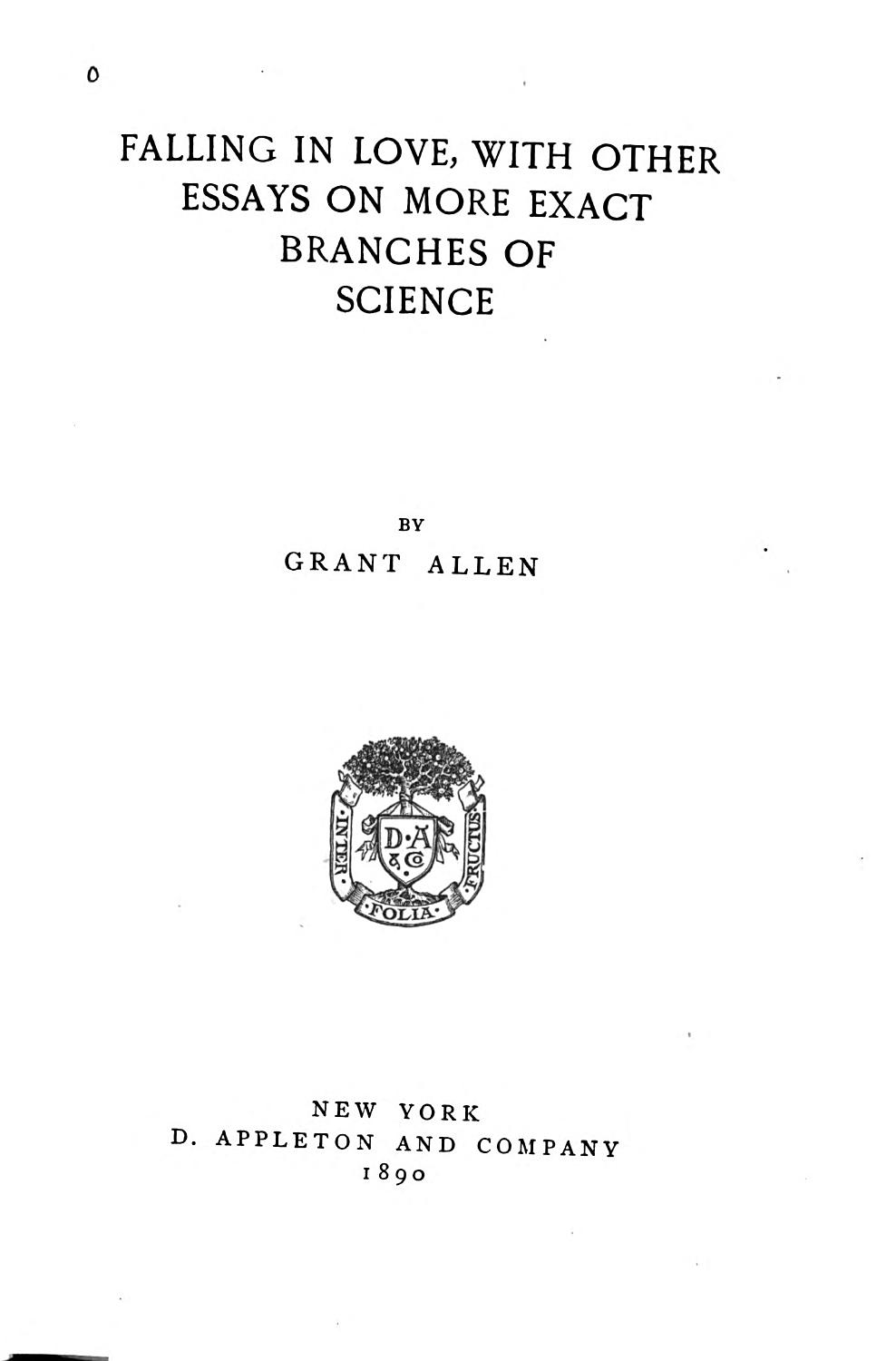
Falling in Love, with Other Essays on More Exact Branches of Science is a collection of essays by Grant Allen, published in 1889. The title is doing some work. The book is not romantic literature. It is a collection of popular science essays in which Allen brings recent developments in biology and evolutionary theory to a general magazine audience, and the title essay applies an evolutionary explanation to the human experience of romantic attraction.
Allen was trained as a classicist at Oxford but spent his life writing about natural science for the magazines. He was a serious popularizer of Darwin and was one of the first English writers to take evolutionary ideas into territory like aesthetics, social custom, and psychology. The essays in this book cover a range of subjects. There is the title piece on the evolutionary logic of mate selection, an essay on the origin of fruit and why fruits exist in the form they do, a piece on the psychology of color, several essays on cell biology and inheritance, and shorter pieces on subjects as varied as the moon and the natural history of beauty.
The writing is direct and clear in the manner of the best Victorian science journalism. Allen is good at choosing examples and at keeping a reader who is not a scientist interested in the argument. Some of the conclusions are dated, particularly the essays that wander into the kind of evolutionary speculation about race and culture that would later be called Social Darwinism. The biological essays have held up better. The piece on fruit is still a good introduction to the idea that the brightness and sweetness of edible fruit are evolutionary signals to seed dispersers.
The book runs about three hundred pages and is best read in essay sized pieces. For readers interested in the popularization of evolutionary thought in late Victorian Britain, this is one of the more enjoyable books in the genre. It pairs naturally with Allen’s other science collections like The Evolutionist at Large and Vignettes from Nature, and with the popular work of Allen’s contemporary Thomas Henry Huxley.
About the Author
Download free books by Grant Allen on BDeBooks. Read Grant Allen’s works online or download as PDF/EPUB · part of our growing free eBook collection.
See all books by Grant Allen →