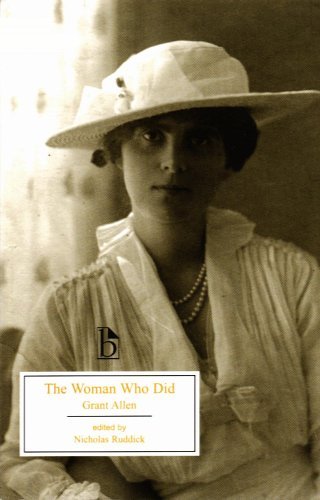
The Woman Who Did
The Woman Who Did is a novel by Grant Allen, published in 1895. It is the book Allen is most famous for after An African Millionaire and the one that caused the most controversy in his lifetime. It is a short polemical novel that takes up the cause of free union over conventional marriage and that became a focus of public argument in the mid 1890s in a way that few novels of the period managed.
The heroine is Herminia Barton, the daughter of a clergyman, educated and idealistic. She refuses to marry conventionally because she believes the institution of marriage is a form of slavery imposed on women. When she falls in love with a barrister named Alan Merrick, the two enter into a free union, living together openly without legal marriage. The first half of the novel works through the moral and intellectual grounds for Herminia’s decision, with Allen using his characters’ conversations to make the case for his position. The second half follows the consequences of her decision over the years, including the birth of her daughter Dolores, the early death of Alan, and the long social ostracism Herminia must endure as a result of her unconventional choice. The ending is one of the most uncompromising in late Victorian fiction.
The book was both a substantial commercial success and a focus of intense criticism. Reviewers attacked it from every direction. Some attacked it for what they saw as immorality, others for what they saw as overly sentimental treatment of its heroine, others for its prose style which was admittedly uneven. Allen had clearly known he was writing a controversial book and was prepared for the attacks. He thought of the novel as a serious contribution to the developing argument about marriage reform.
The book runs about two hundred and fifty pages. As fiction it is uneven. As an intervention in the late Victorian argument about gender and marriage it remains one of the more striking documents of the period. For readers interested in late Victorian polemic novels by progressive writers, this is essential reading. It pairs naturally with the contemporary writing of Mona Caird and with the New Woman novels of the 1890s, particularly the work of Sarah Grand and George Egerton.
About the Author
Download free books by Grant Allen on BDeBooks. Read Grant Allen’s works online or download as PDF/EPUB · part of our growing free eBook collection.
See all books by Grant Allen →

Listen to The Woman Who Did Audiobook Free
Listen to The Woman Who Did by Grant Allen free online. The full audiobook (6 hr 1 min, 24 chapters, read by Ruth Golding) streams free on this page.
The Woman Who Did (1895) is a public domain work.
| # | Chapter | Length | |
|---|---|---|---|
| 1 | Chapter I | 20:52 | |
| 2 | Chapter II | 12:31 | |
| 3 | Chapter III | 37:37 | |
| 4 | Chapter IV | 12:58 | |
| 5 | Chapter V | 22:48 | |
| 6 | Chapter VI | 14:57 | |
| 7 | Chapter VII | 17:22 | |
| 8 | Chapter VIII | 13:09 | |
| 9 | Chapter IX | 18:30 | |
| 10 | Chapter X | 14:48 | |
| 11 | Chapter XI | 13:34 | |
| 12 | Chapter XII | 16:18 | |
| 13 | Chapter XIII | 17:33 | |
| 14 | Chapter XIV | 10:00 | |
| 15 | Chapter XV | 16:11 | |
| 16 | Chapter XVI | 15:10 | |
| 17 | Chapter XVII | 14:13 | |
| 18 | Chapter XVIII | 16:36 | |
| 19 | Chapter XIX | 15:56 | |
| 20 | Chapter XX | 7:55 | |
| 21 | Chapter XXI | 12:38 | |
| 22 | Chapter XXII | 8:29 | |
| 23 | Chapter XXIII | 4:00 | |
| 24 | Chapter XXIV | 7:09 |
Prefer reading? Read The Woman Who Did online free or download the PDF and EPUB above.