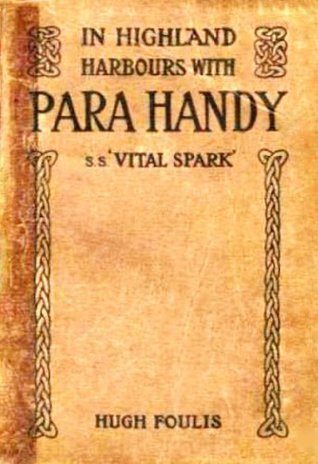
In Highland Harbours with Para Handy
In Highland Harbours with Para Handy is one of Neil Munro’s collections of his beloved Para Handy stories, the comic sketches about the eccentric crew of the puffer steamboat Vital Spark plying the waters of the Clyde and the Western Isles of Scotland. Munro wrote the Para Handy stories for the Glasgow Evening News across a span of more than two decades, and the cumulative collection of more than ninety stories has become one of the most beloved bodies of Scottish comic writing.
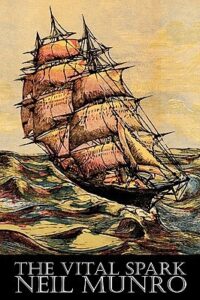
The Vital Spark is a small coal fired steamer of the kind that worked the inland and coastal waters of Scotland from the late nineteenth century through the middle of the twentieth, carrying various cargoes between the small ports and islands of the western Highlands. The crew that gives the stories their character includes Captain Para Handy himself, the proud and slightly self deluding skipper. Dougie the mate, who serves as the long suffering second in command. Macphail the engineer, whose attachment to penny novels and his self image as a man of the world give him his particular comic role. Sunny Jim, the cheerful young deckhand. And the legendary mariner Hurricane Jack, whose escapades feature in many of the stories.
This particular collection focuses on the Vital Spark’s adventures in the Highland harbours of the western coast and islands. The small ports of Argyll, the Inner Hebrides, and the wider western archipelago provide the settings for many of the stories in the volume, with each port bringing its own characters and its own comic situations into Para Handy’s orbit. Munro renders these places with the affection of a writer who knew them intimately, and the stories function as a kind of warm portrait of the working maritime culture of the western Scottish coast at the turn of the twentieth century.
Munro had a real ear for Scottish dialect and his stories capture the rhythms of working class Scottish speech with the kind of accuracy that gives his prose its particular flavor. The comic energy of the Para Handy stories comes partly from the gap between Para Handy’s grand self presentation and the modest reality of what he is actually doing, and partly from the absolute affection Munro clearly has for the world he is depicting. The Western Isles, the small Clyde ports, the inland Scottish waters, all of it is rendered with the kind of love that keeps the comedy from ever turning into mockery.
For readers interested in Scottish humor, in early twentieth century Scottish writing, or in Neil Munro’s catalogue, the Para Handy stories are essential.
About the Author
Download free books by Neil Munro on BDeBooks. Read Neil Munro’s works online or download as PDF/EPUB · part of our growing free eBook collection.
See all books by Neil Munro →