
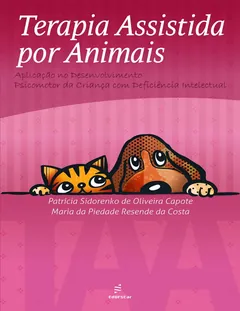
Terapia assistida por animais e o desenvolvimento psicomotor
Referências
Ainsworth, M. D. S. The development of infant-mother attachment. In: Caldwell, B. M.; Ricciuti, H. N. Review of Child Development Research, v. 3, p. 1-94, 1973.
Akiyama, H.; Holtzman, J. M.; Britz, W. E. Pet ownership and health status during bereavement. Omega, v. 17, p. 187-193, 1986.
Allen, K.; Blascovich, J. The value of service dogs for people with severe ambulatory disabilities: a randomized controlled trial. The Journal of the American Medical Association, v. 275, n. 13, p. 10011006, 1996.
Allen, K. M.; Blascovich, J.; Mendes, W. B. Cardiovascular reactivity and the presence of pets, friends, and spouses: the truth about cats and dogs. Psychosomatic Medicine, v. 64, p. 727-739, 2002.
Allen, K. M.; Blascovich, J.; Tomaka, J.; Kelsey, R. M. Presence of human friends and pet dogs as moderators of automatic responses to stress in women. American Psychological Association, v. 61, n. 4, p. 582-589, 1991.
Almeida, M. M. Apresentação e análise das definições de Deficiência Mental propostas pela AAMR – Associação Americana de Retardo Mental, 1908 a 2002. Revista de Educação PUC-Campinas, n. 16, 2004.
Althausen, A. Adolescentes com síndrome de Down e cães: compreensão e possibilidades de intervenção. Dissertação (Mestrado em Psicologia) – Instituto de Psicologia, Universidade de São Paulo, São Paulo, 2006.
Amorim, L. J.; Silva, L. K. J.; Rocha, S. D.; Martin, R. T.; Martin, D. H.; Silva, A. R. P.; Amorim, C. F.; Maximino, V. S.; Zângaro, R. A. Valorizando a vida e cidadania através da terapia facilitada por cães. In: III Seminário Internacional Sociedade Inclusiva – Ações Inclusivas de Sucesso, Belo Horizonte, 2004. p. 1-13.
Aranha, M. S. F. Integração social do deficiente: análise conceitual e metodológica. Temas em Psicologia, v. 2, p. 63-70, 1995.
Barker, S. B.; Dawson, K. S. The effects of animal-assisted therapy on anxiety ratings of hospitalized psychiatric patients. Psychiatric Service, v. 49, p. 797-801, 1998.
Barker, S. B.; Pandurangi, A. K.; Best, A. M. Effects of animal-assisted therapy on patients' anxiety, fear and depression before ECT. The Journal of ECT, v. 19, n. 1, p. 38-44, 2003.
Baun, M. M.; Oetting, K.; Gergstrom, N. Health benefits of companion animals in relation to the physiologic indices of relaxation. Holistic Nursing Practice, v. 5, p. 16-23, 1991.
Beck, A. M.; Katcher, A. H. A new look at pet-facilitated therapy. Journal of the American Veterinary Medical Association, v. 184, p. 414421, 1984.
Becker, M. O poder curativo dos bichos. Rio de Janeiro: Bertrand Brasil, 2003. 322 p.
Bergman, C. Opposing speciesism. The bond. Newsletter of the SF/SPCA Animal Assisted Therapy Program, San Francisco, v. 2, n. 1, p. 1-2, 2000.
Bissoto, M. L. O desenvolvimento cognitivo e o processo de aprendizagem do portador de síndrome de Down: revendo concepções e perspectivas educacionais. Ciências & Cognição, v. 4, n. 2, 2005.
Bjerke, T.; Odegargstuen, T. S.; Kaltenborn, B. P. Attitudes toward animals among Norwegian adolescents. Anthrozoos, v. 11, n. 2, p. 79-86, 1998.
Bussotti, E. A.; Leão, E. R.; Chimentão, D. M. N.; Silva, C. P. R. Assistência individualizada: posso trazer meu cachorro? Revista da Escola de Enfermagem da USP, v. 39, n. 2, p. 195-201, 2005.
Capote, P. S. Terapia assistida por animais (TAA) e deficiência mental: análise do desenvolvimento psicomotor. Dissertação (Mestrado em Educação Especial) – Programa de Pós-Graduação em Educação Especial, Universidade Federal de São Carlos, São Carlos, 2009.
Carr, J. Six weeks to twenty-one years old: a longitudinal study of children with Down's syndrome and their families. Journal of Child Psychology and Psychiatry, v. 29, p. 407-431, 1988.
Casarin, S. Aspectos psicológicos na síndrome de Down. Síndrome de Down, São Paulo, Mackenzie, p. 263-285, 1999.
Cervo, A. R.; Bervian, P. A. Metodologia científica. São Paulo: Prentice Hall, 2002.
Corsi, C. M. et al. Síndrome de Down, desenvolvimento cognitivo e de linguagem: um estudo de investigação. Temas sobre Desenvolvimento, São Paulo, v. 5, n. 25, p. 11-16, 1995.
Cuskelly, M.; Dadds, M. Behavioural problems in children with Down's syndrome and their siblings. Journal of Child Psychology and Psychiatry, v. 33, p. 749-761, 1992.
Davis, S. J. M.; Valla, F. R. Evidence for domestication of the dog 12,000 years ago in the Natufian of Israel. Nature, v. 276, p. 608610, 1978.
Delta Society. Referência disponível em:
<http://www.deltasociety.com/quicklinks/education_and_research/oth
er_resources/animal-assisted-therapy/what_is_AAA/T>. Acesso em: 09 abr. 2008.
Dotti, J. Terapia e animais. São Paulo: Noética, 2005. 294 p. Eddy, J.; Hart, L. A.; Boltz, R. P. The effects of service dogs on social acknowledgments of people in wheelchairs. The Journal of Psychology, v. 122, n. 1, p. 39-45, 1987.
Edwards, N. E.; Beck, A. M. Animal-assisted therapy and nutrition in Alzheimer's disease. Western Journal of Nursing Research, v. 24, n. 6, p. 697-712, 2002.
Faraco, C. B. Animais em sala de aula: um estudo das repercussões psicossociais da intervenção mediada por animais. Dissertação (Mestrado em Psicologia) – Faculdade de Psicologia, Pontifícia Universidade Católica do Rio Grande do Sul, Porto Alegre, 2003.
Fraser, C. Companion animals and the promotion of health. Comprehensive Nursing Quarterly, v. 2, p. 2-17, 1990.
Friedman, E.; Katcher, A. H.; Lynch, J. J.; Thomas, S. A. Animal companions and one-year survival of patients after discharge from a coronary care unit. Public Health Reports, v. 95, p. 307-312, 1980.
Fuchs, H. O animal em casa: um estudo no sentido de desvelar o significado psicológico do animal de estimação. Tese (Doutorado em Psicologia) – Instituto de Psicologia, Universidade de São Paulo, São Paulo, 1988.
Furst, G. Prison-based animal programs: a national survey. The Prison Journal, v. 86, n. 4, p. 407-430, 2006.
Geisler, A. M. Companion animals in palliative care: stories from the bedside. American Journal of Hospice e Palliative Medicine, v. 21, n. 4, p. 285-287, 2004.
Glat, R. Integração dos portadores de deficiências: uma questão psicossocial. Temas em Psicologia, v. 2, p. 89-94, 1995.
Godoy, A. C. S.; Denzin, S. S. Atividades assistidas por animais: aspectos revisivos sob um olhar pedagógico. Ensaios e Ciência, v. 5, n. 5, p. 38, 2007.
Herbert, E.; Carpenter, B. Fathers – The secondary partners: Professional perceptions and fathers' reflections. Children & Society, v. 8, p. 31-41, 1994.
Hornby, G. Effects on fathers of children with Down syndrome. Journal of Child and Family Studies, v. 4, p. 239-255, 1995.
Hoff, T. E.; Bergler, R. The positive influence of dogs on children in divorce crises from the mother's perspective and of the child-dog relationship from the child's perspective. In: 9th International Conference on Human-Animal Interactions, People and Animals, a Global Perspective for the 21st Century. Rio de Janeiro, 2001. p. 13-15.
Johnson, R. A.; Meadows, R. L.; Haubner, J. S.; Sevedge, K. Human-animal interaction: a complementary/alternative medical intervention for cancer patients. American Behavioral Scientist, v. 47, n. 1, p. 55-69, 2003.
Kaiser, L.; Spence, L. J.; McGavin, L.; Struble, L.; Keilman, L. A dog and a happy person visit nursing home residents. Western Journal of Nursing Research, v. 24, n. 6, p. 671-683, 2002.
Kanamori, M.; Suzuki, M.; Yamamoto, K.; Kanda, M.; Matsui, Y.; Kojima, E.; Fukawa, H.; Sugita, T.; Oshiro, H. A day care program and evaluation of animal-assisted therapy (AAT) for the elderly with senile. American Journal of Alzheimer's Disease and Other Dementias, v. 16, n. 4, p. 234-238, 2001.
Kawakami, C. H.; Nakano, C. K. Relato de experiência: terapia assistida por animais (TAA) – mais um recurso na comunicação paciente e enfermeiro. Nursing, v. 61, n. 6, p. 25-29, 2003. (edição brasileira).
Kellert, S. R.; Westervelt, M. O. Historical trends in American animal use and perception. International Journal for the Study of Animal Problems, v. 42, p. 133-146, 1983.
Kidd, A. H.; Kidd, R. M. Factors in adults' attitudes toward pets. Psychological Reports, v. 65, p. 903-910, 1989.
Leary, P. M.; Verth, F. The effects of a mentally retarded child on family functioning in a third world community. Early Child Development and Care, v. 109, p. 83-88, 1995.
Levinson, B. M. The future of research into relationships between people and their animal companions. International Journal for the Study of Animal Problems, v. 3, p. 283-294, 1982.
Lockwood, R. The influence of animals on social perception. In: Katcher, A. H.; Beck, A. M. New perspectives on our life with companion animals. Philadelphia: University of Pennsylvania Press, 1983. p. 64-71.
Martin, F.; Farnum, F. J. Animal-assisted therapy for children with pervasive developmental disorders. Western Journal of Nursing Research, v. 24, n. 6, p. 657-670, 2002.
Martins, M. F. Animais na escola. In: Dotti, J. Terapia e animais. São Paulo: Noética, 2005. 294 p.
Melero, M. L. Aprendiendo a conocer a las personas con síndrome de Down. Málaga: Ediciones Aljibe, 1999. 42 p.
Melson, G. F. Fostering inter-connectedness with animals and nature: the developmental benefits for children. People, animals, environment, p. 15-17, 1990.
Mendonça, T. A. Terapia Ocupacional assistida por animais em gerontologia: uma nova proposta de intervenção. São Luís: Centro Universitário do Maranhão, 2006. Monografia.
Menzies Incorporated. Animal assisted therapy and young people – a review of selected literature. RHMSS Pty Ltd., p. 1-39, 2003. Messent, P. Correlates and effects of pet ownership. In: Anderson, R. S.; Hart, B. L.; Hart, L. A. The pet connection: its influence on our health and quality of life. Minneapolis: Center to Study Human-Animal Relationship and Environments, 1984. p. 331-341.
Mugford, R. A.; M'Comisky, J. G. Some recent work on the psychotherapeutic value of caged birds with old people. In: Anderson, R. S. Pet animals and society. London: R. S. Anderson, 1974. p. 54-65.
Odendaal, J. S. J. A physiological basis for animal-facilitated psychotherapy. University of Pretoria, South Africa, 1999. Doctoral dissertation.
Okoniewski, L.; Zivan, M. Adolescent's perceptions of human-animal relationships. Paper presented at the annual meeting of the Delta Society. Denver, 1985.
Ory, M.; Goldberg, E. Pet ownership and life satisfaction in elderly women. In: Katcher, A. H.; Beck, A. M. New perspectives on our life with companion animals. Philadelphia: University of Pennsylvania Press, 1983. p. 803-817.
Pereira-Silva, N. L. Crianças pré-escolares com síndrome de Down e suas interações familiares. Dissertação (Mestrado em Psicologia) – Instituto de Psicologia, Universidade de Brasília, Brasília, 2000.
Pessoti, I. Deficiência mental: da superstição à ciência. São Paulo: Edusp, 1984.
Poresky, R. H. Sex, childhood pets and young adult's self-concept scores. Psychological Reports, v. 80, p. 371-377, 1997.
Poresky, R. H.; Hendrix, C.; Mosier, J. E.; Samuelson, M. L. Young children's companion animal bonding and adult's pet attitudes: a retrospective study. Psychological Reports, v. 62, p. 419-425, 1988. Porto, R. T. C.; Cassol, S. Zooterapia uma lição de cidadania: o cão socializador e a criança vítima de violência intrafamiliar. Revista Disc. Jur., Campo Mourão, v. 3, n. 2, p. 46-74, 2007.
Raveis, V. H.; Mesagno, F.; Karus, D. E.; Gorey, E. Pet ownership as a protective factor supporting the emotional well-being of cancer patients and their family members. Final Report, 1993.
Rodrigue, J. R.; Morgan, S. B.; Geffken, G. R. Psychosocial adaptation of fathers of children with autism, Down syndrome and normal development. Journal of Autism and Development Disorders, v. 22, p. 249-263, 1992.
Rosa Neto, F. Manual de avaliação motora. Porto Alegre: Artmed, 2002. 136 p.
Santos, K. C. P. T. Terapia assistida por animais: uma experiência além da ciência. São Paulo: Paulinas, 2006. 62 p.
Schwartzman, J. S. Histórico. In: Schwartzman, J. S. (Org.). Síndrome de Down. São Paulo: Mackenzie, 1999 p. 3-15.
Siegel, J. M. Stressful life events and use of physician services among the elderly: the moderating role of pet ownership. Journal of Personality and Social Psychology, v. 58, p. 1081-1086, 1990.
______. Companion animals: in sickness and in health. Journal of Social Issues, v. 49, n. 1, p. 157-167, 1993.
Silva, N. L. P.; Dessen, M. A. Deficiência Mental e família: implicações para o desenvolvimento da criança. Psicologia: Teoria e Pesquisa, v. 17, n. 2, 2001.
Sloper, P.; Knussen, C.; Turner, S.; Cunningham, C. Factors related to stress and satisfaction with life in families of children with Down's syndrome. Journal of Child Psychology and Psychiatry, v. 32, p. 655-676, 1991.
Sobo, E. J.; Eng, B.; Kassity-Krich, N. Canine visitations (pet) therapy. Pilot data on decreases in child pain perception. Journal of Holistic Nursing, v. 24, p. 51-57, 2006.
Thigpen, S. E.; Ellis, S. K.; Smith, R. G. Special education in juvenile residential facilities: can animals help? Essays in Education, v. 14, p. 1-14, 2005.
Triebenbacher, S. L. Pets as transitional objects: their role in children's emotional development. Psychological Reports, v. 82, p. 191200, 1998.
Turnbull, A. P.; Ruef, M. Family perspectives on problem behavior. Mental Retardation, v. 34, p. 280-293, 1996.
Vidovic, V. V.; Stetic, V. V.; Bratko, D. Pet ownership, type of pet and socio-emotional development of school children. Anthrozoos, v. 12, n. 4, p. 211-217, 1999.
Você terminou Terapia assistida por animais e o desenvolvimento psicomotor
Patrícia Sidorenko de Oliveira Capote
Livros como este
-
 Educação, saúde e esporte: novos desafios à Educação Física
-
 Vértice do Impensável: Um Estudo de Narrativas em Síndrome de Down
-
 Atendimento Nutricional a Crianças e Adolescentes: Visão Prática
-
 Deformações Morfológicas da Coluna Vertebral: Tratamento Fisioterápico em Reeducação Postural Global (RPG)
-
 Doença de Chagas: Manual para Experimentação Animal
-
 Oncologia em Cães e Gatos
Depois do livro
Páginas que vieram com esta edição, guardadas aqui para consulta.