
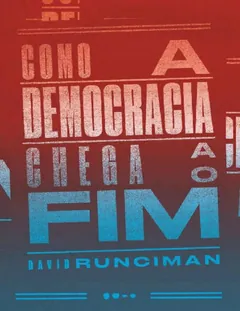
Como a Democracia Chega ao Fim
Notas
Prefácio — Pensando o impensável
1. Francis Fukuyama, “The End of History?”, The National Interest, n. 16,
pp. 3-18, verão de 1989.
[ «« ]
Introdução — 20 de janeiro de 2017
1. “Discurso de posse”, Casa Branca, Governo dos Estados Unidos, 20 de
janeiro de 2017, <http://bit.ly/2mLGtmv>.
[ «« ]
2. Esta ideia se origina com Adam Przeworski no texto “Minimalist
Conception of Democracy: A Defense”, em Democracy’s Value, org. de
Ian Shapiro e Casiano Hacker Cordon (Cambridge: Cambridge University
Press, 1999).
[ «« ]
3. “Declaração do presidente”, National Archives and Records
Administration, 9 de novembro de 2016, <http://bit.ly/2A28UVs>.
[ «« ]
4. Ver nota anterior.
[ «« ]
5. “O que está nos acontecendo, e vem nos acontecendo essencialmente desde
a noite da eleição e por todos os dias seguintes, é um golpe silencioso”,
The Rush Limbaugh Show, 12 de julho de 2017, <http://bit.ly/2hU1lLW>.
[ «« ]
1. Golpe!
1. C. L. Sulzberger, “Greece under the Colonels”, Foreign Affairs, vol. 48, n.
2, 1970, <http://fam.ag/2zjK029>.
[ «« ]
2. Ibid.
[ «« ]
3. Yanis Varoufakis, Adults in the Room: My Battle With Europe’s Deep
Establishment (Londres: The Bodley Head, 2017), p. 78.
[ «« ]
4. Ibid., p. 469.
[ «« ]
5. Yanis Varoufakis, op. cit., p. 82.
[ «« ]
6. Donald Kagan, Studies in the Greek Historians (Cambridge: Cambridge
University Press, 2009), p. 46.
[ «« ]
7. Edward N. Luttwak, Coup D’État: A Practical Handbook
(Harmondsworth: Penguin Books, 1968), p. 9. — No Brasil: Golpe de
Estado: Um manual prático, trad. de Claudia Schilling (Rio de Janeiro:
Paz e Terra, 1991).
[ «« ]
8. Ibid., p. 24.
[ «« ]
9. Citado em Adam Roberts, “Civil Resistance to Military Coups”, Journal of
Peace Research, vol. 12, n. 1, p. 26, 1975.
[ «« ]
10. Jonathan Fenby, The General: Charles De Gaulle and the France He
Saved (Londres: Simon & Schuster, 2010), p. 467.
[ «« ]
11. Nancy Bermeo, “On Democratic Backsliding”, Journal of Democracy,
vol. 27, n. 1, pp. 5-19, 2016.
[ «« ]
12. Ibid., p. 14.
[ «« ]
13. Bruce Ackerman, The Decline and Fall of the American Republic
(Cambridge, MA: Harvard University Press, 2010).
[ «« ]
14. Sam Bourne, To Kill the President (Londres: HarperCollins, 2017). — No
Brasil: Matem o presidente, trad. de Clóvis Marques (Rio de Janeiro:
Record, 2017).
[ «« ]
15. Chris Mullin, A Very British Coup (Londres: Hodder & Stoughton, 1982).
[ «« ]
16. Joseph E. Uscinski et al., “Conspiracy Theories Are for Losers”, APSA
2011 Annual Meeting Paper, agosto de 2011, <http://bit.ly/2zr6OBx>.
[ «« ]
17. Joseph E. Uscinski e Joseph M. Parent, American Conspiracy Theories
(Nova York: Oxford University Press, 2014).
[ «« ]
18. Ver Joel Rogers, “Are Conspiracy Theories for (Political) Losers?”,
YouGov–Cambridge, 13 de fevereiro de 2015, <http://bit.ly/2ACrfI5>
(resultado completo da pesquisa: <http://bit.ly/2k2kvNf>).
[ «« ]
19. Citado em Christian Davies, “The Conspiracy Theorists Who Have Taken
over Poland”, The Guardian Long Read, 16 de fevereiro de 2016,
<http://bit.ly/2enJyVI>.
[ «« ]
20. Ver “Free Silver and the Mind of ‘Coin’ Harvey”, em Richard Hofstadter,
The Paranoid Style in American Politics (Nova York: Vintage, 2008).
[ «« ]
21. Para a versão clássica desta história, ver Richard Hofstadter, The Age of
Reform: From Bryan to F.D.R. (Nova York: Alfred A. Knopf, 1955).
[ «« ]
22. Thomas Piketty, Capital in the Twenty-First Century (Cambridge, MA:
Harvard University Press, 2014). — No Brasil: O capital no século XXI,
trad. de Monica B. de Bolle (Rio de Janeiro: Intrínseca, 2014).
[ «« ]
23. Walter Scheidel, The Great Leveler: Violence and the History of
Inequality From the Stone Age to the Twentyfirst Century (Princeton, NJ:
Princeton University Press, 2017).
[ «« ]
2. Catástrofe!
1. Rachel Carson, “Silent Spring – I”, New Yorker, 16 de junho de 1962,
<http://bit.ly/2zYoOlx>. — No Brasil, em forma de livro: Primavera
silenciosa, trad. de Claudia S. Martins (São Paulo: Gaia, 2010).
[ «« ]
2. John Hersey, “Hiroshima”, New Yorker, 31 de agosto de 1946,
<http://bit.ly/2yibwPT>. — No Brasil, em forma de livro: Hiroshima,
trad. de Hildegard Feist (São Paulo: Companhia das Letras, 2002).
[ «« ]
3. Hannah Arendt, “Eichmann in Jerusalem – I”, New Yorker, 16 de fevereiro
de 1963 (e os quatro números seguintes), <http://bit.ly/2gkvNOi>. — No
Brasil, em forma de livro: Eichmann em Jerusalém, trad. de José Rubens
Siqueira (São Paulo: Companhia das Letras, 1999).
[ «« ]
4. Ibid.
[ «« ]
5. “The Desolate Year”, Monsanto Magazine, outubro de 1962, pp. 4-9.
[ «« ]
6. Paul Krugman, “Pollution and Politics”, The New York Times, 27 de
novembro de 2014, <http://nyti.ms/2B288H9>.
[ «« ]
7. Eben Harrell, “The Four Horsemen of the Nuclear Apocalypse”, Time, 10
de março de 2011, <http://ti.me/2hMn8RY>.
[ «« ]
8. Timothy Snyder, On Tyranny: Twenty Lessons from the Twentieth Century
(Londres: The Bodley Head, 2017), p. 50. — No Brasil: Sobre a tirania:
Vinte lições do século XX para o presente, trad. de Donaldson M.
Garschagen (São Paulo: Companhia das Letras, 2017).
[ «« ]
9. Timothy Snyder, Bloodlands: Europe Between Hitler and Stalin (Nova
York: Basic Books, 2010). — No Brasil: Terras de sangue: A Europa
entre Hitler e Stalin, trad. de Mauro Pinheiro (Rio de Janeiro: Record,
2012).
[ «« ]
10. Derek Parfit, Reasons and Persons (Oxford: Oxford University Press,
1984), pp. 453 ss.
[ «« ]
11. Citado em Craig Lambert, “Nuclear Weapons or Democracy”, Harvard
Magazine, março de 2014, <http://bit.ly/2i2BFgc>.
[ «« ]
12. Nick Bostrom, “Existential Risks: Analyzing Human Extinction
Scenarios and Related Hazards”, Journal of Evolution and Technology,
vol. 9, n. 1, 2002, <http://bit.ly/2jSajtw>.
[ «« ]
13. Ibid.
[ «« ]
14. Raffi Khatchadourian, “The Doomsday Invention”, New Yorker, 23 de
novembro de 2015, <http://bit.ly/2zdfTJY>.
[ «« ]
15. Cormac McCarthy, The Road (Londres: Picador, 2006), p. 54. — No
Brasil: A estrada, trad. de Adriana Lisboa (Rio de Janeiro: Alfaguara,
2007).
[ «« ]
16. David Mitchell, The Bone Clocks (Londres: Sceptre, 2014).
[ «« ]
17. E. M. Forster, “The Machine Stops”, em The Eternal Moment and Other
Stories (Londres: Sidgwick & Jackson, 1928).
[ «« ]
18. Christopher Clark, The Sleepwalkers: How Europe Went to War in 1914
(Londres: Allen Lane, 2013). — No Brasil: Os sonâmbulos: Como eclodiu
a Primeira Guerra Mundial, trad. de Berilo Vargas (São Paulo:
Companhia das Letras, 2014).
[ «« ]
3. Revolução tecnológica!
1. Mahatma Gandhi, Hind Swaraj and Other Writings, org. de Anthony J.
Parel (Cambridge: Cambridge University Press, 1997), p. 35. — No
Brasil: Hind Swaraj: Autogoverno da Índia, trad. de Gláucia Gonçalves,
Divinize Carbonieri, Carlos Gohn, Laura P. Z. Izarra (Brasília: Funag,
2010).
[ «« ]
2. David Edgerton, Shock of the Old: Technology and Global History since
1900 (Londres: Profile, 2006).
[ «« ]
3. Thomas Hobbes, Leviathan, org. de Richard Tuck (Cambridge: Cambridge
University Press, 1996), p. 9. — No Brasil: Leviatã, org. de Eunice
Ostrensky, trad. de J. P. Monteiro, M. B. Nizza da Silva e C. Berliner (São
Paulo: Martins Fontes, 2003).
[ «« ]
4. Mark Zuckerberg, “Building Global Community”, Facebook, 16 de
fevereiro de 2017, <http://bit.ly/2m39az5>.
[ «« ]
5. Dave Eggers, The Circle (Nova York: Alfred A. Knopf, 2013). — No
Brasil: O Círculo, trad. de Rubens Figueiredo (São Paulo: Companhia das
Letras, 2014).
[ «« ]
6. Mark Zuckerberg, “Mark Zuckerberg”, Facebook, 3 de janeiro de 2017,
<http://bit.ly/2hXwZIi>.
[ «« ]
7. Josh Glancy, “Mark Zuckerberg’s ‘Listening Tour’”, Sunday Times, 23 de
julho de 2017, <http://bit.ly/2hVF4gM>.
[ «« ]
8. Dave Eggers, The Circle, p. 386.
[ «« ]
9. O relato mais completo desses fatos se encontra em Jon Ronson, So You’ve
Been Publicly Shamed (Nova York: Riverhead Books, 2015). — No
Brasil: Humilhado: Como a era da internet mudou o julgamento público,
trad. de Mariana Kohnert (Rio de Janeiro: Best Seller, 2015).
[ «« ]
10. Ezra Klein e Alvin Chang, “‘Political Identity Is Fair Game for Hatred’:
How Republicans and Democrats Discriminate”, Vox, 7 de dezembro de
2015, <http://bit.ly/2ja3CQb>.
[ «« ]
11. “Mark Lilla vs Identity Politics”, The American Conservative, 16 de
agosto de 2017, <http://bit.ly/2uTZYhy>.
[ «« ]
12. “Transcrição do quinto debate republicano”, The Washington Post, 15 de
dezembro de 2015, <http://wapo.st/2mTDrBY>.
[ «« ]
13. Joseph Schumpeter, Capitalism, Socialism, and Democracy (Nova York:
Harper and Brothers, 1942). — No Brasil: Capitalismo, socialismo e
democracia, trad. de Luiz A. O. de Araújo (São Paulo: Unesp, 2017).
[ «« ]
14. Joe McGinnis, The Selling of the President 1968 (Nova York: Trident
Press, 1969).
[ «« ]
15. Robert A. Burton, “Donald Trump, Our AI President”, The New York
Times, 22 de maio de 2017, <https://nyti.ms/2rJHrT3>.
[ «« ]
16. Citado em L. A. Scaff, Max Weber in America, Princeton, NJ: Princeton
University Press, 2011, p. 177.
[ «« ]
4. Alguma coisa melhor?
1. Nick Land, “The Dark Enlightenment: Part 1”, The Dark Enlightenment
(2013), <http://bit.ly/2zZA5Cz>.
[ «« ]
2. Ibid.
[ «« ]
3. Curtis Yarvin, “Moldbug’s Gentle Introduction”, The Dark Enlightenment
(2009), <http://bit.ly/2zft6lk>.
[ «« ]
4. Alessio Piergiacomi, “What Would an AI Government Look Like?”,
Quora, 30 de abril de 2016.
[ «« ]
5. Ibid.
[ «« ]
6. Winston Churchill, Câmara dos Comuns, 11 de novembro de 1947,
<http://bit.ly/2hMe3bR>.
[ «« ]
7. Steven Levitsky e Lucan A. Way, Competitive Authoritarianism: Hybrid
Regimes after the Cold War (Cambridge: Cambridge University Press,
2010).
[ «« ]
8. Daniel A. Bell et al., “Is the China Model Better Than Democracy?”,
Foreign Policy, 19 de outubro de 2015, <http://atfp.co/1jRIJXC>.
[ «« ]
9. Ibid.
[ «« ]
10. John Stuart Mill, Considerations on Representative Government 19. Robert Nozick, Anarchy, State, and Utopia (New York: Basic Books,
(Londres: Parker & Son, 1861). — No Brasil: Considerações sobre o
governo representativo, trad. de Denise Bottmann (Porto Alegre: L&PM
Pocket, 2018).
[ «« ]
11. Jason Brennan, Against Democracy (Princeton, NJ: Princeton University
Press, 2016), p. 221.
[ «« ]
12. Ibid., p. 212.
[ «« ]
13. Christopher H. Achen e Larry M. Bartels, Democracy for Realists: Why
Elections Do Not Produce Responsive Government (Princeton, NJ:
Princeton University Press, 2016), p. 310.
[ «« ]
14. Brennan, Against Democracy, p. 7.
[ «« ]
15. David Estlund, Democratic Authority: A Philosophical Framework
(Princeton, NJ: Princeton University Press, 2007).
[ «« ]
16. Brennan, Against Democracy, p. 221.
[ «« ]
17. Brian Wheeler, “Nigel: The Robot Who Could Tell You How to Vote”,
BBC News, 17 de setembro de 2017, <http://bbc.in/2x6K1IV>.
[ «« ]
18. Benjamin M. Friedman, The Moral Consequences of Economic Growth
(New York: Alfred A. Knopf, 2005). — No Brasil: As consequências
morais do crescimento econômico, trad. de Renato Bittencourt (Rio de
Janeiro: Record, 2009).
[ «« ]
1974), p. 310. — No Brasil: Anarquia, Estado e utopia, trad. de Fernando
Santos (São Paulo: WMF Martins Fontes, 2011).
[ «« ]
20. Paul Mason, Postcapitalism: A Guide to Our Future (Londres: Allen
Lane, 2015). — No Brasil: Pós-capitalismo: Um guia para o nosso futuro,
trad. de José Geraldo Couto (São Paulo: Companhia das Letras, 2017).
[ «« ]
21. Ibid, p. 134.
[ «« ]
22. Philip N. Howard, Pax Technica: How the Internet of Things May Set Us
Free or Lock Us Up (New Haven, CT: Yale University Press, 2015), p.
224.
[ «« ]
23. Ibid., pp. 161-2.
[ «« ]
24. Paul Mason, Postcapitalism, p. 283.
[ «« ]
25. Alex Williams e Nick Srnicek, “#ACCELERATE MANIFESTO for an
Accelerationist Politics”, Critical Legal Thinking, 14 de maio de 2013,
<http://bit.ly/18usvb4>.
[ «« ]
26. Yuval Noah Harari, Homo Deus: A Brief History of Tomorrow (Londres:
Harvill Secker, 2016). — No Brasil: Homo Deus: Uma breve história do
amanhã, trad. de Paulo Geiger (São Paulo: Companhia das Letras, 2016).
[ «« ]
27. Derek Parfit, Reasons and Persons (Oxford: Oxford University Press,
1984), parte 3.
[ «« ]
Conclusão — É assim que a democracia chega ao fim
1. “UK to Dodge Greek Fate with Tough Budget — Osborne”, Reuters, 20 de
junho de 2010, <https://reut.rs/2MFIOgV>.
[ «« ]
2. Steven Pinker, The Better Angels of Our Nature: The Decline of Violence
in History and Its Causes (Londres: Allen Lane, 2011). — No Brasil: Os
anjos bons da nossa natureza: Por que a violência diminuiu, trad. de
Bernardo Joffily e Laura T. Motta (São Paulo: Companhia das Letras,
2013).
[ «« ]
3. Ver Clay Shirky, “Power Laws, Weblogs and Inequality”, 8 de fevereiro
de 2003, <http://bit.ly/1nyyc36>.
[ «« ]
4. Alex Cuadros, “Open Talk of a Military Coup Unsettles Brazil”, New
Yorker, 13 de outubro de 2017, <http://bit.ly/2gjbW25>.
[ «« ]
Epílogo — 20 de janeiro de 2053
1. Ver Yuval, Homo Deus.
[ «« ]
Leituras recomendadas
1. No Brasil: Por que as nações fracassam: As origens do poder, da
prosperidade e da pobreza, trad. de Cristina Serra (São Paulo: Elsevier;
Alta Books, 2012).
[ «« ]
2. No Brasil: O fim da história e o último homem, trad. de Aulyde S.
Rodrigues (Rio de Janeiro: Rocco, 2015).
[ «« ]
3. No Brasil: As origens da ordem política, trad. de Nivaldo Montingelli Jr.
(Rio de Janeiro: Rocco, 2013).
[ «« ]
4. No Brasil: Ordem e decadência política: Da Revolução Industrial à
globalização da democracia, trad. de Nivaldo Montingelli Jr. (Rio de
Janeiro: Rocco, 2018).
[ «« ]
5. No Brasil: A chegada do Terceiro Reich, trad. de Lucia Brito (São Paulo:
Crítica, 2017).
[ «« ]
6. No Brasil: Hora final: Alerta de um cientista, trad. de Maria Guimarães
(São Paulo: Companhia das Letras, 2005).
[ «« ]
7. No Brasil: Superinteligência: Caminhos, perigos, estratégias, trad. de
Aurelio A. Monteiro, Clemente G. Penna, Fabiana G. Monteiro, Patricia
R. Geremias (Rio de Janeiro: Darkside, 2018).
[ «« ]
8. No Brasil: Complô contra a América, trad. de Paulo Henriques de Britto
(São Paulo: Companhia das Letras, 2005).
[ «« ]