
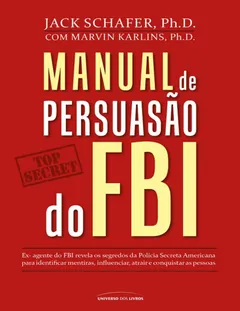
Manual de Persuasão do FBI
Referências bibliográficas
Ajzen, I. (1977). Information processing approaches to interpersonal attraction.
In S. W. Duck (ed.). Theo y and practice in interpersonal attraction (pp. 51–
77). San Diego: Academic Press.
Antheunis, M. L.; V alkenburg, P. M.; Peter, J. (2007). Computer-mediated
communication and interpersonal attraction: An experimental test of two
explanatory hypotheses. Cyberpsychology and Behavior, 10, 831–835.
Aristotle (1999). Rhetoric. In Library of the Future, 4 ed. [CDROM]. Irvine:
World Library.
Aronson, E. (1969). The theory of cognitive dissonance: A current perspective.
In L. Berkowitz (ed.). Advances in experimental psychology, vol. 4. New York:
Academic Press.
Asch, S. E. (1946). Forming impressions of personality. Journal of Abnormal
and Social Psychology, 41, 303–314.
Aubuchon, N. (1997). The anatomy of persuasion. New York: American
Management Association.
Balderston, N. L.; Schultz, D. H.; Helmstetter, F. J. (2013). The effect of threat
on novelty-evoked amygdala response. PloS O NE, 8, 1–10.
Ballenson, J. N.; Blascovich, J.; Beall, A. C.; Loomis, J. M. (2001). Equilibrium
theory revisited: Mutual gaze and personal space in virtual environments.
Presence, 10, 583–598.
Barrick, J. et al. (2012). Candidate characteristics driving initial impressions
during rapport building: Implications for employment interview validity.
Journal of Occupational and Organizational Psychology, 85, 330–352.
Brady, E.; George, R. (2013). Manti Te’o’s “Catfish” story is a common one.
USA Today, January 18.
Branham, M. (2005). How and why do fi eflies light up? Scientific American,
September 5.
Buffa di, L.; Campbell, W. K. (2008). Narcissism and social networking web
sites. Personality and Social Psychology Bulletin, 34, 1303–1314.
Byrne, D. (1969). Attitudes and attraction. In L. Berkowitz (ed.). Advances in
Experimental Psychology, vol. 4. New York: Academic Press.
Carlzon, J. (1989). Moments of truth. New York: Harper Business. Carnegie, D. (2011). How to win friends and influence people. New York: Simon
& Schuster.
Carter, R. (1998). Mapping the mind. Berkeley: University of California Press. Chaplin, W. F. et al. (2000). Handshaking, gender personality and first
impressions. Journal of Personality and Social Psychology, 79, 110–117.
Chen, F. F.; Kenrick, D. T. (2002). Repulsion or attraction? Group membership
and assumed attitude similarity. Journal of Personality and Social Psychology,
83, 111–125.
Cialdini, R. B. (1993). Influence: The psychology of persuasion. New York:
William Morrow.
Clark, M. S.; Mills, J. R.; Corcoran, D. M. (1989). Keeping track of needs and
inputs of friends and strangers. Personality and Social Psychology Bulletin,
15, 533–542.
Clore, G.; Wiggens, N. H.; Itkin, S. (1975). Gain and loss in attraction:
Attributions from nonverbal behavior. Journal of Personality and Social
Psychology, 31, 706–712.
Collins, N. L.; Miller, L. C. (1994). Self-disclosure and liking: A meta-analytic
review. Psychological Bulletin, 116, 457–475.
Craig, E.; Wright, K. B. (2012). Computer-mediated relational development and
maintenance on Facebook. Communication Research Reports, 29 (2), 118–
129.
Curtis, R. C.; Miller, K. (1986). Believing another likes or dislikes you: Behavior
making the beliefs come true. Journal of Personality and Social Psychology,
51, 284–290.
Dalto, C. A.; Ajzen, I.; Kaplan, K. J. (1979). Self-disclosure and attraction:
Effects of intimacy and desirability of beliefs and attitudes. Journal of
Research in Personality, 13, 127–138.
Davis, J. D.; Sloan, M. L. (1974). The basis of interviewee matching and
interviewer self-disclosure. British Journal of Social and Clinical Psychology,
13, 359–367.
DePaulo, B. M. (1992). Nonverbal behavior and self-presentation. Psychological
Bulletin, 111, 203–243.
DeMaris, A. (2009). Distal and proximal influences of the risk of extramarital
sex: A prospective study of longer duration marriages. Journal of Sex
Research, 44, 597–607.
Dimitrius, J.; Mazzarella, M. (1999). Reading people: How to understand people
and predict their behavior — anytime, anyplace. New York: Ballantine.
Egan, G. (1975). The skilled helpe. Monterey: Brooks/Cole. Ekman, P.; Friesen, W. V.; Ancoli, S. (1980). Facial signs of emotional
experience. Journal of Personality and Social Psychology, 39, 1125–1134.
Festinger, L. (1957). A theory of cognitive dissonance. Oxford: Peterson Row. Finkelstein, S. (2013). Building trust in less than 10 minutes. Huffington ost,
July 18.
Frank, M. G.; Ekman, P.; Friesen, W. V. (1993). Behavioral markers and
recognizability of the smile of enjoyment. Journal of Personality and Social
Psychology, 64, 83–93.
Franklin, B. (1916). The autobiography of Benjamin Franklin. New York: G. P.
Putnam’s Sons.
Gagne, F.; Khan, A.; Lydon, J.; To, M. (2008). When flatte y gets you nowhere:
Discounting positive feedback as a relationship maintenance strategy.
Canadian Journal of Behavioral Science, 40, 59–68.
Givens, D. G. (2014). The nonverbal dictionary of gestures, signs and body
language cues. Spokane, WA: Center for Nonverbal Studies. Disponível em:
<http://www.center-for-nonverbal-studies.org/6101.html>.
Gold, J. A.; Ryckman, R. M.; Mosley, N. R. (1984). Romantic mood induction
and attraction to a dissimilar other: Is love blind? Personality and Social
Psychology Bulletin, 10, 358–368.
Grammar, K, J.; Schmitt, A.; Massano, A. H. (1999). Fuzziness of nonverbal
courtship communication unblurred by motion energy detection. Journal of
Personality and Social Psychology, 77, 487–508.
Grant, M. K.; Fabrigar, L. R.; Lim, H. (2010). Exploring the efficac of
compliments as a tactic for securing compliance. Basic and Applied Social
Psychology, 32, 226–233.
Greville, H. (1886). Cleopatra. Boston:Ticknor. Griffeth, R. W.; Vecchiok, R. P.; Logan, J. W. (1989). Equity theory and
interpersonal attraction. Journal of Applied Psychology, 74, 394–401. Gueguen, N. (2008). The effect of a woman’s smile on men’s courtship behavior.
Social Behavior and Personality, 36, 1233–1236.
______. (2010). The effect of a woman’s incidental tactile contact on men’s later
behavior. Social Behavior and Personality, 38, 257–266.
______. (2010). Men’s sense of humor and women’s responses to courtship
solicitations: An experimental field stud. Psychological Reports, 107, 145–
156.
______; Boulbry, G.; Selmi, S. (2009). “Love is in the air”: Congruency between
background music and goods in a flower shop. International Review of Retail,
Distribution and Consumer Research, 19, 75–79.
______; Delfosse, C. (2012). She wore something in her hair: The effect of
ornamentation on tipping, Journal of Hospitality Marketing and Management,
12, 414–420.
______; Martin, A.; Meineri, S. (2011). Similarity and social interaction: When
similarity fosters implicit behavior toward a stranger. Journal of Social
Psychology, 15, 671–673.
______; Martin, A.; Meineri, S. (2011). Mimicry and helping behavior: An
evaluation of mimicry on explicit helping request. Journal of Social
Psychology, 15, 1–4.
______; Morineau, T. (2010). What is in a name? An effect of similarity in
computer-mediated communication. Journal of Applied Psychology, 6, 1–4.
Gunnery, S. D.; Hall, J. A. (2014). The Duchenne smile and persuasion. Journal
of Nonverbal Behavior, 38, 181–194.
Guo, S.; Ahang, G.; Ahai, R. (2010). A potential way of enquiry into human
curiosity. British Journal of Educational Technology, 41, 48–52.
Hall, E. T. (1966). The hidden dimension Garden City: Doubleday. Hancock, J.; Toma, C. (2009). Putting your best face forward: The accuracy of
online dating photographs. Journal of Communication 59, 367–386.
Harnish, R. J.; Bridges, K. R.; Rottschaefer, K. M. (2014). Development and
psychometric evaluation of the sexual intent scale. Journal of Sex Research, 5,
667–680.
Hazan, C. D.; Diamond, L. M. (2000). The place of attachment in human
mating. Review of General Psychology, 4, 186–204.
Hill, C.; Memon, A.; McGeorge, P. (2008). The role of confirmation bias in
suspect interviews: A systematic evaluation. Legal and Criminological
Psychology, 13, 357–371.
Hunt, G. L.; Price, J. B. (2002). Building rapport with the client. Internal
Auditor, 59, 20–21.
Kaitz, M. et al. (2004). Adult attachment style and interpersonal distance.
Attachment and Human Development, 6, 285–304.
Kassin, S. M.; Goldstein, C. C.; Savitsky, K. (2003). Behavior confirmation in
the interrogation room: On the dangers of presuming guilt. Law and Human
Behavior, 27, 187–203.
Kleinke, C. L. (1986). Gaze and eye contact: A research review. Psychological
Review, 100, 78–100.
Kleinke, C. L.; Kahn, M. L. (1980). Perceptions of self-disclosures: Effects of
sex and physical attractiveness. Journal of Personality, 48, 190–205.
Kellerman, J.; Lewis, J.; Laird, J. D. (1989). Looking and loving: The effects of
mutual gaze on feelings of romantic love. Journal of Research in Personality,
23, 145–161.
Kenrick, D. T.; Cialdini, R. B. (1977). Romantic attraction: Misattribution versus
reinforcement explanations. Journal of Personality and Social Psychology, 35,
381–391.
Knapp, M. L.; Hall, J. A. (1997). Nonverbal communication in human
interaction (4 ed.). New York: Harcourt Brace College.
Krumhuber, E.; Manstead, A. S. R. (2009). Are you joking? The moderating role
of smiles in perception of verbal statements. Cognition and Emotion, 23,
1504–1515.
Lee, L. et al. (2008). If I’m not hot, are you hot or not? Psychological Science,
10, 669–677.
Lewis, D. (1995). The secret language of success: Using body language to get
what you want. New York: Galahad Books.
Lynn, M.; McCall, M. (2000). Gratitude and gratuity: A meta-analysis of
research on the service-tipping relationship. Journal of Socio-Economics, 29,
203–214.
Macrea, C. N. et al. (2002). Are you looking at me? Eye gaze and person
perception. Psychological Science, 13, 460–464.
Mai, X. et al. (2011). Eyes are windows to the Chinese soul: From the detection
of real and fake smiles. PLoS O NE, 5, 1–6.
Mantovani, F. (2001). Networked seduction: A test-bed for the study of strategic
communication on the Internet. Cyberpsychology and Behavior, 4, 147–154.
Martin, A.; Gueguen, N. (2013). The influence of incidental similarity on self-
revelation in response to an intimate survey. Social Behavior and Personality,
41, 353–356.
Mehu, M.; Dunbar, R. I. M. (2008). Naturalistic observations of smiling and
laughter in human group interactions. Behavior, 145, 1747–1780.
Mittone, L.; Savadori, L. (2009). The sca city bias. Applied Psychology, 58, 453–
468.
Moore, M. (2010). Human nonverbal courtship behavior: A brief historical
review. Journal of Sex Research, 47, 171–180.
Nadler, J. (2004). Rapport in negotiations and conflict resolution. Marquette Law
Review, 5, 885–882.
Nahari, G.; Ben-Shakhar, G. (2013). Primacy effect in credibility judgments:
The vulnerability of verbal cues to biased interpretations. Applied Cognitive
Psychology, 27, 247–255.
Navarro, J.; Karlins, M. (2007). What every body is saying: An FBI special
agent’s guide to speed-reading people. New York: HarperCollins.
Nelson, H.; Geher, G. (2007). Mutual grooming in human dyadic relationships:
An ethological perspective. Current Psychology, 26, 121–140.
Nelson, S. (2014). Woman checks [boyfriend’s] phone, finds footage of him
having sex with her Staffo dshire bull terrier dog. Huffington ost UK, February
14.
Olff, M. (2012). Bonding after trauma: On the role of support and the oxytocin
system on traumatic stress. European Journal of Psychotraumatology, 3, 1–11.
Opt, S. K.; Loffedo, D. A. (2003). Communicator image and Myers-Briggs type
indicator extroversion-introversion. Journal of Psychology, 137, 560–568.
Patterson, C. H. (1985). Empathic understanding: The therapeutic relationship.
Monterey: Brooks/Cole.
Patterson, J. et al. (2012). Nonverbal indicators of negative affect in couple
interaction. Contemporary Family Therapy, 34, 11–28.
Pease, A. (1984). Signals: How to use body language for power, success, and
love. New York: Bantam Books.
Radford, M. (1998). Approach or avoidance? The role of nonverbal
communication in the academic library user. Library Trends, 46, 1–12.
Rogers, C. R. (1961). On becoming a person. Boston: Houghton Miffli Smeaton, G.; Byrne, D. M.; Murnen, S. K. (1989). The repulsion hypothesis
revisited: Similarity irrelevance or dissimilarity bias. Journal of Personality
and Social Psychology, 56, 54–59.
Stefan, J.; Gueguen, N. (2014). Effect of hair ornamentation on helping.
Psychological Reports: Relationships and Communication, 114, 491–495.
Stewart, J, E. (1980). Defendant’s attractiveness as a factor in the outcome of
criminal trials: An observational study. Journal of Applied Social Psychology,
10, 348–361.
Swann, M. (2013). The professor, the bikini model and the suitcase full of
trouble. New York Times, March 8.
Toma, C. L.; Hancock, J. T.; Ellison, N. B. (2008). Separating fact from fiction:
An examination of deceptive self-presentation in online dating profiles.
Personality & Social Psychology Bulletin, 34, 1023–36. The conference paper
was later published as a journal article.
Vanderhallen, M.; Vervaeke, G.; Holmberg, U. (2011). Witness and suspect
perceptions of working alliance and interviewing style. Journal of
Investigative Psychology and O ffender rofiling, 8 110–130.
Videbeck, S. (2005). The economics and etiquette of tipping. Policy, 20, 38–41. Vonk, R. (2002). Self-serving interpretations of flatte y: Why ingratiation works.
Journal of Personality and Social Psychology, 82, 515–526.
Wang, C. C.; Chang, Y. T. (2010). Cyber relationship motives: Scale
development and validation. Social Behavior and Personality, 38, 289–300.
Wainwright, G. R. (1993). Body language. Teach Yourself Books. London:
Hodder & Stoughton.
Whitty, M. T., & Buchanan, T. (2012). The online romance scam: A serious
cybercrime. Cyberpsychology, Behavior and Social Networking, 15, 181–183.
Zunin, L.; Zunin, N. (1972). Contact: The first four minutes. New York:
Ballantine Books.
Você terminou Manual de Persuasão do FBI
Jack Shafer
Livros como este
-
 Hábitos Atômicos
-
 Os 7 Hábitos das Pessoas Altamente Eficazes
-
 Como ter relacionamentos lucrativos e influenciar pessoas
-
 Gatilhos Mentais
-
 Bíblia da Sedução
-
 A Tríade do Tempo
Depois do livro
Páginas que vieram com esta edição, guardadas aqui para consulta.