
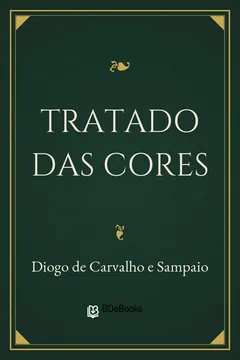
Tratado das Cores
Notas de rodapé
n. 64. Vermelho, e Verde: Branco;
Pag. 115. quando os corpos quando a mayor parte dos
n. 73. naturaes corpos naturaes
Pag. 120.
os rayos da luz, os subtilissimos rayos da luz,
n. 77.
Pag. 125.
(Nota XII.) (Nota XVI.)
n. 84.
Pag. 138.
Blattrn Blattern
Nota XIII.
Pag. 142. he inalteravel: he indestructivel:
No Vocabolario faltaõ as Cores, B - -C , P , e U . Quanto á primeira destas Cores, ella he o mesmo
que Alvaiade, V. A . A segunda he huma Cor especifica do
Vermelho, V. Tab. V. VII. IX. XI. 1. A terceira finalmente, que se faz
de lapis lazuli, se acha discripta na Cor, A , e A P , onde se póde ver.
Notas de rodapé
[1] NOTA I.
[2] NOTA II.
[3] NOTA III.
[4] NOTA IV.
[5] NOTA V.
[6] NOTA VI.
[7] NOTA VII.
[8] VEJA-SE A NOTA XXIII.
[9] NOTA VIII.
[10] NOTA IX.
[11] NOTA XXIII.
[12] NOTA X.
[13] NOTA XI.
[14] NOTA XII.
[15] NOTA XIII.
[16] NOTA XIV.
[17] NOTA XV.
[18] NOTA XVI.
[19] NOTA XVII.
[20] NOTA XVIII.
[21] NOTA XIX.
[22] NOTA XX.
[23] NOTA XXI.
[24] NOTA XXII.
[25] NOTA XXIII.
[26] Maxime refragibilibus purpura, sive violarum Color competit, & rubor minime refrangibilibus, atque mediocribus viriditas vel potius confinium viridis, & viresentis cœrulei. Adeoque radii prout sunt plus plusque refrangibiles apti sunt ad hos ordine colores, rubrum, flavum, viridem, cœruleum, & violaceum generandos una cum omnibus eorum successivis gradibus & coloribus intermediis. Newt. Opt. Part. II. Sect. I.
[27] Simplices sive primitivi Colores. Newton Opt. Par. II. Sect. I. Prop. II.
[28] Partes imaginis, quas colores occupant, proporcionales essent chordæ sic divisæ, ut singulos gradus in octava resonare faciat. Newt. Part. II. Sect. II.
[29] Per colores autem Primitivos non tantum quinque prædictos intelligo, sed & quoslibet alios quibus exibendis aptum datur aliquod radiorum genus. Newt. Opt. Par. II. Sect. I.
[30] Cum isthæc quanta potui diligentia observassem, non proprio tantum sensu consisus, sed (propter summam difficultatem præcise distinguendi confinia Colorum) aliorum judiciis fretus imaginis dimentiones juxta inventa deliniavi. New. Opt. Part. II. Sect. II.
[31] En qualité de Géometre, je crois avoir quelque droit de protester ici (s'il m'est permis de m'exprimer de la sorte) contre cet abus ridicule de la Géométrie dans la Musique. Je le puis avec d'autant plus de raison, qu'en cette matierie les fondemens des calculs sont hypothétiques jusqu'à un certain point, & ne
peuvent même être qu'hypothétiques. Le rapport de l'octave comme 1 à 2, celui de la quinte comme 2 à 3, celui de la tierce majeure comme 4 à 5, &c. ne sont peut-être par les vrais rapports de la nature; mais seulement des rapports approchés . . . . M. D'Alembert, Elémen. de Music. Disc. Prelim. pag. XXX. J. J. Rousseau Diccion. de Mus. na palavra Tempérement.
[32] Newton ayant repété plusieurs fois avec beaucoup de soin,
l'experiencie, (falla da experiencia, n. 26. 27. 36. 37.), trouva que les résultats en étoient très-constants; & après y avoir bien réfléchi, il assaya de les expliquez par les conjectures suivantes. Il lui vint en pensée, que la lumiere pourroit être un fluide composé de parties essentiellement différentes: premiérement, par le degré de réfrangibilité; secondement, par la propriété d'exciter en nous le sentiment de certaines couleurs. En effet en supposant ces deux points, il est aisé de rendre raison &c. M. Nollet Phys. Experim. Leç. XVII.
Tábua I
Tábua I
Tábua II
Tábua II
Tábua III
Tábua III
Tábua IIII
Tábua IIII
Tábua V
Tábua V
Tábua VI
Tábua VI
Tábua VII
Tábua VII
Tábua VIII
Tábua VIII
Tábua VIIII
Tábua VIIII
Tábua X
Tábua X
Tábua XI
Tábua XI
Tábua XII
Tábua XII
Tábua XIII
Tábua XIII
Tábua XIIII
Tábua XIIII
Tábua A
Tábua A
Tábua B
Tábua B
Tábua C
Tábua C
Tábua D
Tábua D
Você terminou Tratado das Cores
Diogo de Carvalho e Sampaio
Livros como este
-
 Recuperação ambiental da Mata Atlântica
-
 Estudos métricos da informação no Brasil
-
 Memória sobre a cultura da Urumbeba e sobre a criação da Cochonilha
-
 Memória Hidrográfica das Ilhas de Cabo Verde
-
 Teoria quântica: estudos históricos e implicações culturais
-
 A filosofia natural de Benjamin Franklin: traduções de cartas e ensaios sobre a eletricidade e a luz
Depois do livro
Páginas que vieram com esta edição, guardadas aqui para consulta.
Aviso do Project Gutenberg
*** END OF THE PROJECT GUTENBERG EBOOK TRATADO DAS CORES ***
Updated editions will replace the previous one—the old editions will be renamed.
Creating the works from print editions not protected by U.S. copyright law means that no one owns a United States copyright in these works, so the Foundation (and you!) can copy and distribute it in the United States without permission and without paying copyright royalties. Special rules, set forth in the General Terms of Use part of this license, apply to copying and distributing Project Gutenberg™ electronic works to protect the PROJECT GUTENBERG™ concept and trademark. Project Gutenberg is a registered trademark, and may not be used if you charge for an eBook, except by following the terms of the trademark license, including paying royalties for use of the Project Gutenberg trademark. If you do not charge anything for copies of this eBook, complying with the trademark license is very easy. You may use this eBook for nearly any purpose such as creation of derivative works, reports, performances and research. Project Gutenberg eBooks may be modified and printed and given away—you may do practically ANYTHING in the United States with eBooks not protected by U.S. copyright law. Redistribution is subject to the trademark license, especially commercial redistribution. START: FULL LICENSE