
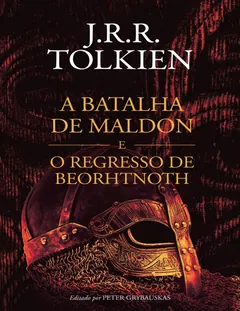
A Batalha de Maldon e O Regresso de Beorhtnoth
IV. Um Antigo Regresso Rimado
IV
REGRESSO
[Como já se disse, uma das características notáveis dos rascunhos antigos do drama em verso de Tolkien é que o diálogo é estruturado em rimas, e não em aliterações. O texto incluído abaixo é o da Versão D (Bodleiana MS. Tolkien 5, ff. 16–22)]
O REGRESSO DE BEORHTNOTH, FILHO DE
BEORHTHELM
A cena inteira se passa no escuro. Ouvem-se duas vozes: a de Totta, lho do menestrel, um jovem, e a de Tudda, um velho servo do duque Beorhtnoth, que foram enviados pelo abade de Ely para o campo de batalha, não muito longe de Maldon. Lá aguardam o abade e alguns monges para levar o corpo de Beorhtnoth até Ely.
Escuridão. Barulho de um homem se movimentando & respirando pesadamente
TOTTA
Ah! Quem vem? É você, Tudda! Eu pensei,
Deus!, que era um deles. Uma hora busquei
no meio desses mortos, à espera sua,
a sós.
TUDDA
Deve estar perto, mas a lua
já se escondeu.
[Ele deixa escapar uma luz de uma lanterna escura.]
TOTTA
Não! Cubra essa luz agora!
[Uma coruja pia.]
Xiu! Que é isso?
TUDDA
Qual seu temor, rapaz? Ora…
[Ele cobre a luz.]
Ajude-me a erguê-los! Poupe o seu ar!
Achou que haveria fantasmas a andar?
Ou lobos dos lais de godos e hunos, é?
Em Essex? Não! Nem os que andam em pé
virão espreitar nesta noite suja
corpos despojados! É uma coruja!
TOTTA
Malditas! Bom que está aqui. Ora… “temor”!
É que pela noite não guardo amor,
com tanto morto à vista. É qual o sombrio
gentio inferno. Onde o mestre caiu?
Na fria e estranha noite — a fronte forte,
altivo e antigo — a alma partiu à morte.
TUDDA
Onde há mais mortos! Aqui! Venha ver!
[Descobre a luz.]
Eis Wulfmær! Junto ao senhor há de jazer.
TOTTA
Qual deles?
TUDDA
Qual? Ora, ambos aqui estão,
o homem que lhe era mais caro ao coração —
não longe estaria o lho-da-irmã —
e o lho de Wulfstan.
TOTTA
O que com afã
há pouco ainda corria e nadava?
TUDDA
E Ælfnoth ao seu lado.
TOTTA
É
É o que eu esperava.
Nunca estavam longe.
TUDDA
Dele também não!
Maldita lanterna e essa minha visão.
Mas aqui foi a última defesa,
e o homem há de estar perto, com certeza.
TOTTA
Que triste ver correrem os barbados
e os jovens morrerem. Deus! Desgraçado
é quem fugiu. O jovem Ælfwine, veja!
TUDDA
Bravo. Do tipo que nunca fraqueja.
Como Offa, era altivo.
TOTTA
Mas uns ali
levaram-no a mal, ou assim ouvi,
queriam Offa mudo aquele dia
no conselho. É o que se diz em poesia:
“Torpe é quem ganha anéis e hidromel bebe
e abandona aquele de quem recebe”.
Queria ter ido à luta voraz,
não cado como bagagem pra trás.
Também o amava. Um plebeu pode ser
mais bravo que o nobre que faz parecer
que descende de Woden e antigos reis!
TUDDA
Como fala! A hora vai chegar, e eis
que as coisas não serão fáceis. Cruel
é o ferro da espada. Se sem labéu
e vivo estivesse após enfrentar
lanças, daria graças. Venha ajudar!
[Uma pausa em que eles se esforçam em meio aos corpos. A lanterna está descoberta no chão.]
Ora! Erga-o! É só um maldito danês,
gentio grandalhão.
TOTTA
Cubra a luz outra vez!
Odeio esse olhar, funesta luzerna,
como o de Grendel à lua. Uma perna!
Mais parecem três!
TUDDA
Paz! São do mestre, sim!
As mais longas desta terra ao con m.
TOTTA
A fronte ia acima das dos reis in éis!
E jaz en m o doador dos anéis
Qual príncipe em canções. Foi-se ao Senhor,
Beorhtnoth.
TUDDA
E o chão pisaram com vigor,
lodo sangrento.
TOTTA
A espada ali no meio!
A de punho dourado, Tudda.
TUDDA
Receio
ser bom não ter lua. Pouco deixaram
do que havia.
TOTTA
Ai! Tudda, eles lhe cortaram
a cabeça; fanaram com machada
o corpo — a guerra é assim desventurada?
TUDDA
Sim, sim. Mas vai dar trabalho o bastante
levar as sobras. Segure e levante!
TOTTA
Mas a carne e o osso inda serão caros
se arruinados. Lamentai sempre amaros
O homem inglês, o homem saxão
Desde a Mércia ao Oriental chão.
Choram damas. O muro cai.
Pra ossada um alto teso alçai!
Onde repousem o elmo e a espada,
Montes de anéis de luz dourada.
Dentre amigos, não tinha par,
Primo e maior de mar a mar;
Mais belo e gentil aos parentes,
Todos sempre o terão nas mentes
Enquanto o sol nos der luz ava;
Glória cobre o que glória amava!
TUDDA
A elegia não é tarefa nossa,
mas dos monges de Ely. Já pra carroça!
Devagar e rme! Vá me seguindo.
Mortos puxam pra baixo. Aonde está indo?
Que é?
TOTTA
Veja! Há alguém ali! Não, dois erradios!
Dois homens! Ou caminhantes-sombrios,
curvos, braçudos!
TUDDA
Ataque sem alarde!
Fique quieto.
[Ele cobre a lanterna.]
[Uma pausa em que se ouve o ruído de passos furtivos se aproximando. Tudda ergue a voz.]
Ei! Chegaram muito tarde
pra luta. Mas se for do seu agrado
posso lutar!
[Para Totta em um sussurro rouco.]
Estão vindo! Cuidado!
[Há um barulho de briga.]
[Tudda em voz alta] Dê uma rasteira!
[Uma pancada e um grito.]
TOTTA
Ahá! Tome isto aqui!
(Gritando) Por Deus do céu, Tudda! Este eu abati
com a espada do mestre! Achou ligeiro
o melhor espólio do campo inteiro!
TUDDA
Pra melhor uso essa espada foi feita.
Um murro e um pontapé, e tudo se ajeita;
já não faltam mortos a nos cercar.
Quando for um danês, pode gritar!
Gentios ou não, odeio todos eles,
pela Cruz, são do demônio, gente reles.
TOTTA
Então vamos! Pois deve haver mais por perto
da corja pirata.
TUDDA
Não, não, por certo
não são homens do Norte ou algo pior.
Estão em Ipswich bebendo a or.
Estes são só ladrões de corpos, gralhas,
sem amigo, rival ou coisa que o valha,
só a fome e a carência. Um deles achou
algo a ado entre os mortos. Escutou?
Vamos!
TOTTA
Deus ajude, são maus os dias:
não se vingam mortos, e em lupinas vias
agem os pobres, qual corvo carniceiro
que rouba dos seus. Meu Deus! Há um terceiro
nas sombras!
TUDDA
Deixe. Ele não vai esperar.
Esse tipo não é de se arriscar.
Vêm furtivos no m da luta. Acuda!
Firme outra vez.
TOTTA
Cadê a carroça, Tudda?
Espero que perto! Chegue pra cá,
que estamos muito pra beirada já,
ou caímos no Panta, bem na enchente.
TUDDA
Aqui está a rampa e a carroça está rente.
Pela cabeça de Edmund! Mesmo privado
da sua, o nosso mestre é bem pesado!
[Uma pausa. Som de homens andando devagar, e novamente ofegando.]
TUDDA
Eis a carroça! Queria a cerveja
beber, perto de onde foi a peleja
que o matou! Dava cerveja excelente
doce e forte… …
… … Mas como de repente
tomaram a rampa? Há aqui pouco rasto
de luta, mas na água um número vasto
devia haver, só que na ribanceira
há um só.
TOTTA
O que diz a cidade inteira,
é que foi graças a ele. Ai de nós!
Soberbo e audaz demais. Foi-se veloz.
Relevemos: seu grão cor o enganou.
Deixou-os passar; desa ou-os; tombou.
Último lho dos homens que os cais
deixaram, contam-nos livros e lais,
de Angel no Leste, e sob elmo, na guerra,
venceram galeses, e nesta terra
um reino fundaram antigamente.
E os ventos do Norte vêm novamente!
TUDDA
E o desvalido é quem carrega o fardo,
sempre é assim, seja lá o que canta o bardo.
Morte aos Vikings! O homem perde seu torrão,
morre e depois o aduba. Dê uma mão,
que logo acabamos! Suba! Olhe o tranco!
Cubra-o neste pano. Devia ser branco.
Serve, por ora. Os monges e o abade
esperam em Maldon. Já está bem tarde.
Chore ou ore; eu toco os cavalos, Totta.
TOTTA
E que Deus nos guie em segura rota!
[Um silêncio em que se ouve o rumor e o ranger de rodas.]
Como geme a roda! E agora, pra onde?…
…Ei, Tudda! Tudda! Por que não responde?
TUDDA
(Pesadamente) Onde? Maldon, rapaz, e Ely, por m,
e aos monges. Devagar. E a estrada é ruim.
Achou que teria cama e conforto?
TOTTA
A estrada é longa.
TUDDA
Não pra quem está morto.
O som não o acordará. Encoste e durma!
[Para os cavalos.]
Upa! Já lhes dei comida! Ande, turma!
Logo chegamos à estala dos monges.
Ninguém roubará o que achamos tão longe.
[O rangido e o ruído, e o som de cascos continuam por um tempo. Luzes bruxuleiam ao longe. O
som tênue de um cântico chega com o vento.]
TOTTA ( Dormitando, meio sonhando)
Em Ely, há Missa, círio e cantochão
antes do enterro. Os dias passarão
e homens — damas choram em Angelcynn —,
vêm novos dias…… seu túmulo, assim,
passa a extinguir-se. Seus parentes somem.
O círio derrete. Igual a todo homem.
Nas trevas as velas se apagam logo.
Façam faíscas, acendam o fogo!
Uma luz perene e chamas vivazes!
Ouço-as sim. Palavras boas e audazes!
Uma voz solene diz vagarosamente:
Hige sceal þe heardra, heorte þe cenre,
mod sceal þe mare þe ure mægen lytlað.
TOTTA
Belas palavras, scop! Sei que ninguém
esquecerá por eras e eras… [dorme]
[A carroça dá um solavanco e ele se sobressalta]
Hein?
Tromba e chacoalha! Tudda, é o que eu lhe digo,
nos dias de Æthelred, a estrada é um perigo.
[Escuridão total e silêncio por um momento.]
[Vozes cantando bem baixo, mas devagar e com palavras distintas.]
Dirige, Domine, in conspectu tuo viam meam.
Introibo in domum tuam: adorabo ad templum sanctum
tuum in timore tuo.
Uma voz (não a de Tudda e nem de Totta)
Tão tristemente cantam os monges de Ely!
Remai, homens! Que o seu canto nos vele.
[O canto lentamente ca mais alto e claro.]
Dirige, Domine, in conspectu tuo viam meam.
Introibo in domum tuam: adorabo ad templum sanctum tuum in timore tuo. Domine deduc me in justitia tua: propter inimicos meos dirige in conspectu tuo viam meam. Gloria Patri et Filio et Spiritui Sancto: sicut erat in principio et nunc, et semper, et in saecula
saeculorum.
Dirige, Domine, in conspectu tuo viam meam.
[O cântico diminui até que se faça silêncio.]
OceanofPDF.com
Darkness. Noise of a man moving about & breathing heavily.
TOTTA
A! Who is there? You, Tudda! I had thought
at, God!, ’twas one of them. An hour I’ve sought
here, waiting for you, groping among the slain,
alone.
TUDDA
Nigh here is where he should have lain;
but the moon is sunk.
[ He lets a light shine from a dark-lantern. ]
TOTTA
No, no! cover that light!
[ An owl hoots. ]
Hish! What was that?
TUDDA
Come, come, lad! What’s your fright?
[ He covers the light. ]
Help me to lift ’em, and spare breath! Less talk!
What do you think? at their ghosts so soon would walk?
Or wolves wander out of lays of Goths and Huns
in Essex here? Nay! Not two-legged ones
neither – they’ll not come here to-night, to prowl
round corpses stripped near naked! ’Twas an owl!
TOTTA
Curse owls! I’m glad you’re here at last. But ‘fright’!
I’m not afraid – though I don’t like the night,
with all these dead unburied. ’Tis like the shade
of heathen hell. Where has our master laid
his mighty head, so proud and old, to-night –
so cold and strange, when soul has taken ight?
TUDDA
Look where they’re thickest lad! As here. Come, see!
[ Opens the light. ]
Here Wulfmær lies! And close to his lord he’ll be.
TOTTA
Which one is that?
TUDDA
Which? Why, they both are here,
tumbled together: the man he held most dear –
not far from kin will lie his sister-son –
and Wulfstan’s boy, too.
TOTTA
He that used to run
so swift, and swim? It seems an hour ago.
TUDDA
And Ælfnoth by him too.
TOTTA
And rightly so,
they were never far apart.
TUDDA
Nor far from him!
A plague on this lamplight, and my eyes are dim.
But it was here they made their last stout stand,
I’ll warrant we nd the old man near at hand.
TOTTA
Poor lads! While men with beards and tried blades ran,
the young boys died, God’s pity! Curse the man
who left them to it. Young Ælfwine, look!
TUDDA
He was a stout one. His knees never shook.
Proud heart, proud tongue, like Offa.
TOTTA
ere were some
took Off a’s words with scowls, and wished him dumb–
they cut too nigh – or so I’m told, that day
at counsel of the lords. As old songs say:
‘’Tis shame to take the ring and drink the mead,
and leave the giver of the gift at need’.
But days are worsened. I wish that I’d been here,
not left with the baggage like a thrall in rear.
I loved him as much as they. A plain churl
may prove more tough when tested than an earl
that traces kin to Woden and old kings!
TUDDA
You talk! Your time’ll come, my lad. en things
will look less easy. Iron has a bitter taste,
and swords are cruel. If you’d ever faced
the yell of spears, now thanking God you’d be
you’re neither dead nor shamed. Come stand by me!
[A pause in which they struggle with bodies. e lamp is stood open on the ground.]
Now! Heave him off ! ’Tis only a cursed Dane,
great hulking heathen.
TOTTA
Shutter that light again!
I can’t abide his eyes. ey glare so grim –
like Grendel’s in the moon. Look! ere’s a limb,
like three men’s legs!
TUDDA
Peace! It’s the master! Yes,
that’s him – the longest in this land, I guess.
TOTTA
His head was o’er the crowns of heathen kings!
Here lies he now at last, who dealt the rings
like princes in old songs. He’s gone to God,
Beorhtnoth our lord.
TUDDA
And the ground about is trod
to bloody mire.
TOTTA
His sword is over here!
You know it, Tudda: with the golden hilts.
TUDDA
I fear
’tis well the moon’s gone. Little have they left
of what we knew.
TOTTA
Woe! Tudda, they have reft
his head, and with their axes mangled him!
And the body – a! is battle then so grim?
TUDDA
Yes, yes – that’s war. But we must make a shift
to bear what’s left. Hold here! Now come! You lift!
TOTTA
None the less dear shall be this esh and bone,
though foes have marred it. Now for ever moan
e Saxon and the English men
From Mercian wood to Eastern fen.
e wall is fallen. Women weep.
Build high the mound his bones to keep!
And there shall lie his helm and sword,
And golden rings be laid in hoard.
For of the friends of men was he
e rst and best from sea to sea;
To folk most fair, to kin most kind,
And ever shall be held in mind
While from the sea there riseth sun;
Glory he loved and glory won!
TUDDA
Come on! No dirges yet! ’Twill be the part
of Ely monks, with luck. Now for the cart!
Hey, steady there. Keep step with me. Now slow!
Dead men drag earthward. Hey, look where you go!
What is it?
TOTTA
Look! ere goes one, see? No, two!
Two men! Or shadow-walkers foul of hue,
bowed, with long arms!
TUDDA
Quick! Put him down! And wait,
and keep your tongue.
[ He puts the lamp out. ]
[A pause in which the noise of stealthy steps is heard approaching. Tudda raises his voice.]
Hi, there! You’re over late
to join the ght. But I can give you some
if that is what you want.
[To Totta in hoarse whisper.]
Look out! ey come!
[ere is a noise of scuffl ing.]
[Tudda loudly] Go on! Trip him!
[ A blow and a shriek.]
TOTTA
A! there, that settles you!
(Crying aloud) Heaven be praised, Tudda! I’ve run him
through, with master’s sword! Quicker than he thought he
found the best thing left to plunder on this ground!
TUDDA
No need. at sword was made for better fare.
A st and boot was quite enough to scare
the likes of them. ere’s dead enough about.
When you have killed a Dane, begin to shout!
ere’s plenty of them near, and by the Rood
I hate ’em, heathen or sprinkled, devil’s brood.
TOTTA
en hurry! ere may be more at hand. Away!
We’ll have the pirate pack on us.
TUDDA
Nay, nay!
ese were no Northmen! What should they come for?
ey’re all in Ipswich now, and drink to or.
ese are corpse-strippers, native carrion-crows
of waste and fen. ey have no friends nor foes,
save want and hunger. One has found the gear
of dead men sharper than he thought. D’you hear?
Come on!
TOTTA
God help us, and these wretched days
when men lie unavenged, and wolvish ways
folk take for need, to pill like carrion-bird
and plunder their own. All hallows! ere’s a third
in the shadows yonder!
TUDDA
Let be. He will not wait.
at sort will ght no odds, early nor late.
ey sneak in when all’s over. Up again!
Steady once more.
TOTTA
Say, Tudda, where’s the wain?
I wish we were by it! Come now, more this way:
we’re walking near the brink. Look out, I say.
We’ll fall into Panta. And the tide is high.
TUDDA
We’re at the causeway – and the wain’s hard by.
ere then – the rst step of the journey’s done.
By Edmund’s head! our lord’s not light with none!
[ A pause. Sound of men slowly walking, and panting again. ]
TUDDA
e wain at last! I wish that I could drink
his funeral ale right now upon the brink
near where he died! Good beer he gave; not thin,
but sweet and strong… …
… … How came they thus to win
across the causeway, think you? ere’s little sign
here of hard ght, and yet just here the brine
should have been choked with them. But by the bank
there’s only one there lying.
TOTTA
ey’ve him to thank,
alas! Or so men say now in the town.
Too bold, too proud! But he is fallen down,
made fool of by great heart. So we’ll not chide.
He let them cross to taste his sword – and died:
the last of the true sons of men of old
that sailed the seas, as songs and books have told,
from Angel in the East, and under helm
upon war’s anvil smote the Welsh, and realm
here in this isle they founded, long ago.
Now from the North again the winds do blow!
TUDDA
And poor men catch it in the neck, today
as long ago; whatever the songs may say,
perish all Vikings! Poor men robbed of land
they loved, must die and dung it. Lend a hand!
And then our task is done. Now up! at’s right!
Cover him over with that cloth. It should be white,
but it must do for now. e monks now wait
in Maldon with their abbot, and we’re late.
Get in! And weep or pray, my lad. I’ll drive.
TOTTA
God guard our going, and grant that we arrive!
[ A silence in which a rumbling & creaking of wheels is heard.]
Where rst tonight? Lord! How these wheels do creak!...
…Hey, Tudda! Tudda! Speak! Why don’t you speak?
TUDDA
(Heavily) Tonight? To Maldon; then to Ely, lad, with monks and all, slow; and the road is bad.
Without a rest. Did you think to get to bed?
TOTTA
’Tis a long road.
TUDDA
But a short one for the dead.
Creaking won’t break his rest. Lie by, and sleep!
[ To the horses.]
Gee up! boys. You’ve been fed. No need to creep.
Good stable have the monks. Don’t heed the sound.
None now will try to steal what we have found.
[e creaking and rumbling and sound of hoofs continues for some time. Lights glimmer in
the distance. ere is a faint sound of chanting borne on the wind.]
TOTTA (Drowsing half in dream.)
Ay! Candles and singing, and the holy Mass
in Ely, ere he’s buried. And days will pass,
and men – and women weep in Angelcynn –
and new days follow…… and his tomb begin
to fade, and all his kith pass out of ken.
e candles gutter in the wind. Like men.
ey soon go out, the candles in the dark.
Come smite the int, and strike a spark!
A ame – a light – a re that won’t go out!
A yes, I hear them. Good words those, and stout!
A solemn voice says slowly:
Hige sceal þe heardra, heorte þe cenre,
mod sceal þe mare þe ure mægen lytlað.
TOTTA
Well said the scop! And that won’t be forgot
for many an age… an age…an age… [sleeps]
[e cart bumps and he starts.]
What?
Hey, rattle, rattle, bump! Tudda, I say,
No sleep! e roads are rough in Æthelred’s day.
[Complete dark and silence for a while.]
[Voices chanting low and faintly, but slowly and with distinct words.]
Dirige, Domine, in conspectu tuo viam meam.
Introibo in domum tuam: adorabo ad templum sanctum tuum in timore tuo.
A voice (not of Tudda or Totta).
Sadly they sing, the monks of Ely isle!
Row lads, row! Let us listen here a while.
[e chanting slowly grows louder and clearer.]
Dirige, Domine, in conspectu tuo viam meam.
Introibo in domum tuam: adorabo ad templum sanctum
tuum in timore tuo.
Domine deduc me in justitia tua: propter inimicos meos
dirige in conspectu tuo viam meam.
Gloria Patri et Filio et Spiritui Sancto: sicut erat in
principio et nunc, et semper, et in saecula saeculorum.
Dirige, Domine, in conspectu tuo viam meam.
[e chanting fades into silence.]
OceanofPDF.com