
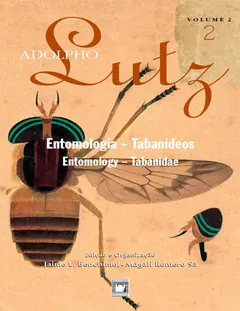
Adolpho Lutz: entomologia, tabanídeos
Descriptions from the Oswaldo Cruz Institute's Tabanidae collection (1909-11)
Descriptions from the Oswaldo Cruz
Institute's Tabanidae collection (1909-
11)
“Tabanidae collection” [in Port.] is part of Instituto Oswaldo Cruz. Em Manguinhos (Rio de Janeiro: Officinas de Kósmos, 1909, pp. 28-30). This richly illustrated pamphlet presented the sera and vaccines produced at Manguinhos, along with information on the institute's biological collections, publications, laboratories, and other sophisticated facilities then under construction or recently inaugurated. The gathering of this collection of Tabanidae is explained in “Contribution to the knowledge of the indigenous fauna of Tabanidae,” an article by Lutz and Neiva published in Memórias do Instituto Oswaldo Cruz, also in 1909, the year in which the periodical was first released. The collection includes the specimens brought by Adolpho Lutz when he transferred from the São Paulo Bacteriological Institute to its counterpart in Rio de Janeiro in 1908. The image that heads the document is an alusion to Lutz's 1907 study of an endemic disease that was doing serious harm to the herds on Marajó Island. When still director of the São Paulo Institute, Lutz concluded that this disease, known as “mal de caderas,” was caused by Trypanosoma equinum, and that Tabanidae must play a central role in its transmission, as was the case with nagana, a cattle disease transmitted by the bite of the tsetse fly, common in equatorial Africa.
This pamphlet was part of the public relations material that Manguinhos released after its transformation from a mere Serum Therapy Institute into the Institute of Experimental Medicine, in 1908; that same year, it was re-christened the Oswaldo Cruz Institute. (Further information can be accessed at the Oswaldo Cruz Virtual
Library at www.prossiga.br/oswaldocruz/).
This leap in quality was partly due to the success attained by the sanitarians and researchers headed by Oswaldo Cruz at the 14 th Congress of Hygiene and Demography, held in Berlin in September 1907. A leaflet published at that time made no reference to entomological collections. The one designed for the International Hygiene Exposition held in Dresden in June 1911 does describe Manguinhos' Tabanidae collection; although the description is much the same as the one printed in 1909, it also includes a number of new species described by Adolpho Lutz and Arthur Neiva. For this reason, we have reproduced herein part of Internationale Hygiene-Ausstellung Dresden 1911 (Rio de Janeiro: Instituto Oswaldo Cruz, 1911, pp. 33-5).
During the 1950s, the entomologist Alexander Graham Bell Fairchild (1906-1994) offered his collaboration in organizing and revising Adolpho Lutz's Tabanidae collection, most of which was stored at the Oswaldo Cruz Institute, with a smaller portion at the Butantan Institute. The Adolpho Lutz Virtual Library
(www.bvsalutz.coc.fiocruz.br) provides a “List of Tabanidae within the Butantan Institute collection in 1941” [in Port.], along with the two articles that Fairchild published in Memórias do Instituto Oswaldo Cruz: “The Adolpho Lutz Collection of Tabanidæ (Diptera). I. The described genera and species, condition of the collection, and selection of lectotypes” (v. 59, fasc. 2, Jul. 1961, p.185-249) and “The Adolpho Lutz Collection of Tabanidæ (Diptera). II. Status of the names published without description” (v.59, fasc. 3, Sep. 1961, p.279-95).