
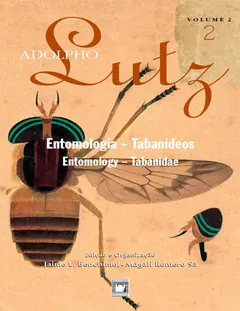
Adolpho Lutz: entomologia, tabanídeos
The Adolpho Lutz Collection of Tabanidæ (Diptera)
The Adolpho Lutz Collection of
Tabanidae (Diptera)
Adolpho Lutz was born in Rio de Janeiro, December 18, 1855, the son of Swiss parents. His father, Gustav Lutz, was the first of a long line of “Burger of Bern” to emigrate from his native land. When Adolpho Lutz was slightly over two years old the family went to live in Bern for a time but on their return to Brazil left the three eldest boys at school in Switzerland. Lutz only saw the land of his birth again as a grown man.
As a quite small boy he was already sure of his vocation, the study of Natural History. Intending to live in Brazil he decided, however, as an adolescent, to study Medicine as it seemed the liberal profession most closely akin to biology that would enable him to make a living. This proved to be a wise decision since it was precisely the conjunction of medicine and biology that enable him to make his pioneer contribution to the development of tropical medicine and medical zoology in Brazil.
Lutz' life and work can be divided into three main phases, the practitioner (1881-1892), the director of the Bacteriological Institute of the State of São Paulo (1893-1908) and the member of the Instituto Oswaldo Cruz (1909-1938), and always the research worker, until his death (October, 1940).
Lutz' scientific work was carried out under difficult circumstances. When practising medicine he lacked both time and laboratory facilities for research. While setting up news standards of public health and revolutionizing methods of dealing with endemic and epidemic diseases, he needed not only time but above all peace; even in the later years, at Manguinhos (Instituto Oswaldo Cruz), he never had adequate assistance or dealing with routine. Nevertheless, Lutz worked on doggedly. As a country doctor he devoted most of his spare time to study of interesting diseases, such as leprosy, and of the parasites of man and his domestic animals. He observed the habits of mosquitoes before and during the great epidemic of yellow fever at Campinas (1889). In São Paulo, he started working systematically on blood-sucking Diptera, beginning with the mosquitoes, at first in cooperation with Theobald and later alone. During this period he discovered Forest Malaria (1898 published 1903) and saw the first known cases of Jungle Yellow Fever. From 1903 to 1907 he published papers on Culicidae, and also on blood-sucking Diptera as transmitters of disease.
However, being ever a restless pioneer, in search of new fields, he went on to the horse-flies. His first papers on Tabanidae were published while he was in São Paulo, the preliminary notes in the Revista da Sociedade Scientifica de São Paulo, (1905-1906) and in Zentralblatt für Bakteriologie (1907) the first major synthesis on Brazilian Tabanids in Zoologische Jahrbücher. After settling in Rio, most of his work came out in the Memorias do Instituto Oswaldo Cruz, to which he was one of the main contributors for many years. In the first period of the Institute, the prestige of Oswaldo Cruz and the prosperity of the institution made it possible to publish in a foreign language as well as in Portuguese and to illustrate Lutz' taxonomic papers with color plates. During and after the first World War the Institute lost its best illustrators and for fairly long periods the policy of a double text could not be maintained. These circumstances led Lutz to postpone publishing on Tabanidæ, especially on the genera of Tabaninæ not dealt with in his former papers. Gradually, he got interested in other groups and returned only sporadically to the horse-flies, though he had probably intended to deal with the whole family, at least in regard to Brazil, and perhaps to expound his taxonomic system.
Many of Lutz' species and of his specimens were collected personally by him. Much of the work of preservation also devolved on him and that not only in the early days. In Lutz' time the Bacteriological Institute of São Paulo was constantly understaffed, with only from one to four doctors to attend to all the problems connected with Public Health arising in the state territory (247,222 km2) and with either one preparator or no one to look after the collections. At the Oswaldo Cruz Institute, Lutz had a “laboratory servant” as his whole staff. The two successive incumbents were both unusually good but they had their limitations, as to literacy, technical training, etc. The sporadic secretarial help that Lutz enjoyed during his life-time would not make up even a tenth of his sixty years of research. In the early days literature was very hard to obtain. Everything had to be sent for from abroad with great delay and much difficulty. He could only examine types and older collections during his short and very infrequent journeys to Europe and North America.
Lutz made the best he could of the circumstances and worked out simple methods enabling him to keep up with his work. His specimens were kept in drawers in cabinets, not in little boxes, but grouped together under the right generic and specific names. Localities might be indicated very succinctly but in such a manner as to allow him to place the specimen correctly. Long series of the same kind might be given one collective label, delimiting them. Specimens that did not quite fit into any of these yet seemed very much akin were put at the periphery of the closest allied species. New forms received a provisory name and were placed in readiness for description, then or later, according as to whether there was hope of obtaining more specimens or not. Occasionally two names, mostly with the same meaning and derived from the main diagnostic character were put down. In a few cases this may have led to some confusion later, if the discarded name was not removed from all the specimens, for lack of time or through forgetfulness. The undetermined specimens left to the sides of the allied forms may also have caused some doubt when the Lutz' Collection was moved after his death. Some names may, of course, have been wrongly applied by him but this sort of error is inevitable, as in early days the paucity of known forms led to very generalized descriptions which later proved applicable to several different species. Some descriptions may also have escaped the pioneer working far from the main centers of research, despite his polyglot gifts.
Lutz' descriptions of new forms were short and succinct. They stressed the main diagnostic characters and left the unimportant ones, or those held in common with other forms, unmentioned. This criterium was consistently applied by Lutz. When his attention was called to latter-day rituals of description, he was apt to remark that the main thing was to give the essential, differential characters, and he might add: “A bon entendeur, salut”. Alas!
Lutz was keenly interested in the preservation of his collection and had worked out a technique described by him (1924, 1929-30) in: “Sammeln Präparieren, Untersuchen und Bestimmen der hygienisch wichtigen Insekten”. Kraus, R. und Uhlenhuth, P. Handb. mikobiol. Tech., v.3, p.2135-82; 24 figs. (Berlin und Wien); re-ed by Kolle, Kraus & Uhlenhuth in rd Hdb. path. Mikroorgan. , 3 ed., v.10, p.551-90). He desired the collection, or at least the types, to remain at the Instituto Oswaldo Cruz. Whenever he could he would pin a red label to types and blue ones to cotypes though, under the stress of excessive work and varying interests, this was sometimes overlooked. In his life-time the collection was carefully attended to.
After Lutz' death all his collections were very much neglected for several years. Occasionally, specimens, or whole drawers, were taken out, examined and not always returned in the right order or to the exact place. During Dr. Fairchild's visit, a number of specimens and even whole drawers of Lutz' horse-flies were found in other laboratories. One doubtful treatment against insect-pests and mould was also resorted to. Finally, the whole collection was taken from the original drawers and put into new cabinets, in small boxes. These circumstances may have disturbed the right order and have mixed up doubtful specimens with clear-cut forms. They certainly went counter to Lutz' personal methods of conservation and probably also to his original separation of forms.
When Lutz settled in Rio, he left part of his collections at the Bacteriological Institute in São Paulo. Later they were all sent to the Butantan Institute, where his pioneer collection of Pathology was lost. For a long time the only clue to the Lutz Tabanids that remained in São Paulo was a list given to his daughter by a former curator of insects at Butantan.
Some years after Lutz' death his daughter was invited to help organize her father's collections in a definitive way. Owing to the circumstances explained above she felt rather anxious about the result of alternate neglect and manipulation of the specimens. She also felt that the Lutz system of taxonomy of the Tabanids, based in part on characters of the living animal, such as the color and pattern of the eyes ought to be stressed; that the large number of nomina
nuda 1 needed to be checked and the collection examined, in case it still contained undescribed forms. Consequently, she
All that remains is to thank Dr. and Mrs. Fairchild, the directors of the Institutions, Prof. Amilcar Vianna Martins and Dr. Flavio da Fonseca, and above all, the President of the Conselho Nacional de Pesquisas. Prof. Anto-nio Moreira Couceiro, for their enlightened views as to the importance of preserving the Adolpho Lutz Collection Tabanids. Also to express the hope that with increased facilities for travelling, Lutz' system based on the characters of the living specimens may be easier to expound and to use.
Bertha Lutz
Museu Nacional, Rio de Janeiro
1 Nomen nudum: name published before 1931 that did not comply with articles 12 and 16 of the International Code of Zoological Nomenclature. The first article determined that any name published prior to this date should be accompanied by a description, definition, or indication. Article 16 defined the meaning of ‘indication’ (bibliographical reference to a previously published description; publication of a new name for the genus group or species group in connection with an illustration, to cite just two examples). [E.N.]