
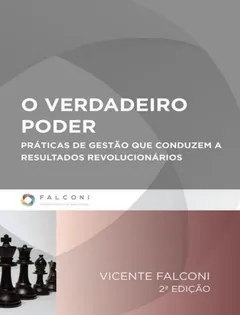
O Verdadeiro Poder
Bibliografia Citada
1 WELCH, Jack; WELCH, Suzy. Winning. New York: Harper Collins, 2005. 372 p.
2 CLARK, Robert M. Intelligence analysis; a target centric approach. 2nd. ed. Washington: CQ Press, 2007. 321p.
3 DESCARTES, René. Discurso do método; regras para a direção do espírito. São Paulo: Martin Claret, 2005. 144 p.
4 MASLOW, Abraham H. Motivation and personality. 2nd. New York: Harper & Row, 1954. 369 p.
5 CAMPOS, Vicente Falconi. Gerenciamento da rotina do trabalho do dia a dia. 8.ed. Nova Lima (MG): Editora FALCONI, 2004. 266 p.
6 WEBER, Max. The theory of social and economic organization. London: William Hodge & Co, 1947
7 CAMPOS, Vicente Falconi. Gerenciamento pelas diretrizes; (Hoshin Hanri). 4. ed. Nova Lima (MG): Editora FALCONI, 1996. 300 p.
8 BERTALANFFY, Ludwig von. General systems theory; foundations, development, applications. New York: George Braziller, 1968. 295 p.
9 SHINGO, Shigeo. A study of the Toyota production system; from an industrial engineering viewpoint. Edição revisada. New York: Productivity Press, 1989. 257 p.
10 McGREGOR, Douglas. The human side of enterprise. 25th Anniversary Imprensa [EDIÇÃO ESPECIAL] (Hardcover). New York: McGraw-Hill, 1985. 243 p.
11 OLIVEIRA, Carlos Augusto de. Inovação da tecnologia, do produto e do processo. Nova Lima (MG): EDG, 2003. 310 p.
12 NONAKA, I.; TAKEUCHI, H. The knowledge-creating company; how japanese companies create the dynamics of innovation. Oxford: Oxford University Press, 1995. 270 p.
13 HANSEN, M. T.; NOHRIA, N.; TIERNEY, T. What’ s your strategy for managing knowledge? Harvard Business Review, v.77, p.106-116. Mar./Apr, 1999.
14 FERREIRA, Aurélio B. H. Novo dicionário da língua portuguesa. 2.ed. Rio de Janeiro: Nova Fronteira, 1986.
15 HINO, Satoshi. Inside the mind of toyota management principles for enduring growth. New York: Productivity Press, 2002. 327 p.
16 ULRICH, D.; KERR, S.; ASHKENAS, R. O Work-Out da GE; como implementar o revolucionário método da GE para eliminar a burocracia e atacar os problemas organizacionais - rápido! Rio de Janeiro: Quality Mark, 2003. 358 p.
17 Wikipedia. The Free Enciclopédia. Disponível em:
<http://en.wikipedia.org/wiki/Model>. Acesso em: fev. 2009
18 MINTO, Bárbara. The Minto pyramid principle; logic in writing, thinking and problem solving. Minto International Inc., 1996. 253 p.
19 LANE, Bill. Jacked Up; the inside story of how Jack Welch talked GE into beco- ming the world’s greatest company. New York: McGraw Hill, 2008. 324 p.
20. FRIGA, Paul N. The McKinsey engagement; a powerful toolkit for more efficient & effective team problem solving. New York: McGraw Hill, 2009. 247 p.
21 SOBEK, Durward K. et al. Understanding A3 thinking; a critical component of Toyota’s PDCA management system. Boca Raton, Florida: CRC Press, 2008. 165 p.
22 WHEELER, Donald J. Entendendo a variação; a chave para administrar o caos. Rio de Janeiro: Qualitymark, 2001. 140 p.
23 HOSOTANI, Katsuya. The QC problem solving approach; solving workplace problems the Japanese way. Tokyo: 3A Corporation, 1989. 168 p.
24 Haines, Stephen G. System thinking & learning. Amherst: HRD Press, 1998. 218 p.
25 RUMMLER, Geary A. Serious performance consulting; according to rummler. OR, USA: John Wiley & Sons, 2007. 176 p.
26 PORTER, Michael E. Competitive advantage; creating and sustaining superior performance. New York: The Free Press, 1985.
27 DRUCKER, Peter F. Managing for the future; the 1990’s and beyond, New York: Truman Talley Books/Dutton, 1992.
28 HARRIS, Robert L. Information graphics; a comprehensive illustrated reference. Oxford: Oxford University Press, 1999. 448 p.
29 FORRESTER, Jay W. Designing the future, 1998. Disponível em:
<http://sysdyn.clexchange.org/sdep/papers/Designjf.pdf.>.
30 SENGE, Peter M. A quinta disciplina. São Paulo: Best Seller, 1990.
31 CAMPOS, Vicente Falconi. Qualidade total; padronização de empresas. Nova Lima (MG): Editora FALCONI, 2004. 142 p.
Você terminou O Verdadeiro Poder
Vicente Falconi
Livros como este
-
 Os 7 Hábitos das Pessoas Altamente Eficazes
-
 TED Talks: O Guia Oficial do TED para Falar em Público
-
 Hábitos Atômicos
-
 A Tríade do Tempo
-
 6Ds: As Seis Disciplinas que Transformam Educação em Resultados para o Negócio
-
 Conflitos, eficiência e democracia na gestão pública
Depois do livro
Páginas que vieram com esta edição, guardadas aqui para consulta.