
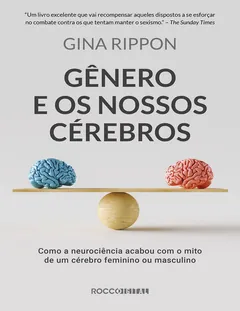
Gênero e os Nossos Cérebros
Capítulo 36
• 36. Site SexDifference. • 37. T. D. Satterthwaite, D. H. Wolf, D. R. Roalf, K. Ruparel, G. Erus, S. Vandekar, E. D. Gennatas, M. A. Elliott, A. Smith, H. Hakonarson e R. Verma, “Linked Sex Differences in Cognition and Functional Connectivity in Youth”, Cerebral Cortex 25:9 (2014), pp.
2383-94, na p. 2383. • 38. A. Kaiser, S. Haller, S. Schmitz e C. Nitsch, “On Sex/Gender Related Similarities and Differences in fMRI Language Research”, Brain Research Reviews 61:2 (2009), pp.
49-59. • 39. R. Rosenthal, “The File Drawer Problem and Tolerance for Null Results”, Psychological
Bulletin 86:3 (1979), p. 638. • 40. D. J. Prediger, “Dimensions Underlying Holland’s Hexagon: Missing Link between Interests and Occupations?”, Journal of Vocational Behavior 21:3 (1982), pp.
259-87. • 41. Ibid, p. 261. • 42. Departamento do Censo dos Estados Unidos, 1980 Census of the Population: Detailed Population Characteristics (Departamento de Comércio dos EUA,
Departamento do Censo, 1984). • 43. B. R. Little, “Psychospecialization: Functions of Differential Orientation towards Persons and Things”, Bulletin of the British Psychological Society 21 (1968), p.
113. • 44. P. I. Armstrong, W. Allison e J. Rounds, “Development and Initial Validation of Brief Public Domain RIASEC Marker Scales”, Journal of Vocational Behavior 73:2 (2008), pp. 287-99. •
45. V. Valian, “Interests, Gender, and Science”, Perspectives on Psychological Science 9:2 (2014),
pp. 225-30. • 46. R. Su, J. Rounds e P. I. Armstrong, “Men and Things, Women and People: A Meta-
analysis of Sex Differences in Interests”, Psychological Bulletin 135:6 (2009), p. 859. • 47. M. T. Orne, “Demand Characteristics and the Concept of Quasi-controls”, em R. Rosenthal e R. L.
Rosnow, Artifacts in Behavioral Research (Oxford, Oxford University Press, 2009), pp. 110-37. • 48. J. C. Chrisler, I. K. Johnston, N. M Champagne e K. E. Preston, “Menstrual Joy: The Construct and
Its Consequences”, Psychology of Women Quarterly 18:3 (1994), pp. 375-87. • 49. J. L. Hilton e W.
Von Hippel, “Stereotypes”, Annual Review of Psychology 47:1 (1996), pp. 237-71. • 50. N. Eisenberg e R. Lennon, “Sex Differences in Empathy and Related Capacities”, Psychological
Bulletin 94:1 (1983), p. 100. • 51. C. M. Steele e J. Aronson, “Stereotype Threat and the Intellectual Test Performance of African Americans”, Journal of Personality and Social Psychology 69:5 (1995), p. 797; S. J. Spencer, C. Logel e P. G. Davies, “Stereotype Threat”, Annual Review of Psychology 67
(2016), pp. 415-37. • 52. S. J. Spencer, C. M. Steele e D. M. Quinn, “Stereotype Threat and Women’s
Math Performance”, Journal of Experimental Social Psychology 35:1 (1999), pp. 4-28. • 53. M. A. Pavlova, S. Weber, E. Simoes e A. N. Sokolov, “Gender Stereotype Susceptibility”, PLoS One 9:12
(2014), e114802. • 54. Fine, Delusions of Gender. • 55. D. Carnegie, How to Win Friends and Influence People (Nova York, Simon & Schuster, 1936).
CAPÍTULO 4: Mitos do cérebro, neurolixo e neurossexismo
1. N. K. Logothetis, “What We Can Do and What We Cannot Do with Fmri”, Nature 453:7197
(2008), p. 869. • 2. R. S. J. Frackowiak, K. J. Friston, C. D. Frith, R. J. Dolan, C. J. Price, S. Zeki, J. T. Ashburner e W. D. Penny (orgs.), Human Brain Function, 2ª ed. (San Diego e Londres, Academic
Press, 2004). • 3. A. L. Roskies, “Are Neuroimages like Photographs of the Brain?”, Philosophy of
Science 74:5 (2007), pp. 860-72. • 4. R. A. Poldrack, “Can Cognitive Processes Be Inferred from
Neuroimaging Data?”, Trends in Cognitive Sciences 10:2 (2006), pp. 59-63. • 5. J. B. Meixner e J. P. Rosenfeld, “A Mock Terrorism Application of the P300-Based Concealed Information Test”,
Psychophysiology 48:2 (2011), pp. 149-54. • 6. A. Linden e J. Fenn, “Understanding Gartner’s Hype
Cycles”, Strategic Analysis Report R-20-1971 (Stamford, CT, Gartner, 2003). • 7. J. Devlin e G. de Ternay, “Can neuromarketing really offer you useful customer insights?”, Medium, 8 de outubro de
2016, https://medium.com/@GuerricdeTernay/can-neuromarketingreally-offer-you-useful-customer-
insights-e4d0f515f1ec (acessado em 13 de novembro de 2018). • 8. A. Orlowski, “The Great Brain Scan Scandal: It isn’t just boffins who should be ashamed”, Register, 7 de julho de 2016,