
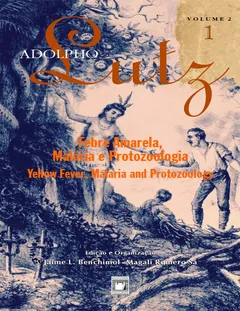
Adolpho Lutz: febre amarela, malária e protozoologia
A recommendation to all scientists and sanitarians: Read and experience the works of Adolpho Lutz
A recommendation to all scientists
and sanitarians: Read and experience
the works of Adolpho Lutz.
Leônidas de Mello Deane many times recommended (unsuccessfully), while I was a student, that I read Lutz's works on ancylostomiasis and schistosomiasis, to which he devoted great scientific respect. Leônidas used to tell me that if I really wanted to become a parasitologist, I should read them.He valued Lutz's obstinacy and academic discipline and, more than that, his capacity to travel comfortably among all the aspects of these parasitological diseases.
Coming from Leônidas Deane, a tireless protozoologist, I cannot imagine a greater compliment to a scientist than to consider his works on helminthology a model.
When he retired, Samuel Pessoa moved to the Butantan Institute and spent his time studying snake Hematozoa. At that time, Prof. Pessoa told me of his surprise at the good quality of Lutz's observations on the same subject. You should read them, he recommended (successfully). Deane and Pessoa shared an admiration for Lutz's deep versatility and insatiable naturalist curiosity, qualities I believe the three of them shared.
This compulsive curiosity propelled Lutz to study all that Nature offered him, as if he had enough time for it. They say that from early childhood he wanted to be a “naturalist” and, when he was an adolescent, he had read The Origin of Species.
This healthy unrestricted curiosity shared by Cuvier, Darwin, Russell, Humboldt, and Agassiz, so appreciated in 19th-century European culture, would be censored by Lutz's personal and scientific detractors. He was accused of being voluble and inconstant for approaching many different subjects, such as bronchitis, leprosy, ancylostomiasis, schistosomiasis, crustaceans, birds, snakes, amphibians, intestinal fevers, yellow fever, malaria, and, above all, insects.
However, his detractors never understood the medical science setting where Lutz was an actor.
Western tradition, until the 18 th century, viewed diseases as alterations of bodily humors. Only external macroscopic causes, such as malformations and traumas and, among the parasites, only lice, scabiosis, and larger worms were considered. The microscopic world did not exist.
To correct humoral deviations, the best thing was the use of leeches, an efficient emetic, or a powerful enema, not to mention mercury and arsenic potions. Debilitated patients often died of the treatment rather than of the diseases themselves.
The introduction of quinine for the treatment of malaria caused a great medical revolution, two centuries before the causal agents of malaria were discovered. What quinine made evident was that a drug (il poveri dei Gesuiti) could cure a disease without the use of enemas, leeches, or exorcism. Medical schools confronted each other harshly. The dispute went on until the middle of the 19th century, when Pasteur disclosed the role of bacteria in fermentation (1860), and Koch attributed to bacteria the cause of anthrax (1876) and, later, of tuberculosis and cholera. Pasteur followed with pneumococcal, staphylococcal, and streptococcal descriptions. Lister's success in surgical asepsis, until then empirical, found the missing explanation and, from then on, surgery reached new levels the world over. Next came the vaccines and the curative sera.
These events happened between Lutz's birth (1855) and his return to Brazil (1881). Before he returned to Brazil, he visited London and Paris, where he certainly inhaled the effervescent atmosphere of discoveries and scientific curiosity. This atmosphere involved public administrations and the whole society in the task of creating new institutes for the study of microorganisms and the diseases they caused.
The rallying cry was not specialization, but daring and curiosity. A new world was there to be disclosed.
Lutz felt bored when he wrote his Ph.D. dissertation, presented in Bern, on the use of an Anacardeaceae in the treatment of bronchitis. His practice in Bern was also uneventful. He was more interested in what was going on in Leuckart's laboratory, in Leipzig, discovering new parasites and their cycles (tapeworms, trichinosis, liver flukes), than in his modest clinical activity. To compensate for this, he worked as a naturalist, describing copepods in the Swiss lakes, a well-known group of parasite vectors. He did not hesitate to return to Brazil, where he discovered the unexplored world of tropical pathology. I can imagine his excitement, wanting to learn and understand everything. More than anything else, I admire his Helvetian discipline in controlling his excitement and in persistently and methodically organizing his observations.
His curiosity led him, together with his medical practice in Limeira, São Paulo, to study leprosy and to follow more than 200 patients for many years. At the same time, he systematized the study of ancylostomiasis and described strogyloidiasis. Keen on his studies, he described pellagra, before avitaminosis was even known. Not yet fully satisfied, he explored regional amphibians and ended up describing a myxosporidium in their gall bladders. He searched for diseases in domestic animals and found them. He recommended measures to fight coccidiosis in rabbits. Restless, he spent some time in Hamburg with Unna, immersed in the world of microbiology. He returned to Brazil and went to Hawaii to study leprosy and to direct a leprosarium. His curiosity was unlimited.
However, Lutz had a remarkable characteristic: an accentuated interest in the epidemiological chain and in the life and reproductive cycles of parasites, more than in their morphology and structure.
When describing ancylostomiasis in Brazil, he noticed that the oral apparatus of Necatos was different from the European Ankylostoma s, but he showed no further interest in it.
Many times, he ventured into the study of protozoa, but their morphology never seduced him. He never plunged into the structure of Sporozoa and never studied their apical complex, in the many studies on these parasites he wrote with Splendore. He studied pebrine in butterflies for many years, but he did not contribute significantly to the structure of Sporozoa. He studied intestinal amoebae and, although he knew the subject well, and even warmed the stage of his microscope to keep them active, he did not go deeper in the study, either of their morphology or of their cysts. He found trypanosomes in rats and amphibians, but did not go further into their study. He was the first one in the Americas to register the presence of Hematozoa in birds but did not spend much time with their morphological details. The same is true of the many amphibian Hematozoa he found.
On the other hand, he was especially interested in the transmission chain of parasites. Pasteur, Koch, and others had mastered pathogen description. Now it was time to disclose a new world, that of pathogen transmission. In many cases, such as those of water, food, etc., transmission was easy to detect. In other cases, it was a great mystery. Leuckart described worms’ life cycles, but agents and cycles of many parasites had not yet been described, such as malaria and yellow fever.
Philip Manson (1880) had described filaria transmission by the common mosquito, originating the “mosquito theory” of disease transmission (1878-83), ridiculed by many, but of enormous scientific weight and of epidemiological implications. This idea impressed Lutz, because he soon tried to adjust it to the transmission of leprosy. He never really abandoned this idea, but did not insist on it for lack of concrete evidence.
What would hold Lutz's attention for a long time was the study of yellow fever transmission, through which he confirmed, to incredulous Brazilian scientists, Reed's experiments in Cuba.
Next, he faced his great challenge: the malaria that occurred in the Atlantic forests and in the ancillary forests of São Paulo rivers, today restricted to the Brazilian south and southeast coastal area. This vivax malaria was recurrent and mild, and manifested itself in epidemic bouts in the Serra do Mar mountains, among the workers on the São Paulo-Santos Railway. Its epidemiology and its history preceded the history of the terrible Madeira-Mamoré epidemic in Rondonia. However, there was a fortunate difference between them. The outbreak that occurred in São Paulo was mild, not lethal. Lutz studied this bout in depth. He found its vectors (anopheles, now belonging to the sub-genus Kerteszia) and their breeding places: the verticils of the bromeliad, which are always full of water.
To Lutz's disappointment, his work was contested by American entomologists on quite inconsistent grounds.
Lutz felt wronged many times. On another occasion, he clearly distinguished amoebic diarrhea from bacterial diarrhea, going further and describing amoebic liver abscesses. When traveling to the United States, he disclosed his results to American scientists who, later on, described this abscess, giving Lutz no credit for it. Lutz has been less cited than he really deserved. Today, Lutz, one of the major Brazilian scientists, would run the risk of being misevaluated by contemporary scientometrists, who are less worried about their research contents than about indices of impact and citations.
Lay press criticism of his works in São Paulo and Rio also annoyed him. Lutz, who did not like publicity, was hurt by these diatribes, many times because of their political overtones.
I think that, besides his real interest in entomology, this chronic annoyance with public policies led him, in the last thirty years of his life, to the silence of his laboratory in Manguinhos, where he had been invited by Oswaldo Cruz, and where he elevated the taxonomy of Brazilian Diptera to incomparable levels on the international scene.
The publication of the present volumes on Adolpho Lutz will be a landmark in Brazilian scientific historiography because they provide valuable information that had been scattered and practically inaccessible. The bibliography and the commentated abstracts are pertinent and carefully ordered. They are accompanied by a solid “Historical Introduction” by Jaime Benchimol and collaborators.
If I had had these publications at hand at the beginning of my career, I would certainly have followed Leônidas Deane's suggestions, besides finding it much easier to follow Samuel Pessoa's recommendations. Now it is up to me to recommend to all Brazilian tropicalists and sanitarians, old and young: read and experience the complete works of Adolpho Lutz.
Prof. Erney Felício Plessmann de Camargo
President, Conselho Nacional de Desenvolvimento Científico e
Tecnológico Institute of Biomedical Sciences, Universidade de São
Paulo