
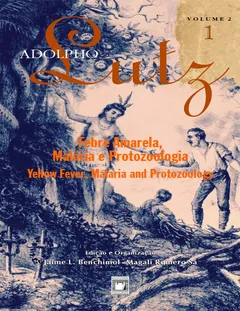
Adolpho Lutz: febre amarela, malária e protozoologia
Another chapter in the life of the great Brazilian scientist and naturalist, Adolpho Lutz
Another chapter in the life of the great
Brazilian scientist and naturalist,
Adolpho Lutz
It has always been my view that the range, precision and quality of Adolpho Lutz's work makes him Brazil's greatest scientist in the field of biomedicine. Allied to his solid background in medicine and pathology, he had comprehensive expertise in parasitology, microbiology and entomology, which gave him a clear technical edge over his colleagues, of whom two of the most illustrious and well-known were Vital Brazil and Oswaldo Cruz; incidentally, both of whom were great admirers of his.
Adolpho Lutz emigrated to Brazil at the end of the 19 th century, with baggage that included formative experiences in European universities and health services and a fine-tuned spirit of observation. It was a testing time for public health in Brazil, with some major problems including yellow fever and malaria. There had been a spectacular outbreak of the much-feared bubonic plague at Santos port, one of the major gateways to Brazil, and there were fears it would reach Rio de Janeiro, the capital city at the time. This did later come to pass, just as the three aforementioned scientists had predicted when called to São Paulo in 1899. It was their warning that sparked the creation of the Federal Serum Therapy Institute in 1900, which later became the Oswaldo Cruz Institute in 1907.
It was Adolpho Lutz's great capacity not only as a scientist but also as the Director of the Bacteriology Institute of São Paulo that helped great strides be taken in public health in the state. These contributions included his analyses and criticisms about yellow fever and malaria, the first ever use of the Widal reaction in Brazil to diagnose typhoid fever, and further, his studies into cholera and the bubonic plague by direct bacilloscopy examinations. However, Lutz often clashed with the medical profession and local societies, who felt threatened when they saw their empirical diagnoses questioned by his scientific methods. It was probably this that persuaded the scientist to accept the invitation by Oswaldo Cruz to join our Institute in Rio de Janeiro in 1908.
After our short introduction to Adolpho Lutz's academic and scientific background, we move on to make a brief analysis, in this foreword, of some texts that are included in this first book of Volume II of his Complete Works. We analyze some passages from reports by the Bacteriology Institute dated between 1893 and 1908, then we discuss a report by Adolpho Lutz about a proposed serum for treating yellow fever, his report on the mission to Montevideo to investigate the putative discovery by Dr. Sanarelli of the yellow fever microbe, the work on yellow fever in São Paulo and the mosquito as its agent of propagation, the discovery of forest malaria, the instructions for preventing malaria, and finally his “Reminiscences on yellow fever in São Paulo State” published in 1930, by which time Adolpho Lutz had been a researcher at the Oswaldo Cruz Institute for more than 20 years.
In his 1893 report for the Bacteriology Institute, Adolpho Lutz sets out the (mostly negative) results of five autopsies of yellow fever victims, three from Cambuci and two from Santos. He discusses the microscopic examination of the liver and spleen by different staining methods, which did not reveal any organism that could have caused the ailment. Lutz writes of the minute examination of mucous membranes from the stomach and intestines of these cases, stating that he had found a bacillus similar to one previously isolated by Le Dantec at the same laboratory only in cases of yellow fever, but which had not yet been associated to the disease. Likewise, in the report from the first semester of 1894 he does not encounter any germ that may cause the disease, but does identify Bacterium coli communis (synonymous for Bacilo coli, today Escherichia coli), a germ attributed to post mortem invasion. He mentions that when yellow fever broke out in Campinas, Limeira, Rio Claro and Belém dos Descalvados in 1889, it was denied with the same zeal as were the cholera and typhoid epidemics in São Paulo. He ends the report decisively: “Not only do we consider the yellow fever problem still unresolved, but we also consider that its resolution is particularly difficult … either the germ has so few distinguishing features as to make it easily confused with common germs, or it can only be encountered in abundance for a very short period of time [which we know today as viremia], or else we do not yet have a suitable method for identifying or culturing it,” [which was indeed the case at the time].
In 1896, Adolpho Lutz wrote an introduction to “Contribution to the Study of Yellow Fever. The Urine of Patients with Yellow Fever,” a paper by Dr. J. Bonilha de Toledo, who had graduated from the Faculty of Brussels and worked as a medical assistant at the Bacteriology Institute. In it, he makes an important analogy between rabies and its vaccine and yellow fever and the prospects for a yellow fever vaccine, saying,
“In the Bacteriology Institute reports I have sought to identify the
reasons for the studies’ lack of success, which has been
confirmed for some time by our Institute and by other parties.
One of the greatest obstacles is the fact that we do not know
any animal that is subject to this malady [yellow fever], which
would allow one to follow the example supplied by vaccination
and by hydrophobia, in which the unidentified virus is
manipulated and utilized for its prevention and cure thanks to
the ease with which its presence can be identified in the
inoculated animal. It is well known that there is no shortage of
animals that have contracted hydrophobia, and the vaccine,
which has almost no side-effects, can be used to inoculate
humans.”
At the end of his introduction he praises the work of Dr. Toledo, “mainly for pursuing original investigations, which is extremely rare among us, for many of whom science consists merely of discussing and replicating the work of others.”
In May 1897, the Bacteriology Institute received a request to report on a “serum” proposed by Dr. Phelippe Caldas of Rio Grande do Sul state, which had been obtained from parts of the stomach of yellow fever patients in São Sebastião hospital, Rio de Janeiro. The stomach parts had been ground up and inoculated in a culture medium that had been sterilized by filtration. According to Dr. Caldas, a germ “with quite marked rotating movements” had then grown. Some horses had then been inoculated with it and a serum had been produced that would cure yellow fever. After a detailed presentation of the production of this serum and how it should be applied, Adolpho Lutz and his assistants Dr. Arthur Vieira de Mendonça and Dr. Bonilha de Toledo made a minute analysis of the “serum”. Their conclusions bear the Director of the Bacteriology Institute's characteristically emphatic manner:
“1) Dr. Caldas has not proven that he has isolated the yellow
fever germ. 2) He has not proven that his cultures, even if
impure, contain the germ that causes this malady. 3) He has not
proven that inoculated animals show signs of any infection or
intoxication similar to yellow fever. 4) He has not proven that he
has a method for verifying the properties or the immunological
value of the “Serum” for these animals. 5) He has not proven
that the data indicated in his instructions have any rational
basis. 6) He has not proven that the clinical experiments (four
cases) show the “Serum” to have any therapeutic action.
In the same year, Adolpho Lutz was sent as a member of a commission to attend a lecture given by Prof. Sanarelli in Montevideo about the putative discovery of the yellow fever microbe. Accompanied by his assistant Dr. Arthur Vieira de Mendonça, he attended the talk given at the Solis Theater about the announced discovery, and then visited the Institute of Hygiene, where the experiments had been conducted. The preamble from Lutz's report dated July 27, 1897, states that “it might be preferable to postpone this discussion until the publication of the paper announced in Annales de L'Institut Pasteur,” noting that that summarized report was based only upon the lecture given by Dr. Sanarelli to a mixed audience of professionals and laypersons. In this “provisional report” he analyzes the facts presented by Sanarelli, saying that the germ that he
“has managed to isolate from the blood in the organs of people
suffering from the disease has given us a negative result. There
is a divergence here that can, however, be explained by the
following observations: 1. This germ is so difficult to find that it
was only possible to isolate it in half of the cases. 2. The
Sanarelli bacillus has a commonplace form… it cannot be
differentiated from the bacillus found in the abdomen or from coli
comum. 3. Under normal conditions this bacillus does not
produce colonies. 4. The agar cultures could be mistaken for
varieties of Bacillus coli communis. 5. The presence of other
bacteria stop the Sanarelli bacillus from developing.”
We now know that the germ isolated by Prof. Sanarelli, called Bacillus icteroides, is Salmonella typhimurium, a type of Salmonella enteritidis that causes human gastroenteritis, infection with bacteremia and the intense production of enterotoxin, which must have caused Sanarelli to make his erroneous diagnosis concerning yellow fever.
In the annual report published by the Bacteriology Institute of São Paulo in December 1898, Adolpho Lutz points to a drop in the number of cases of yellow fever compared to previous years, and reiterates his continued desire to discover the disease's etiologic agent, its transmission mechanisms and possible preventative measures. He again refers to the “discovery” by Prof. Sanarelli, Director of the Institute of Hygiene in Montevideo, and analyzes an attempt in Rio de Janeiro by Dr. Havelburg to isolate the yellow fever agent by injecting the stomach contents of people with the disease into rabbits. However, he shows that the isolated bacilli are coli comunis, a secondary contaminant in cases of the disease that Lutz himself had often encountered in similar cases. As for Sanarelli's bacillus, despite the difficulty in isolating it, he recognizes the quality of the researcher's work and alludes to the possibility of his eventually obtaining a serum (which has the extraordinary agglutinative power of the bacilli) that may have a proven effect on man.
In a note “on the issue of the efficacy of the vaccine against yellow fever” published ten years earlier in a journal for Germans in Brazil, Adolpho Lutz had written a paper about vaccination in general, showing that: 1) numerous diseases attack the same organism once only because of immunity; 2) the same disease may appear with different degrees of intensity according to its own nature rather than the nature of the individual infected; 3) milder ailments may grant immunity against a similar yet more intense diseases. He added the proviso that for milder diseases, immunity may not be long-lasting, but if there was repeated infection immunity may be long-lasting. He gave smallpox, diphtheria, tuberculosis, cholera and anthrax as examples, showing the relative effect of the vaccination according to the disease and the degree of infection.
In February 1901, Adolpho Lutz published a rebuttal to an article by Dr. Mendonça about yellow fever in Revista Médica de São Paulo journal:
Even though I do not make a habit of entering into discussions
which take science as a pretext to engage in sterile polemics,”
he wrote, “I shall today make an exception by replying to Dr.
Mendonça… It does not bother me that he holds differing
opinions to mine, but what I do not understand is how this
difference justifies the accusation of lack of logic leveled against
anybody who thinks differently, when the accuser does not even
seek to demonstrate the truth of the theses upon which it is
based.
He complains about the (unauthorized) transcript of a letter of his published in a foreign journal, from which Dr. Mendonça concluded that Lutz considered Sanarelli's bacillus to be the definitive cause of yellow fever, adding that, “actually, I implied that the aforementioned bacillus's etiologic role is questionable.” After a lengthy clarification in which he defends the transmission of yellow fever by mosquitoes (Culex taeniatus), he once again contradicts Dr. Mendonça who, in the same article questions whether Yersin's serum might be a bactericide and antitoxin, comparing it to Sanarelli's serum. Lutz shows that there was no relation between the two, saying, “I do not agree with the journal's editor [Dr. Mendonça] when he states that both serums in question are identical: not only is there no doubt, nor could there be, as to the etiologic role of the Yersin (bubonic plague) bacillus, since the preventative action of the serum has been proven experimentally on repeated occasions.” And he reiterates: “It was not a priori that Dr. Mendonça calls me a great defender of Yersin's serum, but I have closely observed its effect on patients.” At the end he deals with Dr. Mendonça's criticism of Dr. Calmette and the Pasteur Institute, adding, “Even among our group in which each man gives himself the right to criticize his masters, it cannot pass unnoticed that the relative scientific positions of the critic and the criticized make this authoritarian tone unjustified.”
Also worthy of mention is a long presentation made in 1901 by Emílio Ribas, Director of the São Paulo State Sanitation Service, about “The mosquito as an agent of propagation of yellow fever”. The article was published with additional comments by Adolpho Lutz on the Culex taeniatus and how it was involved in the spread of yellow fever in that state.
In his article about “Forest-dwelling mosquitoes and forest malaria” criticized by Knab and Dyar, Adolpho Lutz demonstrates his extraordinary powers of observation, while also alluding to independent observations made by Carlos Chagas to support his views. In his September 1902 article, he tells of cases of mild malaria during the construction of the São Paulo-Santos railroad. I believe this is the first time in medical literature that the transmission of malaria by anophelines that breed in bromeliads is mentioned. This was later proven in an area of Santa Catarina state which withstood all attempts to control the disease from the 1940s until 1986, after the endemic had been controlled in southern, south-eastern and north-eastern Brazil, except in woodland areas on the outskirts of towns along the Santa Catarina coast. The conditions that came to be called the “bromeliad-malaria complex” were characteristically forestland in which bromeliads grew that provided breeding conditions for mosquitoes of the subgenus, the only malaria vector in the region. In his work, Adolpho Lutz says, “I have specimens of this species [in this case, A. lutzii, described in 1901 by Teobald] collected in different parts of the area stretching from Santos to Conceição and also from Joinvile [Santa Catarina state], thanks to the kindness of Sr. Schmalz.” All evidence suggests that the plasmodia observed by Lutz were P. vivax, which he describes as “large, relatively scarce plasmodia that produce frequent relapses.” We should also recall that for many years Prof. Leonidas Deane believed that primate plasmodia (P. brasilianum) were transmitted to man. He did a number of studies in coastal areas of Santa Catarina state where there was malaria in areas with bromeliads, and in forest and parkland on the outskirts of São Paulo, in which he used a technique of his own to prove infection by a primate plasmodium causing a brief, mild bout of malaria. The controversy between Knab and Dyar on the one hand and Lutz on the other came about because the American entomologists did not believe that mosquitoes that had never had any contact with man could transmit malaria to man. They supposed the case described by Lutz to most likely be an asymptomatic form acquired in an urban area and later exacerbated when the person started working on the railroad construction in the forest. Lutz and Chagas witnessed other epidemics of malaria among workers that had come into contact with forest-dwelling mosquitoes for the first time.
Lutz was inspired to write a fascinating text to the editor of Gazeta de Notícia th newspaper on October 26, 1903, in response to the editor's request for him to give his final word on the prevention of yellow fever. The editor had written:
Those that disagree that the striped mosquito transmits yellow
fever cite the report in which you support Sanarelli's
experiments that attribute the pathogenic role of the terrible
ailment to bacillus icteroides; others, however, mention work of
yours in which you condemn Sanarelli's theory and even the
authenticity of bacillus icteroides, considering the work of the
Havana commission to be of greater value… we extend you this
appeal, that you expound categorically yet succinctly the ideas
that currently exist regarding the prevention of yellow fever.
Lutz's reply:
Dear Sir. I cannot fail to comply with your reiterated request to
expound my thoughts on the transmission of yellow fever by
mosquitoes and it would give me great satisfaction to contribute
to the adoption of any measures that could rid my birth town
from this pestilence. I believe this will only come about when
measures are taken against the transmission of the malady by
Stegomyas (Aëdes), which I believe is now an established fact.
As for Sanarelli's bacillus, Lutz states that when this bacillus appeared in 1897, it seemed for some time that the issue of yellow fever had been resolved, or at least in etiologic terms. But even then Lutz had warned of its potential transmission by “blood-sucking insects”. He mentions the theory put forward by Finlay, who had warned of the potential transmission of the disease by mosquitoes since 1881, and which was finally confirmed in Havana (by Walter Read, Carrol, Lazear and Agramonte, the members of the US Army's Yellow Fever Commission to Cuba).
Finally, in 1930, Adolpho Lutz published his “Reminiscences on Yellow Fever in São Paulo State” in the Memórias do Instituto Oswaldo Cruz (volume XXIV, no. 3), which were based on a lecture that he gave at the 4 th South American Conference on Hygiene, Pathology and Microbiology in July 1929. In it, he reviews his entire experience on the subject, including information about the first cases of the disease in Rio de Janeiro in 1849, saying that his father had known the city before it was struck by the malady. His mother lived in Rio for a further 30 years without ever suffering from it, but his father and one brother had “two attacks” each, and another took sick during an epidemic in Santos in 1879. From this, Lutz concluded that the possibility of family immunity could be discarded.
As I conclude these introductory paragraphs to the monumental scientific contribution of Brazil's great naturalist Adolpho Lutz, I feel honored at having had the opportunity to admire the man and his work once again.
Prof. José Rodrigues Coura
Head of the Department of Tropical Medicine and of the Laboratory
of Parasitic Diseases Instituto Oswaldo Cruz – Fundação Oswaldo
Cruz