
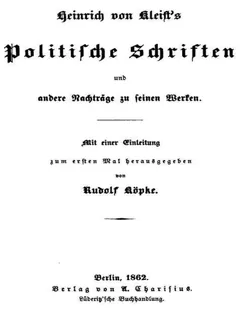
Heinrich von Kleist's politische Schriften und andere Nachträge zu seinen Werken
Anmerkungen.
Einleitung.
[1] Das letzte Lied; H. v. Kleist gesammelte Schriften III, 373, der zweiten Ausgabe von Tieck und J.
Schmidt.
[2] So schrieb Kleist an Zschokke; s. E. v. Bülow, H. v. Kleists Leben und Briefe S. 27.
[3] Die umfassendste Sammlung von Briefen Kleists sind die an seine Schwester Ulrike gerichteten, 57
an der Zahl, aus den Jahren 1795 bis zum Augenblick seines Todes, nebst einem an Pannwitz aus dem
Jahre 1802, von Koberstein 1860 herausgegeben; 23 Briefe aus der Zeit von 1799 bis 1811 an seinen
Lehrer, seine Braut, deren Schwester, seinen Freund Rühle und Fouqué, gab Bülow heraus; 6
Brieffragmente von 1807 bis 1811 Tieck in der Einleitung zu Kleists Schriften; ein Brief von 1809 an
H. v. Collin steht in Hoffmanns Findlingen I, 320, ein von Bülow nicht gekannter von 1811 an Fouqué,
in den Briefen an F. Baron de la Motte Fouqué, herausgegeben von H. Kletke I, 223; 6 aus den Jahren
1810 und 1811 an F. v. Raumer in dessen Lebenserinnerungen und Briefwechsel I, 229. Anekdotenhaft
ist was Peguilhen von Kleist erzählt in der Sammlung Berühmte Schriftsteller der Deutschen Berlin
1854 I, 309; die Denkschrift desselben über Kleists Tod, die dem Staatskanzler vorlag aber nicht
erscheinen durfte, scheint verloren. Umfassende Charakteristiken Kleists sind neuerdings gegeben
worden in den Preußischen Jahrbüchern II, 599, 1858, und von J. Schmidt in seiner Einleitung zu den
gesammelten Schriften Kleists, 1859; Nachträge dazu von Koberstein in der Einleitung zu Kleists
Briefen an seine Schwester.
[4] Tiecks Ausgabe von 1826 I, S. XX.
[5] S. X Vorrede.
[6] In der Inhaltsanzeige des Februarheftes. Dadurch widerlegt sich Bülows Angabe S. 44 eine Novelle
der Madame de Gomez habe dem Dichter den Stoff in Paris geliefert. Sucht man in einer fremden
Litteratur nach einer Parallele zu dieser Geschichte, so könnte man auch an Cervantes’ de la fuerça
de la sangre erinnern, wo ähnliche Verhältnisse freilich maßvoller dargestellt werden.
[7] Eine quellengemäße geschichtliche Darstellung der Kohlhasischen Händel hat Klöden gegeben in
Gropius’ Beiträge zur Geschichte Berlins, Berlin 1840 S. 61 ff. Wenn er im Vorwort sagt, zu Kleists
Erzählung habe die Geschichte nichts als einige Namen beigesteuert, so ist dagegen zu bemerken, daß
nicht die wesentlichen Thatsachen, sondern gerade die Namen unhistorisch sind; denn der Junker hieß
Günther von Zaschwitz auf Melaun bei Düben. Man möchte doch vermuthen, nicht Pfuels Erzählung,
sondern irgend einem älteren Buche habe Kleist den Stoff entlehnt, vielleicht dem von B. Mentz,
Kurtze Erzehlung vom Vrsprung vnd Hehrkommen der Chur vnnd Fürstlichen Stämmen, Sachsen,
Brandenburg, Anhalt vnd Lawenburg, Wittenberg 1597, das Klöden außer Hafftiz besonders benutzt
hat.
[8] III, 71.
[9] III, 48.
[10] III, 124.
[11] Ich führe einige Beweisstellen für die im Text hervorgehobenen Lieblingsworte Kleists an:
„dergestalt daß“ Kohlhaas III, 39, 47, 57, 75, 104, 109, 114; das Erdbeben in Chili S. 164; die
Verlobung in St. Domingo S. 188; das Bettelweib von Locarno S. 224, 225, 226; die heilige Caecilie S.
249, 250; der Zweikampf S. 272, 273; Käthchen von Heilbronn II, 132. „Gleichwohl“: Kohlhaas III,
22, 35, 63, 75, 102, 109; Marquise v. O. S. 151; Findling 235; die heilige Caecilie 252; Käthchen von
Heilbronn I, 123, 125, 130; die Hermannsschlacht 397; der Prinz v. Homburg 325, 345; Amphitryon I,
374, 375. „Nicht sobald — als“: Kohlhaas III, 34, 39, 58. „Falls“: Kohlhaas III, 27, 64, 77, 94.
„Gleichviel“: Kohlhaas III, 57, 60, 79; Marquise v. O. 153; die heilige Caecilie 251; der Zweikampf
286; Prinz v. Homburg II, 279, 281, 315, 320, 323, 327, 331; die Hermannsschlacht 509; Amphitryon
I, 417. „Inzwischen“: Kohlhaas III, 34, 43, 77, 98, 106, 111; Marquise v. O. 124, 125; der Zweikampf
266, 287.
[12] Penthesilea I, 201, 224; die Hermannsschlacht II, 383; an Franz den Ersten III, 374.
[13] Akt III. Sc. 1. II, 188.
[14] Käthchen v. Heilbronn A. V. S. 1. II, 248; die Hermannsschlacht A. II, S. 1. II, 402; III, 379.
[15] III, 376, 377, 372.
[16] A. III, S. 6. II, 443.
[17] Kleist an seine Schwester 17. Sept. 1807 und die folgenden Briefe S. 129 ff. 144. Adam Müller an
Gentz 6. Febr. 1808, Briefwechsel S. 126.
[18] Kleists ges. Schriften I, S. XX.
[19] Bülow S. XI.
[20] Brief an seine Schwester o. D. S. 157.
[21] Phöbus I, 39.
[22] Hans Sachs Worte I, 189 der Kemptener Ausgabe, wo sich indeß nur die Legende der Welt Lauf
findet. Es scheint Kleist hat seine Originale nicht sowohl in einer Gesammtausgabe der Werke von
Hans Sachs als in einem Einzeldruck gelesen; in einem solchen, wovon ein Exemplar im Besitz des
Herrn W. v. Maltzahn ist, finden sich neben zwei andern Erzählungen gerade die beiden von Kleist
nachgedichteten; es ist: Das erst Gesprech, Von der Welt lauff; und das dritt Gespräch, von eim | faulen
Bawrenknecht, vnd einer | endlichen Bauren Maidt. | Der Haupttitel lautet: Vier schöne Gesprech
zwischen | Sanct Peter vnd dem Herren, | sehr nützlich zu lesen, vnd | zu hören — Hanß Sachs.
Gedruckt zu Nürnberg | durch Valentin Newber kl. 8. 16 Bll.
[23] S. die Briefe an seine Schwester o. D. und von 1799, 1801 S. 5, 20, 49, 51; an seine Braut 1801,
Bülow S. 145; 1806 S. 243.
[24] Briefe von 1801, Bülow S. 226, 210, 204, 27; Koberstein S. 46, 50. Katechismus der Deutschen 8.
I, 1, 7; von der Ueberlegung I, 2, 5.
[25] Brieffragment bei Bülow S. 66; 1801 S. 207, 227; 1803 Koberstein S. 90.
[26] 1801, 1803 Koberstein S. 45, 90.
[27] Briefe an seine Schwester S. 110, 145.
[28] Hermannsschlacht A. I, S. 3. I, 1; II, 394, 386, 391, 434, 444; III, 3, 6.
[29] Kleists Wort über die Thusnelda zu Dahlmann in J. Schmidts Einleitung S. XCV; (v. Bassewitz)
die Kurmark Brandenburg während der Zeit von 1806 bis 1808 II, 709; v. Höpfner der Krieg von 1806
und 1807 II, 326, 332.
[30] Lehrbuch der Journalistik 4, 8. Die Worte des Grafen Schlabrendorff hat Jochmann aufbewahrt,
Reliquien, herausgegeben von Zschokke, I, 135.
[31] Hermannsschlacht A. I, 3, 10, 4, 9; II, 397, 399, 456, 467. Hoffmann Findlinge I, 320.
[32] Häusser deutsche Geschichte III, 151, 183, 439. Europas Palingenesie Leipzig 1810 I, 147, 149.
[33] Hermannsschlacht V, 24, 14. II, 519, 499; Prinz von Homburg IV, 1. S. 340.
I, 1, 1.
[34] Wahrscheinlich dachte sich Kleist unter dem rheinbündischen Officier einen sächsischen, denn
kaum ein anderer hätte im Sommer 1806 mit einem preußischen Officier in Berlin ein patriotisches
Convivium halten können, in einer Zeit, wo über ein preußisch-sächsisches Bündniß, als Grundlage
des nordischen Reichsbundes unter Preußens Führung, verhandelt wurde. Kurz vor dem Ausbruch des
Kriegs kam es bekanntlich zu einer Vereinigung der preußischen und sächsischen Armee. Der König,
der durch Ablehnung des Kreuzes der Ehrenlegion nicht kompromittirt werden soll, ist also der König
von Sachsen, der diesen Titel seit dem Posener Vertrage 11. Dec. 1806 führte.
[35] Eine in Berlin noch jetzt bestehende bekannte Weinhandlung, in der Kleist viel verkehrt haben
soll.
[36] Davoust, der bei Auerstädt siegte.
[37] Die eingeklammerten Worte sind in der Abschrift irrthümlich ausgelassen.
[38] Am 9. April 1809 eröffneten die Oesterreicher unter dem Erzherzog Karl den Krieg, indem sie in
Baiern einrückten. Zu einem Massenaufstande hatte der Erzherzog in einem undatirten Aufruf an die
„Völker Deutschlands“ aufgefordert; der in demselben Sinn abgefaßte Armeebefehl ist vom 6. April.
S. Europas Palingenesie I, 147, 152.
[39] Das erste Bülletin Napoleons über die einleitenden Gefechte vom 19. bis 23. April ist vom 24.
April. S. Europas Palingenesie II, 39. Der gleich darauf erwähnte Montesquiou war Napoleons
Kammerherr und zu ähnlichen Sendungen mehrfach gebraucht worden. Kurz vor der Schlacht von
Jena war er in preußische Gefangenschaft gerathen.
I, 1, 2.
[40] Diese Scenen spielen also während des Krieges von 1806 und 1807, und ihr Schauplatz soll, wie
leicht ersichtlich, Potsdam und Berlin sein. In Potsdam war das große Cavalleriedepot der Franzosen;
s. (v. Bassewitz) die Kurmark Brandenburg während der Zeit von 1806 bis 1808 I, 266.
[41] Aber hat die Handschrift.
I, 1, 3.
[42] Dies scheint darauf hinzuweisen, daß Kleist hier etwa die Vorgänge in Stettin im Auge hatte,
dessen Uebergabe an eine schwache Abtheilung französischer Cavallerie am 29. Oct. 1806 die Reihe
schmachvoller Capitulationen der Hauptfestungen im östlichen Theile der preußischen Lande
eröffnete. Dagegen scheint die Niederbrennung der Vorstädte auf Küstrin oder Magdeburg zu deuten.
S. v. Höpfner Krieg von 1806 und 1807 II, 326, 332.
I, 1, 4.
[43] Den Nürnberger Correspondenten von 1809 habe ich nicht auftreiben können.
[44] Am 23. April hatte die französische Armee nach heftigem Kampfe Regensburg genommen. Die
Hauptmasse bestand aus Baiern und Würtembergern, denen Napoleon am 30. in einer Anrede, die der
Kronprinz von Baiern verdollmetschte, diesmal die ausschließliche Ehre des Kampfs gegen die
Oesterreicher zugesprochen hatte; Europas Palingenesie II, 12, 38.
[45] Durch den Frieden von Preßburg am 26. December 1805, der auf Oesterreichs Kosten Baiern,
Würtemberg und Baden vergrößerte, den beiden ersten die souveraine Königswürde zusprach, und ein
deutsches Reich nicht mehr, sondern nur noch eine confédération Germanique kannte.
[46] Am 26. August 1806.
[47] Am 1. November 1806 besetzten die Franzosen Kassel. Vous avez cessé d’exister, sagte
Napoleon in seinem 13. Bülletin dem Kurfürsten.
[48] Hier ist wohl die entgegenkommende Anerkennung gemeint, die Napoleon als Konsul seit Durocs
Sendung im November 1799 in Berlin fand, und die Vermittlung, welche Preußen in Folge dessen
zwischen ihm und dem Kaiser Paul einzuleiten suchte. — Erst anderthalb Jahr nach dem Tilsiter
Frieden, am 5. Dezember 1808, räumten die Franzosen Berlin.
[49] Am 6. August 1806.
[50] Dazu war man österreichischer Seits doch nicht geneigt, wohl aber wich man einem französischen
Bündniß auf Kosten Preußens aus.
[51] In Böhmen.
[52] Vatter hat die Handschrift.
I, 1, 5.
[53] Gewinsel, die Handschrift.
[54] Durch Patent vom 9. Juni 1808 wurde die Errichtung einer Landwehr „zur Vertheidigung des
vaterländischen Bodens“ angeordnet.
I, 1, 6.
[55] auch — welchem, die Handschrift.
[56] vernommen, die Handschrift.
[57] Am 7. Mai 1807 schloß Napoleon ein Bündnis mit dem Schach von Persien, dessen Gesandter zu
diesem Zweck nach Elbing kam.
I, 1, 7.
[58] Die Volkserhebung in Spanien begann im Mai 1808.
[59] Sachsen war dem Rheinbunde im Posener Vertrage beigetreten.
[60] Der Rheinbund vom 12. Juli 1806.
[61] Hier fehlen zwei Blätter, die den Schluß des vierten, das fünfte, sechste und den Anfang des
siebenten Capitels enthielten.
[62] Fehlen abermals zwei Blätter, das zehnte, elfte und den Anfang des zwölften Capitels enthaltend.
[63] Am 9. April 1809 erhoben sich die Tiroler.
[64] Wenn man nicht annehmen will, zwischen diesem und dem folgenden Satze sei durch Schuld des
Abschreibers eine Frage und eine Antwort ausgefallen, in denen der erste Grund unmittelbar
angegeben wurde, und daß dann erst die nähere Erläuterung folgte, warum er nicht viel einbringen
könne, so sind die letzten vier Sätze des Capitels von dunkler Spitzfindigkeit nicht frei zu sprechen. Es
würden dann die freiwilligen Beiträge einmal als geringfügig bezeichnet werden, weil sie als Geld und
Gut, dem Vaterlande und der Freiheit gegenüber, an sich keinen Werth haben, und doch zugleich als
ein einträgliches Mittel, wenn die Menschen es lieber dem gönnen, von dem sie zur Freiheit geführt
werden, als den Feinden, die ihnen das Eigenthum mit Gewalt entreißen.
[65] Dies scheint ein bitterer Seitenblick auf die zurückhaltende Politik des preußischen Ministeriums,
das seit Steins Abgang am 24. Nov. 1808 Dohna, Altenstein und Beyme leiteten. Es ist bekannt, wie
sehr Oesterreich schon damals Preußen zum entschiedenen Handeln zu bestimmen suchte, aber auch
zugleich, daß Preußen schwerlich stark genug dazu war.
I, 2, 1.
[66] In der Schlacht bei Aspern am 21. und 22. Mai 1809.
[67] bewußt, die Handschrift. Der Schluß fehlt.
I, 2, 2.
[68] Woher dies Citat sei, vermag ich nicht zu sagen.
[69] sind fügt die Handschrift überflüssig hinzu.
I, 2, 3.
[70] ist fügt die Handschrift hinzu.
[71] Die letzten drei Worte wiederholt die Handschrift. In Bülows Abdruck, Kleists Leben und Briefe
S. 254, fehlen die Worte: „Alles was sie Vortreffliches fand in sich aufzunehmen gleich“ —.
[72] Bülow liest für Dienstleistungen Einflüsterungen!
[73] Die Worte: „die dem ganzen Menschengeschlecht angehört“ fehlen bei Bülow.
I, 5, 3.
[74] Jungius, Professor am Friedrich-Wilhelms Gymnasium.
I, 5, 4.
[75] Dieser Artikel von einem ungenannten Verfasser brachte eine wissenschaftlich gehaltene
Widerlegung der in dem Schreiben aus Berlin I, 5, 2 ausgesprochenen Ansichten Kleists, und schloß
mit einem Ausfall gegen die trügerischen Terminologien neuer und unverschämter Lehrer, die sich auf
erdichtete Facta stützen.
Berlin, Druck von Gustav Schade.
Marienstraße Nr. 10.
Anmerkungen zur Transkription
Der Originaltext ist in Fraktur gesetzt. Im Original g e s p e r r t hervorgehobener Text wurde in einem anderen Schriftstil markiert. Textstellen, die im Original in Antiqua gesetzt sind, wurden in einer anderen Schriftart markiert.
Die variierende Schreibweise des Originales wurde weitgehend beibehalten, ebenso eigentümliche Schreibweisen, die zum Teil auch noch in späteren Ausgaben zu finden sind
wie zum Beispiel Pescherü (Pescherä), Baxer (Boxer) oder Joung (Young). Lediglich offensichtliche Druckfehler wurden korrigiert, teilweise unter Verwendung weiterer Ausgaben, wie hier aufgeführt (vorher/nachher):
(mehrfache Fälle)
... erst Julian Schmidt’s Ausgabe hat aus dem Phoebus einen ...
... erst Julian Schmidt’s Ausgabe hat aus dem Phöbus einen ...
... Ganze, sehr verschiedene Personen sprechen sich über ...
... Ganzes, sehr verschiedene Personen sprechen sich über ...
... fünf Stücke werden Ende April oder Anfangs Mai entstanden ...
... fünf Stücke werden Ende April oder Anfang Mai entstanden ...
... Wendung erhält dieser Gedanke in der Hermannschlacht; ...
... Wendung erhält dieser Gedanke in der Hermannsschlacht; ...
... leben wollte. Nur zu Stein, Scharnharst, Gneisenau konnte ...
... leben wollte. Nur zu Stein, Scharnhorst, Gneisenau konnte ...
... halten Sie für die Erfindung einer satanischen List, um das ...
... halten sie für die Erfindung einer satanischen List, um das ...
... Es giebt Leute, die sich die Epochen, in welcher die ...
... Es giebt Leute, die sich die Epochen, in welchen die ...
... welches ohne Zweifel die höchste ist, die erschwungen werden ...
... welche ohne Zweifel die höchste ist, die erschwungen werden ...
... elektrischer Körper, lehrt, daß wenn man in der Nähe ...
... elektrischer Körper, lehrt, daß wenn man in die Nähe ...
... daß sich in eines Menschen Händen, zu einer beliebigen Gestalt ...
... das sich in eines Menschen Händen, zu einer beliebigen Gestalt ...
... I, 5, 2. ...
... I, 5, 3. ...
... I, 5, 3. ...
... I, 5, 4. ...
End of the Project Gutenberg EBook of Politische Schriften und andere Nachträge zu seinen Werken, by Heinrich von Kleist
*** END OF THIS PROJECT GUTENBERG EBOOK POLITISCHE SCHRIFTEN UND ***
***** This file should be named 50979-h.htm or 50979-h.zip ***** This and all associated files of various formats will be found in:
http://www.gutenberg.org/5/0/9/7/50979/
Produced by Karl Eichwalder, Constanze Hofmann, Jens
Sadowski, and the Online Distributed Proofreading Team at http://www.pgdp.net. This book was produced from scanned images of public domain material from the Google Books project.
Updated editions will replace the previous one--the old editions will be renamed.
Creating the works from print editions not protected by U.S. copyright law means that no one owns a United States copyright in these works, so the Foundation (and you!) can copy and distribute it in the United States without permission and without paying copyright royalties. Special rules, set forth in the General Terms of Use part of this license, apply to copying and distributing Project Gutenberg-tm electronic works to protect the PROJECT GUTENBERG-tm concept and trademark. Project Gutenberg is a registered trademark, and may not be used if you charge for the eBooks, unless you receive specific permission. If you do not charge anything for copies of this eBook, complying with the rules is very easy. You may use this eBook for nearly any purpose such as creation of derivative works, reports, performances and research. They may be modified and printed and given away--you may do practically ANYTHING in the United States with eBooks not protected by U.S. copyright law. Redistribution is subject to the trademark license, especially commercial redistribution.
START: FULL LICENSE
THE FULL PROJECT GUTENBERG LICENSE
PLEASE READ THIS BEFORE YOU DISTRIBUTE OR USE THIS WORK
To protect the Project Gutenberg-tm mission of promoting the free distribution of electronic works, by using or distributing this work (or any other work associated in any way with the phrase "Project Gutenberg"), you agree to comply with all the terms of the Full Project Gutenberg-tm License available with this file or online at www.gutenberg.org/license.
Section 1. General Terms of Use and Redistributing Project Gutenberg-tm electronic works
1.A. By reading or using any part of this Project Gutenberg-tm electronic work, you indicate that you have read, understand, agree to and accept all the terms of this license and intellectual property (trademark/copyright) agreement. If you do not agree to abide by all the terms of this agreement, you must cease using and return or destroy all copies of Project Gutenberg-tm electronic works in your possession. If you paid a fee for obtaining a copy of or access to a Project Gutenberg-tm electronic work and you do not agree to be bound by the terms of this agreement, you may obtain a refund from the person or entity to whom you paid the fee as set forth in paragraph 1.E.8.
1.B. "Project Gutenberg" is a registered trademark. It may only be used on or associated in any way with an electronic work by people who agree to be bound by the terms of this agreement. There are a few things that you can do with most Project Gutenberg-tm electronic works even without complying with the full terms of this agreement. See paragraph 1.C below. There are a lot of things you can do with Project Gutenberg-tm electronic works if you follow the terms of this agreement and help preserve free future access to Project Gutenberg-tm electronic works. See paragraph 1.E below.
1.C. The Project Gutenberg Literary Archive Foundation ("the Foundation" or PGLAF), owns a compilation copyright in the collection of Project Gutenberg-tm electronic works. Nearly all the individual works in the collection are in the public domain in the United States. If an individual work is unprotected by copyright law in the United States and you are located in the United States, we do not claim a right to prevent you from copying, distributing, performing, displaying or creating derivative works based on the work as long as all references to Project Gutenberg are removed. Of course, we hope that you will support the Project Gutenberg-tm mission of promoting free access to electronic works by freely sharing Project Gutenberg-tm works in compliance with the terms of this agreement for keeping the Project Gutenberg-tm name associated with the work. You can easily comply with the terms of this agreement by keeping this work in the same format with its attached full Project Gutenberg-tm License when you share it without charge with others.
1.D. The copyright laws of the place where you are located also govern what you can do with this work. Copyright laws in most countries are in a constant state of change. If you are outside the United States, check the laws of your country in addition to the terms of this agreement before downloading, copying, displaying, performing, distributing or creating derivative works based on this work or any other Project Gutenberg-tm work. The Foundation makes no representations concerning the copyright status of any work in any country outside the United States.
1.E. Unless you have removed all references to Project Gutenberg:
1.E.1. The following sentence, with active links to, or other immediate access to, the full Project Gutenberg-tm License must appear prominently whenever any copy of a Project Gutenberg-tm work (any work on which the phrase "Project Gutenberg" appears, or with which the phrase "Project Gutenberg" is associated) is accessed, displayed, performed, viewed, copied or distributed:
This eBook is for the use of anyone anywhere in the United States and most other parts of the world at no cost and with almost no restrictions whatsoever. You may copy it, give it away or re-use it under the terms of the Project Gutenberg License included with this eBook or online at www.gutenberg.org. If you are not located in the United States, you'll have to check the laws of the country where you are located before using this ebook.
1.E.2. If an individual Project Gutenberg-tm electronic work is derived from texts not protected by U.S. copyright law (does not contain a notice indicating that it is posted with permission of the copyright holder), the work can be copied and distributed to anyone in the United States without paying any fees or charges. If you are redistributing or providing access to a work with the phrase "Project Gutenberg" associated with or appearing on the work, you must comply either with the requirements of paragraphs 1.E.1 through 1.E.7 or obtain permission for the use of the work and the Project Gutenberg-tm trademark as set forth in paragraphs 1.E.8 or 1.E.9.
1.E.3. If an individual Project Gutenberg-tm electronic work is posted with the permission of the copyright holder, your use and distribution must comply with both paragraphs 1.E.1 through 1.E.7 and any additional terms imposed by the copyright holder. Additional terms will be linked to the Project Gutenberg-tm License for all works posted with the permission of the copyright holder found at the beginning of this work.
1.E.4. Do not unlink or detach or remove the full Project Gutenberg-tm License terms from this work, or any files containing a part of this work or any other work associated with Project Gutenberg-tm.
1.E.5. Do not copy, display, perform, distribute or redistribute this electronic work, or any part of this electronic work, without prominently displaying the sentence set forth in paragraph 1.E.1 with active links or immediate access to the full terms of the Project Gutenberg-tm License.
1.E.6. You may convert to and distribute this work in any binary, compressed, marked up, nonproprietary or proprietary form, including any word processing or hypertext form. However, if you provide access to or distribute copies of a Project Gutenberg-tm work in a format other than "Plain Vanilla ASCII" or other format used in the official version posted on the official Project Gutenberg-tm web site (www.gutenberg.org), you must, at no additional cost, fee or expense to the user, provide a copy, a means of exporting a copy, or a means of obtaining a copy upon request, of the work in its original "Plain Vanilla ASCII" or other form. Any alternate format must include the full Project Gutenberg-tm License as specified in paragraph 1.E.1.
1.E.7. Do not charge a fee for access to, viewing, displaying, performing, copying or distributing any Project Gutenberg-tm works unless you comply with paragraph 1.E.8 or 1.E.9.
1.E.8. You may charge a reasonable fee for copies of or providing access to or distributing Project Gutenberg-tm electronic works provided that
* You pay a royalty fee of 20% of the gross profits you derive from the use of Project Gutenberg-tm works calculated using the method you already use to calculate your applicable taxes. The fee is owed to the owner of the Project Gutenberg-tm trademark, but he has agreed to donate royalties under this paragraph to the Project Gutenberg Literary Archive Foundation. Royalty payments must be paid within 60 days following each date on which you prepare (or are legally required to prepare) your periodic tax returns. Royalty payments should be clearly marked as such and sent to the Project Gutenberg Literary Archive Foundation at the address specified in Section 4, "Information about donations to the Project Gutenberg Literary Archive Foundation."
* You provide a full refund of any money paid by a user who notifies you in writing (or by e-mail) within 30 days of receipt that s/he does not agree to the terms of the full Project Gutenberg-tm License. You must require such a user to return or destroy all copies of the works possessed in a physical medium and discontinue all use of and all access to other copies of Project Gutenberg-tm works.
* You provide, in accordance with paragraph 1.F.3, a full refund of any money paid for a work or a replacement copy, if a defect in the electronic work is discovered and reported to you within 90 days of receipt of the work.
* You comply with all other terms of this agreement for free distribution of Project Gutenberg-tm works.
1.E.9. If you wish to charge a fee or distribute a Project Gutenberg-tm electronic work or group of works on different terms than are set forth in this agreement, you must obtain permission in writing from both the Project Gutenberg Literary Archive Foundation and The Project Gutenberg Trademark LLC, the owner of the Project Gutenberg-tm trademark. Contact the Foundation as set forth in Section 3 below.
1.F.
1.F.1. Project Gutenberg volunteers and employees expend considerable effort to identify, do copyright research on, transcribe and proofread works not protected by U.S. copyright law in creating the Project Gutenberg-tm collection. Despite these efforts, Project Gutenberg-tm electronic works, and the medium on which they may be stored, may contain "Defects," such as, but not limited to, incomplete, inaccurate or corrupt data, transcription errors, a copyright or other intellectual property infringement, a defective or damaged disk or other medium, a computer virus, or computer codes that damage or cannot be read by your equipment.
1.F.2. LIMITED WARRANTY, DISCLAIMER OF DAMAGES - Except for the "Right of Replacement or Refund" described in paragraph 1.F.3, the Project Gutenberg Literary Archive Foundation, the owner of the Project Gutenberg-tm trademark, and any other party distributing a Project Gutenberg-tm electronic work under this agreement, disclaim all liability to you for damages, costs and expenses, including legal fees. YOU AGREE THAT YOU HAVE NO REMEDIES FOR NEGLIGENCE, STRICT LIABILITY, BREACH OF WARRANTY OR BREACH OF CONTRACT EXCEPT THOSE PROVIDED IN PARAGRAPH 1.F.3. YOU AGREE THAT THE FOUNDATION, THE TRADEMARK OWNER, AND ANY DISTRIBUTOR UNDER THIS AGREEMENT WILL NOT BE LIABLE TO YOU FOR ACTUAL, DIRECT, INDIRECT, CONSEQUENTIAL, PUNITIVE OR INCIDENTAL DAMAGES EVEN IF YOU GIVE NOTICE OF THE POSSIBILITY OF SUCH DAMAGE.
1.F.3. LIMITED RIGHT OF REPLACEMENT OR REFUND - If you discover a defect in this electronic work within 90 days of receiving it, you can receive a refund of the money (if any) you paid for it by sending a written explanation to the person you received the work from. If you received the work on a physical medium, you must return the medium with your written explanation. The person or entity that provided you with the defective work may elect to provide a replacement copy in lieu of a refund. If you received the work electronically, the person or entity providing it to you may choose to give you a second opportunity to receive the work electronically in lieu of a refund. If the second copy is also defective, you may demand a refund in writing without further opportunities to fix the problem.
1.F.4. Except for the limited right of replacement or refund set forth in paragraph 1.F.3, this work is provided to you 'AS-IS', WITH NO OTHER WARRANTIES OF ANY KIND, EXPRESS OR IMPLIED, INCLUDING BUT NOT LIMITED TO WARRANTIES OF MERCHANTABILITY OR FITNESS FOR ANY PURPOSE.
1.F.5. Some states do not allow disclaimers of certain implied warranties or the exclusion or limitation of certain types of damages. If any disclaimer or limitation set forth in this agreement violates the law of the state applicable to this agreement, the agreement shall be interpreted to make the maximum disclaimer or limitation permitted by the applicable state law. The invalidity or unenforceability of any provision of this agreement shall not void the remaining provisions.
1.F.6. INDEMNITY - You agree to indemnify and hold the Foundation, the trademark owner, any agent or employee of the Foundation, anyone providing copies of Project Gutenberg-tm electronic works in accordance with this agreement, and any volunteers associated with the production, promotion and distribution of Project Gutenberg-tm electronic works, harmless from all liability, costs and expenses, including legal fees, that arise directly or indirectly from any of the following which you do or cause to occur: (a) distribution of this or any Project Gutenberg-tm work, (b) alteration, modification, or additions or deletions to any Project Gutenberg-tm work, and (c) any Defect you cause.
Section 2. Information about the Mission of Project Gutenberg-tm
Project Gutenberg-tm is synonymous with the free distribution of electronic works in formats readable by the widest variety of computers including obsolete, old, middle-aged and new computers. It exists because of the efforts of hundreds of volunteers and donations from people in all walks of life.
Volunteers and financial support to provide volunteers with the assistance they need are critical to reaching Project Gutenberg-tm's goals and ensuring that the Project Gutenberg-tm collection will remain freely available for generations to come. In 2001, the Project Gutenberg Literary Archive Foundation was created to provide a secure and permanent future for Project Gutenberg-tm and future generations. To learn more about the Project Gutenberg Literary Archive Foundation and how your efforts and donations can help, see Sections 3 and 4 and the Foundation information page at www.gutenberg.org
Section 3. Information about the Project Gutenberg Literary Archive Foundation
The Project Gutenberg Literary Archive Foundation is a non profit 501(c)(3) educational corporation organized under the laws of the state of Mississippi and granted tax exempt status by the Internal Revenue Service. The Foundation's EIN or federal tax identification number is 64-6221541. Contributions to the Project Gutenberg Literary Archive Foundation are tax deductible to the full extent permitted by U.S. federal laws and your state's laws.
The Foundation's principal office is in Fairbanks, Alaska, with the mailing address: PO Box 750175, Fairbanks, AK 99775, but its volunteers and employees are scattered throughout numerous locations. Its business office is located at 809 North 1500 West, Salt Lake City, UT 84116, (801) 596-1887. Email contact links and up to date contact information can be found at the Foundation's web site and official page at www.gutenberg.org/contact
For additional contact information:
Dr. Gregory B. Newby
Chief Executive and Director
gbnewby@pglaf.org
Section 4. Information about Donations to the Project Gutenberg Literary Archive Foundation
Project Gutenberg-tm depends upon and cannot survive without wide spread public support and donations to carry out its mission of increasing the number of public domain and licensed works that can be freely distributed in machine readable form accessible by the widest array of equipment including outdated equipment. Many small donations ($1 to $5,000) are particularly important to maintaining tax exempt status with the IRS.
The Foundation is committed to complying with the laws regulating charities and charitable donations in all 50 states of the United States. Compliance requirements are not uniform and it takes a considerable effort, much paperwork and many fees to meet and keep up with these requirements. We do not solicit donations in locations where we have not received written confirmation of compliance. To SEND DONATIONS or determine the status of compliance for any particular state visit www.gutenberg.org/donate
While we cannot and do not solicit contributions from states where we have not met the solicitation requirements, we know of no prohibition against accepting unsolicited donations from donors in such states who approach us with offers to donate.
International donations are gratefully accepted, but we cannot make any statements concerning tax treatment of donations received from outside the United States. U.S. laws alone swamp our small staff.
Please check the Project Gutenberg Web pages for current donation methods and addresses. Donations are accepted in a number of other ways including checks, online payments and credit card donations. To donate, please visit: www.gutenberg.org/donate
Section 5. General Information About Project Gutenberg-tm electronic works.
Professor Michael S. Hart was the originator of the Project Gutenberg-tm concept of a library of electronic works that could be freely shared with anyone. For forty years, he produced and distributed Project Gutenberg-tm eBooks with only a loose network of volunteer support.
Project Gutenberg-tm eBooks are often created from several printed editions, all of which are confirmed as not protected by copyright in the U.S. unless a copyright notice is included. Thus, we do not necessarily keep eBooks in compliance with any particular paper edition.
Most people start at our Web site which has the main PG search facility: www.gutenberg.org
This Web site includes information about Project Gutenberg-tm, including how to make donations to the Project Gutenberg Literary Archive Foundation, how to help produce our new eBooks, and how to subscribe to our email newsletter to hear about new eBooks.